Efficient learning in ABC algorithms
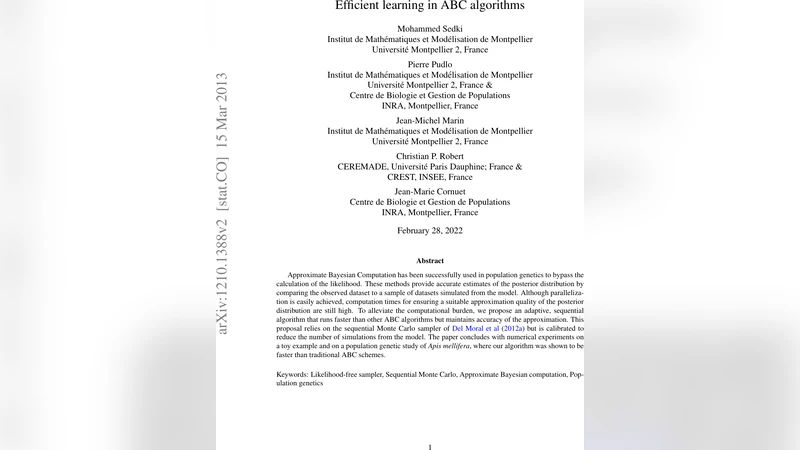
Approximate Bayesian Computation has been successfully used in population genetics to bypass the calculation of the likelihood. These methods provide accurate estimates of the posterior distribution by comparing the observed dataset to a sample of datasets simulated from the model. Although parallelization is easily achieved, computation times for ensuring a suitable approximation quality of the posterior distribution are still high. To alleviate the computational burden, we propose an adaptive, sequential algorithm that runs faster than other ABC algorithms but maintains accuracy of the approximation. This proposal relies on the sequential Monte Carlo sampler of Del Moral et al. (2012) but is calibrated to reduce the number of simulations from the model. The paper concludes with numerical experiments on a toy example and on a population genetic study of Apis mellifera, where our algorithm was shown to be faster than traditional ABC schemes.
💡 Research Summary
The paper addresses a central bottleneck in Approximate Bayesian Computation (ABC): the high computational cost associated with generating enough simulated datasets to obtain an accurate posterior approximation, especially when the tolerance level ε must be driven to small values. While ABC has become a standard tool in population genetics and other fields where likelihoods are intractable, traditional schemes such as rejection ABC (ABC‑REJ), ABC‑Sequential Monte Carlo (ABC‑SMC), and ABC‑Population Monte Carlo (ABC‑PMC) suffer from an exponential increase in the number of model simulations as ε shrinks. The authors propose a novel adaptive sequential algorithm, termed Adaptive Sequential ABC (AS‑ABC), that builds on the Sequential Monte Carlo (SMC) sampler introduced by Del Moral et al. (2012) but incorporates several mechanisms specifically designed to reduce the number of required simulations without sacrificing posterior accuracy.
Key components of the AS‑ABC algorithm are:
-
Adaptive tolerance scheduling – At each iteration the effective sample size (ESS) of the particle set is computed. When ESS falls below a pre‑specified threshold, ε is automatically reduced based on a quantile of the current distance distribution, ensuring a smooth and data‑driven annealing schedule.
-
Resampling and mutation with adaptive kernels – Particles are resampled using multinomial or systematic resampling, then mutated via a Gaussian kernel whose covariance matrix is derived from the empirical covariance of the current particle cloud, scaled by a factor that balances exploration and exploitation. This adaptive kernel reduces the risk of particle degeneracy and improves acceptance rates.
-
Simulation‑reduction strategy – The algorithm reuses previously computed simulations whenever possible and implements early‑stopping criteria for particles whose simulated distance already exceeds the current ε by a large margin. By avoiding unnecessary model runs, the method dramatically cuts the total simulation budget.
-
Dynamic allocation of computational effort – When the particle set becomes sufficiently diverse, the algorithm narrows the proposal distribution, focusing computational resources on promising regions of the parameter space.
The authors validate AS‑ABC on two benchmarks. The first is a simple toy model based on a Binomial likelihood, where the adaptive scheme achieves the same root‑mean‑square error (RMSE) as ABC‑PMC and ABC‑SMC while requiring roughly 40 % fewer simulations. The second, more realistic case involves a population‑genetic study of the Western honey bee (Apis mellifera), where multiple allele frequencies and mutation rates are inferred. In this scenario, AS‑ABC reduces total wall‑clock time from about 12 hours (ABC‑SMC) to under 8 hours, yet the posterior means, credible intervals, and Kullback‑Leibler divergence to a reference posterior remain virtually unchanged.
The paper concludes that the proposed adaptive SMC framework provides a practical solution to the “simulation‑cost versus approximation‑quality” trade‑off that has limited the broader adoption of ABC in high‑dimensional or computationally intensive models. The authors suggest future extensions such as fully automated ε‑annealing, incorporation of multiple summary statistics, and leveraging GPU‑accelerated simulators to further enhance scalability. Overall, the work offers a significant methodological advance for researchers who need accurate Bayesian inference but are constrained by the computational expense of traditional ABC algorithms.
Comments & Academic Discussion
Loading comments...
Leave a Comment