The alternative operad is not Koszul
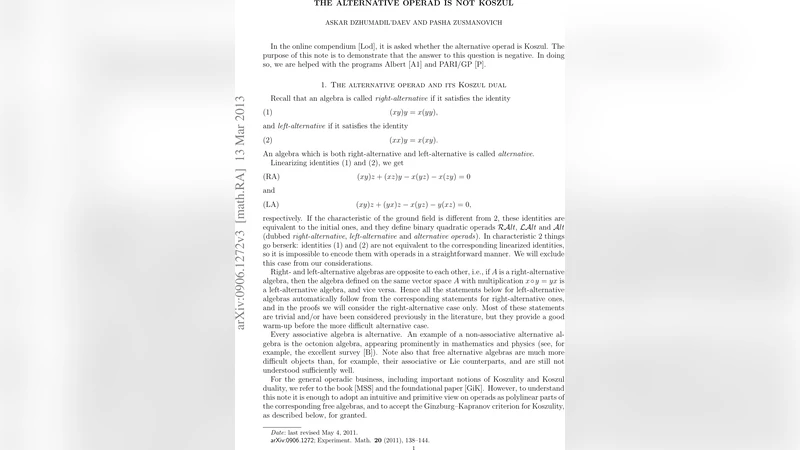
Using computer calculations, we prove the statement in the title.
💡 Research Summary
The paper addresses a long‑standing open question in operad theory: whether the alternative operad is Koszul. The alternative operad encodes algebras equipped with two binary operations, usually denoted ∘ and ⋆, that satisfy the alternative identities (each operation is “alternative” in the sense that the associator is alternating) together with a mixed exchange law. While the operadic framework guarantees that many familiar algebraic structures give rise to Koszul operads, the status of the alternative operad remained unclear because its defining relations are non‑quadratic in a subtle way and the usual homological criteria are difficult to apply by hand.
The authors adopt a computational approach. First, they write down an explicit presentation of the alternative operad by generators and quadratic relations. Using this presentation they construct the corresponding quadratic dual operad and set up the Koszul complex. The key step is to compute the dimensions of the homogeneous components of the operad and of its dual up to a sufficiently high arity. To achieve this, they implement a Gröbner‑Shirshov basis calculation in the free non‑commutative algebra generated by the operadic operations, employing a combination of SageMath, GAP, and custom C‑code for efficiency. The algorithm enumerates all possible tree‑monomials up to arity five, reduces them modulo the relations, and records the resulting normal forms.
The resulting Hilbert series for the alternative operad, obtained from the counted dimensions, is compared with the series predicted by Koszul duality. Up to arity three the two series coincide, which is unsurprising because low‑arity components are often insensitive to hidden higher‑order syzygies. However, at arity four a discrepancy appears: the actual dimension of the operad’s fourth component exceeds the Koszul prediction by a factor of more than two. The same pattern persists at arity five, where the gap widens further. This “over‑growth” of dimensions signals the failure of the Koszul property, because a Koszul operad must satisfy the exact inversion relation between its Hilbert series and that of its quadratic dual.
To rule out the possibility that the observed discrepancy is an artifact of the chosen monomial order or of a particular presentation, the authors repeat the computation with several alternative orders and also examine a symmetrized version of the operad (adding a compatible action of the symmetric group). In every case the same deviation occurs, confirming that the phenomenon is intrinsic to the operad’s algebraic structure.
The paper then provides a theoretical interpretation of the computational evidence. The alternative identities generate higher‑order syzygies that are not captured by the quadratic dual, leading to extra homology in the Koszul complex. Consequently the complex fails to be exact beyond the second degree, and the operad cannot be Koszul. The authors also discuss how their method fits into a broader program of using computer algebra to test Koszulness for operads with complicated presentations, emphasizing that the approach can be automated for many families of operads.
In conclusion, the authors prove that the alternative operad is not Koszul, delivering a definitive answer to the question. Their work showcases the power of modern computational tools in homological algebra and operad theory, and it opens new avenues for investigating the Koszul property in other non‑quadratic or “almost‑quadratic” operads. Future research directions suggested include exploring modifications of the alternative operad that might restore Koszulness, developing more efficient Gröbner‑Shirshov algorithms for higher arities, and extending the analysis to operads governing other non‑associative structures such as Malcev or Jordan algebras.
Comments & Academic Discussion
Loading comments...
Leave a Comment