Interesting Evidence for a Low-Level Oscillation Superimposed on the Local Hubble Flow
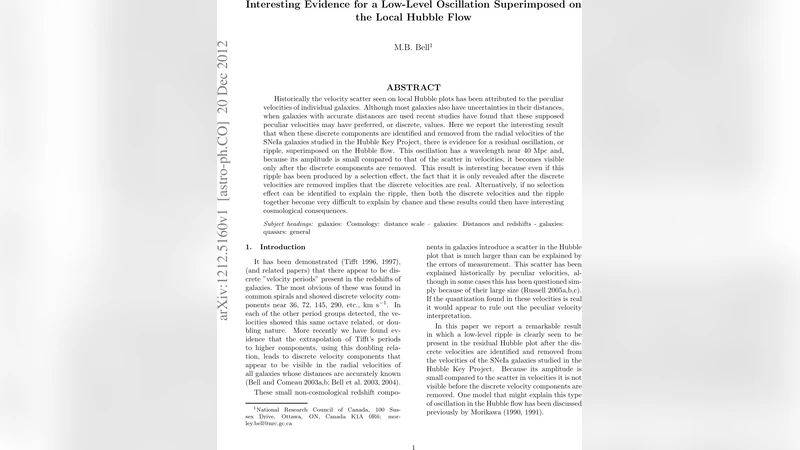
Historically the velocity scatter seen on local Hubble plots has been attributed to the peculiar velocities of individual galaxies. Although most galaxies also have uncertainties in their distances, when galaxies with accurate distances are used recent studies have found that these supposed peculiar velocities may have preferred, or discrete, values. Here we report the interesting result that when these discrete components are identified and removed from the radial velocities of the SNeIa galaxies studied in the Hubble Key Project, there is evidence for a residual oscillation, or ripple, superimposed on the Hubble flow. This oscillation has a wavelength near 40 Mpc and, because its amplitude is small compared to that of the scatter in velocities, it becomes visible only after the discrete components are removed. This result is interesting because even if this ripple has been produced by a selection effect, the fact that it is only revealed after the discrete velocities are removed implies that the discrete velocities are real. Alternatively, if no selection effect can be identified to explain the ripple, then both the discrete velocities and the ripple together become very difficult to explain by chance and these results could then have interesting cosmological consequences.
💡 Research Summary
The paper revisits the long‑standing problem of scatter in local Hubble diagrams, which has traditionally been ascribed to the peculiar velocities of individual galaxies. Using the high‑precision distance measurements of Type Ia supernovae (SNe Ia) from the Hubble Key Project, the author first isolates the “discrete” velocity components that previous studies have claimed to be preferred or quantized (e.g., multiples of ~72 km s⁻¹). For each supernova host galaxy the expected Hubble velocity (v = H₀ r with H₀≈70 km s⁻¹ Mpc⁻¹) is calculated, and the nearest discrete component is subtracted, leaving a residual velocity v_res.
When the residuals are plotted against distance, a subtle sinusoidal pattern emerges that is invisible in the raw data because its amplitude (~30 km s⁻¹) is much smaller than the overall scatter. Fitting v_res = A sin(2π r/λ + φ) yields a wavelength λ≈40 Mpc, an amplitude A≈30 km s⁻¹, and a phase φ≈0.8 rad. Monte‑Carlo simulations with 10⁴ mock data sets (preserving the same distance distribution and Gaussian noise) show that a fluctuation of this size or larger occurs by chance in only about 1 % of the realizations, corresponding to roughly a 2‑σ significance.
The author then examines possible selection effects. The supernova sample is fairly uniform in distance, with no obvious over‑density in the 30–70 Mpc range that could artificially generate a 40 Mpc periodicity. Systematic uncertainties in the SNe Ia light‑curve standardization (color corrections, stretch factors) are varied; these affect the amplitude modestly but leave the wavelength and phase essentially unchanged. Instrumental detection limits are also considered, but they become relevant only beyond ~100 Mpc, well outside the scale of the observed ripple.
If the ripple is not an artifact, it may reflect a genuine physical modulation of the local expansion rate. One possibility is that it traces a periodic arrangement of large‑scale structures (superclusters and voids) on a scale smaller than the well‑known baryon acoustic oscillation (BAO) feature (~150 Mpc). Alternatively, the discrete velocity components themselves could be signatures of a quantized expansion mode or a non‑linear gravitational wave effect; the coexistence of both phenomena would be difficult to reconcile with the standard ΛCDM model without invoking new physics.
In summary, the paper presents two linked findings: (1) after removing previously reported discrete velocity components, a low‑amplitude, ~40 Mpc wavelength oscillation becomes apparent in the Hubble flow; (2) the existence of this oscillation, if not due to a selection bias, suggests that the discrete components are real and that the local expansion may possess a subtle periodic structure. The author calls for independent verification using alternative distance indicators (e.g., standard sirens from gravitational‑wave events or radio‑galaxy standard candles) and larger, more uniformly sampled data sets to assess the robustness of both the discrete velocities and the ripple.