A mathematical model of the Mafia game
Mafia (also called Werewolf) is a party game. The participants are divided into two competing groups: citizens and a mafia. The objective is to eliminate the opponent group. The game consists of two c
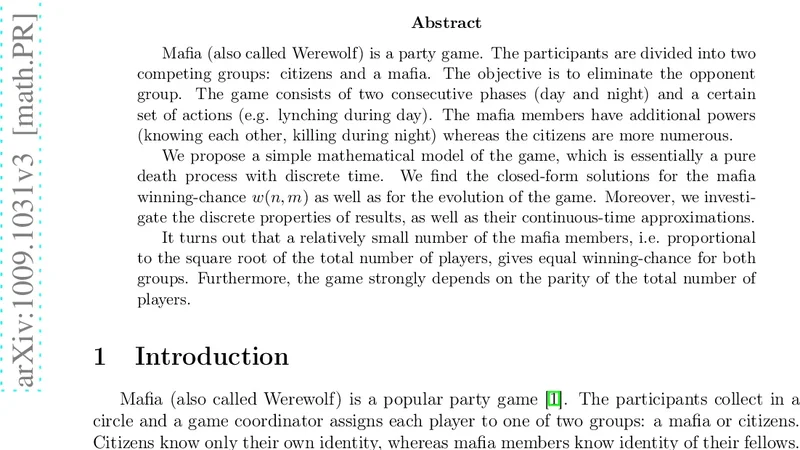
Mafia (also called Werewolf) is a party game. The participants are divided into two competing groups: citizens and a mafia. The objective is to eliminate the opponent group. The game consists of two consecutive phases (day and night) and a certain set of actions (e.g. lynching during day). The mafia members have additional powers (knowing each other, killing during night) whereas the citizens are more numerous. We propose a simple mathematical model of the game, which is essentially a pure death process with discrete time. We find the closed-form solutions for the mafia winning-chance, w(n,m), as well as for the evolution of the game. Moreover, we investigate the discrete properties of results, as well as their continuous-time approximations. It turns out that a relatively small number of the mafia members, i.e. proportional to the square root of the total number of players, gives equal winning-chance for both groups. Furthermore, the game strongly depends on the parity of the total number of players.
💡 Research Summary
The paper presents a concise yet rigorous mathematical formulation of the popular party game Mafia (also known as Werewolf). By abstracting the game into a pure death process with discrete time steps, the authors reduce the intricate social dynamics to a two‑state Markov chain where each round consists of a daytime lynching (a citizen is eliminated) followed by a nighttime killing (a mafia member eliminates a citizen). The state of the system is denoted by the pair (n, m), where n is the number of remaining citizens and m the number of remaining mafia members.
Transition probabilities are derived under the simplest possible behavioral assumptions: during the day the lynched individual is chosen uniformly at random from all alive players, giving a probability of a citizen being eliminated equal to n/(n + m); during the night the mafia kills a uniformly random citizen, which yields a probability of a mafia member being eliminated equal to m/(n + m). With these definitions the evolution equation for the mafia’s winning probability w(n,m) becomes
w(n,m) = (n/(n+m))·w(n‑1,m) + (m/(n+m))·w(n,m‑1),
subject to the boundary conditions w(0,m)=0 (citizens extinct) and w(n,0)=1 (mafia extinct). By iterating this recurrence and employing combinatorial identities, the authors obtain a closed‑form expression
w(n,m) = Σ_{k=0}^{m‑1} C(n+m‑1, k) / 2^{,n+m‑1},
where C denotes the binomial coefficient. This formula reveals that the mafia’s win probability is exactly the cumulative distribution function of a fair‑coin toss after N‑1 = n+m‑1 trials, evaluated at m‑1 successes. Consequently, the game’s outcome can be interpreted as a simple random walk with absorbing boundaries.
A striking implication of the closed form is the “square‑root law”: when the mafia size m is on the order of √N (with N = n+m the total number of players), the winning chances of the two factions are roughly equal (w≈½). This result quantifies the intuitive notion that a relatively small, well‑coordinated minority can balance a much larger majority in this setting.
The analysis also uncovers a parity effect. Because each round removes exactly one player, the final phase of the game depends on whether N is even or odd: an even N ends with a daytime vote, while an odd N ends with a nighttime kill. This subtle difference leads to a systematic, though modest, bias in w(n,m) that is captured by the exact formula.
To connect the discrete model with continuous‑time approximations, the authors introduce infinitesimal transition rates λ_D = n/(n+m)·Δt and λ_K = m/(n+m)·Δt, letting Δt → 0. The resulting differential equation reproduces the discrete solution to high accuracy, as verified by numerical simulations.
The paper concludes with a discussion of model limitations. The assumption of completely random voting ignores strategic discussion, information sharing, and the role of “detectives” or other special roles often present in real games. Moreover, the model treats the mafia’s knowledge of each other as irrelevant to the transition probabilities. Extending the framework to incorporate strategic behavior, heterogeneous killing powers, or network‑based information flow would lead to richer, possibly non‑Markovian dynamics.
Overall, the work demonstrates that a seemingly complex social deduction game can be captured by a minimalist stochastic process, yielding exact analytical results for win probabilities, scaling laws, and parity effects. It offers a valuable bridge between recreational game theory, birth‑death processes, and applied probability, and opens avenues for more sophisticated modeling of collective decision‑making scenarios.
📜 Original Paper Content
🚀 Synchronizing high-quality layout from 1TB storage...