On the Complexity of Maximum Clique Algorithms: usage of coloring heuristics leads to the 2^(n5) algorithm running time lower bound
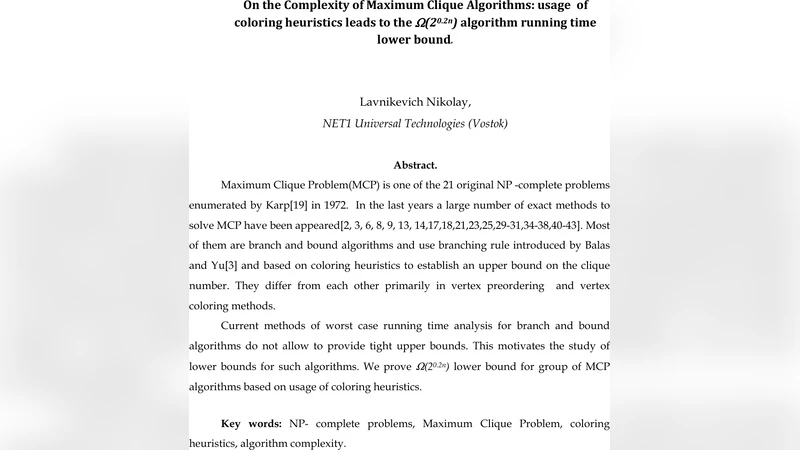
Maximum Clique Problem(MCP) is one of the 21 original NP–complete problems enumerated by Karp in 1972. In recent years a large number of exact methods to solve MCP have been appeared(Babel, Wood, Kumlander, Fahle, Li, Tomita and etc). Most of them are branch and bound algorithms that use branching rule introduced by Balas and Yu and based on coloring heuristics to establish an upper bound on the clique number. They differ from each other primarily in vertex preordering and vertex coloring methods. Current methods of worst case running time analysis for branch and bound algorithms do not allow to provide tight upper bounds. This motivates the study of lower bounds for such algorithms. We prove 2^(n\5) lower bound for group of MCP algorithms based on usage of coloring heuristics.
💡 Research Summary
The paper investigates a fundamental lower bound for a large class of exact maximum‑clique algorithms that rely on vertex‑coloring heuristics to obtain an upper bound on the size of the maximum clique. After reviewing basic graph‑theoretic notions and summarizing the state‑of‑the‑art exact algorithms (with complexities ranging from O(2^{0.528n}) down to O(2^{0.166n}) in the best known cases), the authors focus on the practical branch‑and‑bound schemes introduced by Balas and Yu, which use a greedy coloring to prune the search tree.
The core of the proof constructs, for any n divisible by 5, a graph C_{5,q} that is the join of q = n/5 copies of the 5‑cycle C5. This graph has n = 5q vertices, a maximum clique of size ω = 2q (i.e., 0.4n), and a chromatic number χ = 3q (i.e., 0.6n). Consequently the chromatic gap χ−ω equals q = 0.2n. Assuming the coloring heuristic returns a coloring using at least χ colors (or close to it), the pseudo‑code EXACT_MC will, at each recursion level, iterate over color classes while the number of remaining colors exceeds the current best clique size. Starting with k = 3q colors, the while‑loop executes for color‑class indices from 3q down to 2q+1, i.e., q iterations. Each iteration selects a vertex, creates a subgraph consisting of its neighbors, and recurses. The same pattern repeats on each subsequent level, decreasing both the clique size and the number of colors by one each time. After q levels the recursion stops, having generated at least 2^{q} recursive calls. Since q = n/5, the total work is bounded below by Ω(2^{n/5}) = Ω(2^{0.2n}).
Thus, any algorithm that follows the described scheme—lower‑bound heuristic clique, upper‑bound heuristic coloring, and branching on the last vertex of the last color class—cannot have a worst‑case running time better than Ω(2^{0.2n}). The authors note that this lower bound is independent of the specific coloring heuristic used, as long as it respects the basic property that the number of colors is at least the chromatic number.
The proof relies heavily on the assumption that the coloring heuristic yields a coloring close to optimal for the constructed join graph, and it does not analyze the impact of vertex ordering or more sophisticated bounding techniques. Moreover, the hard instance C_{5,q} is highly artificial; its relevance to typical benchmark graphs is unclear. Nevertheless, the paper provides a valuable theoretical insight: the use of coloring‑based upper bounds intrinsically limits the best achievable exponential factor for branch‑and‑bound maximum‑clique algorithms. Future work could explore whether alternative upper‑bound strategies or improved coloring methods can break the Ω(2^{0.2n}) barrier, or whether similar lower bounds hold for other combinatorial optimization problems that employ coloring heuristics.
Comments & Academic Discussion
Loading comments...
Leave a Comment