Fra"isse sequences: category-theoretic approach to universal homogeneous structures
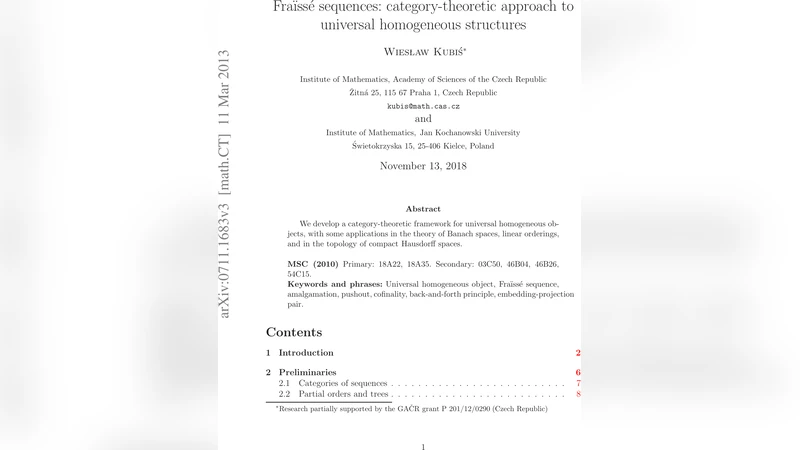
We develop category-theoretic framework for universal homogeneous objects, with some applications in the theory of Banach spaces, linear orderings, and in topology of compact spaces.
💡 Research Summary
The paper presents a categorical reformulation of Fraïssé theory, introducing the notion of a “Fraïssé sequence” in an arbitrary small category 𝒦 and showing how its colimit yields a universal homogeneous object. After a concise historical overview of classical Fraïssé limits—originally developed for countable relational structures—the authors identify the limitations of case‑by‑case constructions and motivate a unified, category‑theoretic framework.
The core definitions are as follows. The category 𝒦 is required to be countable up to isomorphism, to consist of monomorphisms (embeddings) as morphisms, and to satisfy two structural properties: the Amalgamation Property (AP) and the Joint Embedding Property (JEP). AP guarantees that any two morphisms with a common domain can be merged into a commuting square, while JEP ensures that any two objects embed into a common super‑object. Under these hypotheses one can build an ω‑chain
(A_0 \hookrightarrow A_1 \hookrightarrow A_2 \hookrightarrow \dots)
such that each step is “rich”: every object of 𝒦 appears as a subobject of some (A_n), and every embedding from a subobject of (A_n) into any object of 𝒦 extends to an embedding into a later (A_m). This ω‑chain is called a Fraïssé sequence.
The main theorem states that the colimit (U = \varinjlim A_n) exists in the ambient category (typically Set‑enriched) and enjoys two pivotal features: (1) universality – every object of 𝒦 admits a morphism into U, and (2) homogeneity – any isomorphism between finite sub‑objects of U extends to an automorphism of U. The proof proceeds via a categorical back‑and‑forth argument: starting from a partial isomorphism, one repeatedly applies AP to extend it step by step, thereby constructing a global automorphism. Uniqueness up to isomorphism follows from the same back‑and‑forth technique, mirroring the classical Fraïssé theorem.
To demonstrate the power of the framework, the authors work out three detailed examples.
-
Banach spaces: 𝒦 consists of finite‑dimensional Banach spaces with linear isometries. The Fraïssé limit is the Gurariĭ space, a separable Banach space characterized by the extension property for ε‑isometries. The categorical construction recovers the known uniqueness and universality of the Gurariĭ space without invoking functional‑analytic specifics.
-
Linear orders: 𝒦 is the category of finite linear orders with order‑preserving embeddings. The limit is the dense countable linear order without endpoints, i.e., the rational order ((\mathbb{Q},<)). The paper shows how the classical back‑and‑forth proof of the order’s homogeneity is a direct instance of the categorical argument.
-
Compact zero‑dimensional spaces: 𝒦 comprises finite discrete spaces with continuous maps. The colimit, after taking the Stone dual, is the Cantor set. This yields a categorical perspective on the well‑known fact that every compact metrizable zero‑dimensional space is a continuous image of the Cantor set.
Beyond these, the authors discuss potential extensions. By allowing multi‑sorted signatures or relaxing the monomorphism requirement, one can treat algebraic structures such as groups or rings. Moreover, non‑ω‑continuous chains could address uncountable Fraïssé limits, and imposing additional constraints on morphisms (e.g., fixing a distinguished point) leads to new homogeneous objects in topology and dynamics.
In conclusion, the paper succeeds in abstracting Fraïssé’s combinatorial construction into a clean categorical language. It provides a single theorem that simultaneously explains the existence and uniqueness of several celebrated universal homogeneous structures, and it opens a pathway for future research on homogeneous objects in more exotic categories, on the dynamics of their automorphism groups, and on connections with model theory, functional analysis, and topological dynamics.
Comments & Academic Discussion
Loading comments...
Leave a Comment