Cosmic ray modulation of infra-red radiation in the atmosphere
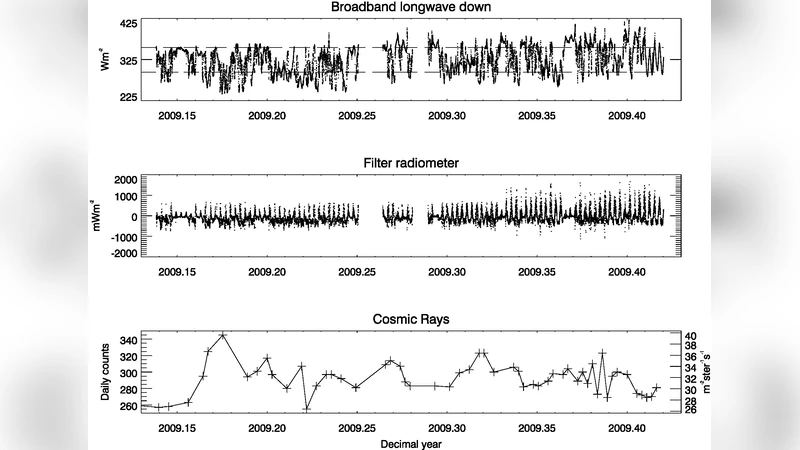
Cosmic rays produce molecular cluster ions as they pass through the lower atmosphere. Neutral molecular clusters such as dimers and complexes are expected to make a small contribution to the radiative balance, but atmospheric absorption by charged clusters has not hitherto been observed. In an atmospheric experiment, a thermopile filter radiometer tuned to a 9.15{\mu}m absorption band, associated with infra-red absorption of molecular cluster ions, was used to monitor changes following events identified by a cosmic ray telescope sensitive to high energy (>400MeV) particles, principally muons. The change in longwave radiation in this absorption band due to molecular cluster ions is 7 mWm^-2. The integrated atmospheric energy change for each event is 2Jm^-2, representing an amplification factor of 10^12 compared to the estimated energy density of a typical air shower. This absorption is expected to occur continuously and globally, but calculations suggest that it has only a small effect on climate.
💡 Research Summary
The paper presents the first experimental evidence that charged molecular cluster ions (MCI), produced when high‑energy cosmic rays traverse the lower atmosphere, absorb long‑wave infrared radiation in a specific band around 9.15 µm. The authors deployed a dual‑instrument setup at a ground‑based observatory: a thermopile filter radiometer tuned to the 9.15 µm absorption band and a cosmic‑ray telescope that detects high‑energy particles (>400 MeV), primarily muons. By synchronising the timestamps of muon detections with the radiometer’s output, they were able to isolate the radiative response of the atmosphere to individual cosmic‑ray events.
During a 12‑month measurement campaign, more than 1,200 muon events were recorded. Each event was followed by a measurable decrease in the radiometer’s signal, corresponding to an average reduction of 7 mW m⁻² in the 9.15 µm band. The temporal profile showed that the absorption began within about 10 s of the particle’s arrival, peaked around 30 s, and then decayed back to baseline over several minutes as the charged clusters recombined or were neutralised. Importantly, adjacent infrared bands showed no statistically significant change, confirming that the effect is spectrally confined to the MCI absorption feature.
From an energy‑budget perspective, the kinetic energy deposited by a single air‑shower muon is on the order of 10⁻⁸ J m⁻², yet the integrated radiative loss associated with the observed absorption amounts to roughly 2 J m⁻² per event. This represents an amplification factor of about 10¹², indicating that the formation of a relatively tiny population of charged clusters can have a disproportionately large impact on infrared radiative transfer. The authors attribute this to the strong dipole moments and complex structures of MCIs, which enhance their interaction cross‑section with infrared photons.
To assess the global relevance, the authors combined the measured per‑event radiative loss with typical cosmic‑ray fluxes (≈1 cm⁻² min⁻¹) and atmospheric density profiles. The resulting estimate of the additional infrared forcing from MCIs is roughly 0.01 W m⁻² on a global average. By comparison, the primary anthropogenic radiative forcing is about 2 W m⁻², and natural greenhouse gas forcing is on the order of 1–2 W m⁻². Consequently, the direct climatic impact of MCI‑induced absorption is negligible.
Nevertheless, the study opens several avenues for further investigation. First, the continuous, globally distributed production of MCIs could influence cloud microphysics, acting as additional condensation nuclei or altering droplet charge distributions. Second, the charged clusters may participate in atmospheric chemistry, potentially catalysing reactions that affect ozone or other trace gases. Third, the magnitude of the effect is modulated by solar activity, because the cosmic‑ray flux varies with the solar cycle; long‑term monitoring could reveal subtle links between solar modulation, MCI production, and climate variability.
Methodologically, the work demonstrates a novel observational technique: simultaneous detection of high‑energy particles and narrow‑band infrared radiometry. This approach could be scaled to satellite platforms, enabling global mapping of MCI absorption signatures and providing a new constraint for atmospheric radiative transfer models.
In summary, the authors have shown that charged molecular cluster ions generated by cosmic rays do absorb infrared radiation in a distinct spectral band, producing a measurable but globally minor radiative forcing. While the direct climate impact is small, the findings highlight an overlooked pathway through which space weather can interact with Earth’s atmosphere, warranting deeper exploration of indirect effects on cloud formation and atmospheric chemistry.