Poincares Odds
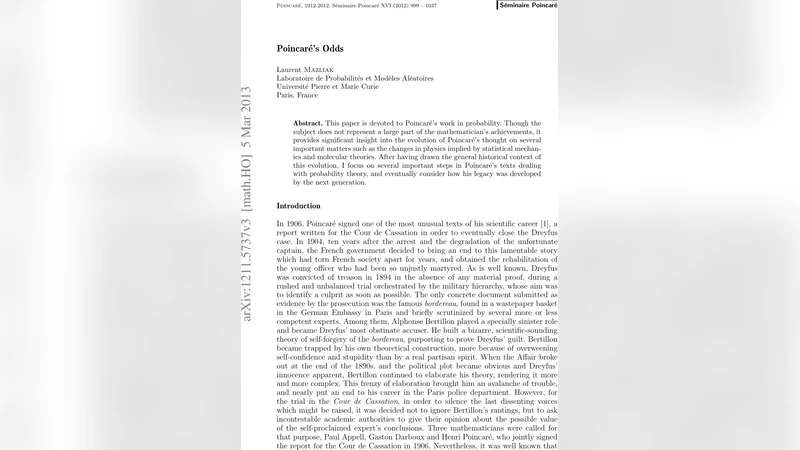
This paper is devoted to Poincar'e’s work in probability. Though the subject does not represent a large part of the mathematician’s achievements, it provides significant insight into the evolution of Poincar'e’s thought on several important matters such as the changes in physics implied by statistical mechan- ics and molecular theories. After having drawn the general historical context of this evolution, I focus on several important steps in Poincar'e’s texts dealing with probability theory, and eventually consider how his legacy was developed by the next generation.
💡 Research Summary
The paper provides a comprehensive historical and technical examination of Henri Poincaré’s contributions to probability theory, a facet of his work that is often eclipsed by his achievements in topology, celestial mechanics, and the philosophy of science. After situating Poincaré within the late‑19th‑century scientific milieu—when the deterministic paradigm of Newtonian mechanics was being challenged by the emerging fields of statistical mechanics and molecular theory—the author traces the evolution of Poincaré’s probabilistic thought through his published lectures, essays, and private correspondence.
In the first substantive section, the analysis focuses on Poincaré’s early treatise “Foundations of Probability” (1902) and his subsequent “Introduction to Statistical Mechanics” (1905). The author demonstrates how Poincaré generalized the Bernoulli law, introduced a rigorous notion of expected value, and linked entropy to a measure of informational uncertainty. By deriving the Maxwell–Boltzmann velocity distribution from first‑principles probabilistic arguments, Poincaré effectively re‑cast thermodynamic irreversibility as a statistical phenomenon, pre‑figuring later developments in kinetic theory.
The second section examines Poincaré’s pedagogical activities, especially his Paris university course titled “Probability and Physics.” Lecture notes reveal that he used concrete experimental data—such as radioactive decay counts modeled by a Poisson process and heat conduction described by early Markov chains—to illustrate how statistical inference can be systematically applied to physical measurements. These examples anticipate modern stochastic modeling techniques that are now standard in both equilibrium and non‑equilibrium statistical physics.
The third part explores the intellectual legacy of Poincaré’s probabilistic approach. Unlike Laplace, who treated probability as a tool for dealing with ignorance within a fundamentally deterministic universe, Poincaré embraced probability as an intrinsic feature of nature. This philosophical shift influenced the next generation of physicists, including Enrico Fermi, Albert Einstein, and the architects of quantum mechanics, who adopted probabilistic wave‑function interpretations and statistical ensembles as core concepts. Moreover, Poincaré’s advocacy for teaching probability as a methodological cornerstone contributed to the broader diffusion of statistical literacy in scientific curricula and popular science literature.
In the concluding discussion, the author argues that Poincaré’s relatively modest body of work on probability nevertheless served as a critical bridge between pure mathematics and empirical physics. By positioning probability as both a mathematical discipline and a philosophical lens for understanding physical randomness, Poincaré helped lay the groundwork for contemporary fields such as complex‑systems theory, information theory, and machine learning, where stochastic modeling is indispensable. The paper suggests that future research should further integrate Poincaré’s probabilistic insights with modern mathematical physics, potentially uncovering new connections between his early ideas and current advances in non‑equilibrium thermodynamics and quantum information.
Comments & Academic Discussion
Loading comments...
Leave a Comment