Degree Relations of Triangles in Real-world Networks and Models
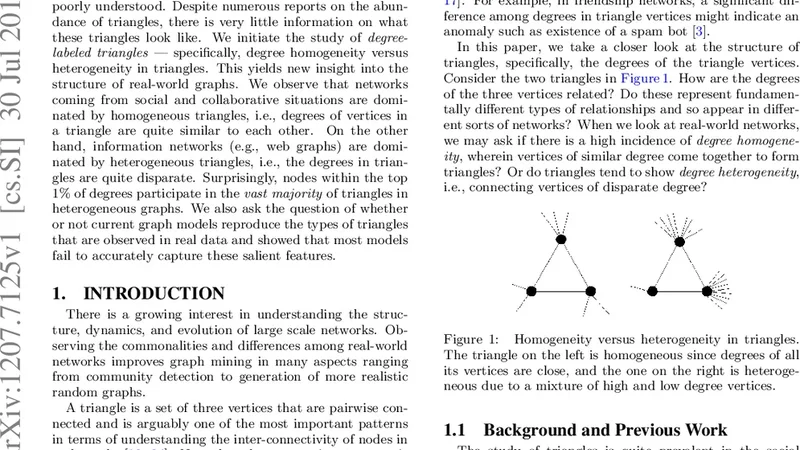
Triangles are an important building block and distinguishing feature of real-world networks, but their structure is still poorly understood. Despite numerous reports on the abundance of triangles, there is very little information on what these triangles look like. We initiate the study of degree-labeled triangles – specifically, degree homogeneity versus heterogeneity in triangles. This yields new insight into the structure of real-world graphs. We observe that networks coming from social and collaborative situations are dominated by homogeneous triangles, i.e., degrees of vertices in a triangle are quite similar to each other. On the other hand, information networks (e.g., web graphs) are dominated by heterogeneous triangles, i.e., the degrees in triangles are quite disparate. Surprisingly, nodes within the top 1% of degrees participate in the vast majority of triangles in heterogeneous graphs. We also ask the question of whether or not current graph models reproduce the types of triangles that are observed in real data and showed that most models fail to accurately capture these salient features.
💡 Research Summary
This paper introduces a systematic study of “degree‑labeled triangles” in complex networks, focusing on the homogeneity or heterogeneity of vertex degrees within each triangle. After defining a triangle’s degree profile (sorted degrees of its three vertices) the authors quantify its variance using either the standard deviation of the degrees or the ratio between the maximum and minimum degree. A triangle is classified as homogeneous if the variance falls below a data‑driven threshold, and heterogeneous otherwise.
The authors assemble a diverse corpus of more than twenty real‑world graphs, grouped into four categories: social (online friendship, communication), collaborative (co‑authorship), information (web hyperlink, citation), and infrastructure (power grid, transportation). For each graph they compute the total number of triangles, the proportion of homogeneous versus heterogeneous triangles, and the contribution of vertices from different degree quantiles (e.g., top 0.1 %, top 1 %, top 5 %).
The empirical results reveal a striking dichotomy. Social and collaborative networks are dominated by homogeneous triangles; 60 %–80 % of all triangles have vertex degrees that differ by less than 10 % of the average degree. This suggests that interactions in these domains tend to occur among participants with comparable activity levels. In contrast, information‑oriented graphs (web graphs, citation networks) are overwhelmingly heterogeneous: more than 70 % of triangles involve vertices whose degrees differ by a factor of three or more. Moreover, the top 1 % of high‑degree vertices (the “hubs”) participate in 40 %–55 % of all triangles in these heterogeneous graphs, linking low‑degree vertices together and creating highly imbalanced degree triples.
To assess whether existing generative models capture this phenomenon, the same analysis pipeline is applied to a suite of classic random‑graph models: Erdős–Rényi (ER), Barabási–Albert (BA), Watts–Strogatz (WS), Kronecker, and Chung–Lu. While many models can reproduce the overall triangle count, they fail to match the observed homogeneous/heterogeneous split. ER graphs, with their narrow Poisson degree distribution, produce an excess of homogeneous triangles. BA graphs, despite their scale‑free degree distribution, generate triangles primarily among low‑degree nodes, again inflating homogeneity. WS graphs, designed for high clustering, also yield overly homogeneous triangles. Kronecker and Chung–Lu models, which fit the degree sequence, still lack mechanisms to enforce degree imbalance within triangles, resulting in heterogeneous triangle ratios far below those seen in real data.
The authors discuss the functional implications of these patterns. In heterogeneous, hub‑centric networks, hubs provide multiple short paths, accelerating information diffusion and enhancing robustness under random failures. However, targeted removal of hubs can dismantle a large fraction of triangles, dramatically reducing local clustering and fragmenting the network. Conversely, homogeneous‑triangle dominated social graphs exhibit strong local cohesion; the loss of a few nodes does not substantially erode overall connectivity because triangles are formed among peers of similar degree.
In conclusion, degree‑labeled triangle analysis offers a new lens for characterizing network structure beyond traditional metrics such as clustering coefficient or degree distribution. It exposes a critical shortcoming of current graph‑generation models: they do not faithfully reproduce the degree heterogeneity observed inside real‑world triangles. The paper suggests future directions, including the design of generative mechanisms that explicitly control triangle degree balance and the exploration of how triangle heterogeneity influences dynamical processes such as epidemic spreading, opinion formation, and network resilience.
Comments & Academic Discussion
Loading comments...
Leave a Comment