Computing the homology of groups: the geometric way
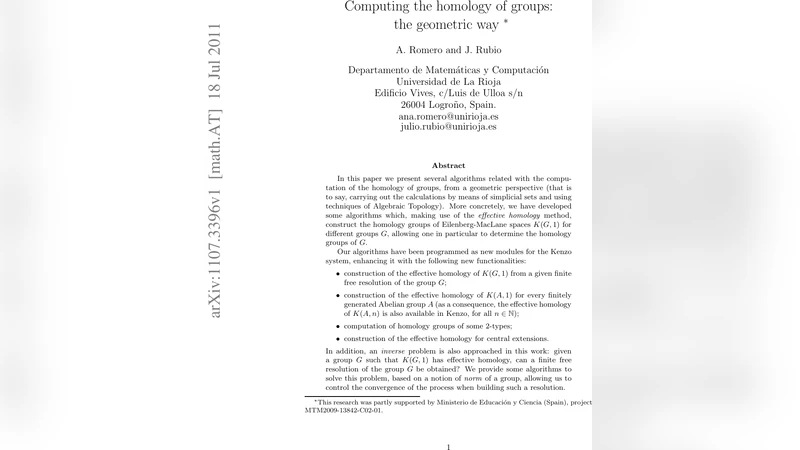
In this paper we present several algorithms related with the computation of the homology of groups, from a geometric perspective (that is to say, carrying out the calculations by means of simplicial sets and using techniques of Algebraic Topology). More concretely, we have developed some algorithms which, making use of the effective homology method, construct the homology groups of Eilenberg-MacLane spaces K(G,1) for different groups G, allowing one in particular to determine the homology groups of G. Our algorithms have been programmed as new modules for the Kenzo system, enhancing it with the following new functionalities: - construction of the effective homology of K(G,1) from a given finite free resolution of the group G; - construction of the effective homology of K(A,1) for every finitely generated Abelian group A (as a consequence, the effective homology of K(A,n) is also available in Kenzo, for all n); - computation of homology groups of some 2-types; - construction of the effective homology for central extensions. In addition, an inverse problem is also approached in this work: given a group G such that K(G,1) has effective homology, can a finite free resolution of the group G be obtained? We provide some algorithms to solve this problem, based on a notion of norm of a group, allowing us to control the convergence of the process when building such a resolution.
💡 Research Summary
The paper “Computing the Homology of Groups: The Geometric Way” presents a suite of algorithms that compute group homology from a geometric perspective, using the effective homology framework and the Kenzo computer algebra system. Traditionally, two approaches exist for calculating the homology of a group G: an algebraic method based on free resolutions of the group ring ℤG, and a geometric method that builds a contractible space with a free G‑action, whose orbit space is the aspherical Eilenberg–MacLane space K(G,1). While the algebraic approach is well supported by software such as GAP‑HAP, the geometric approach has been largely ignored because the simplicial models of K(G,1) are infinite in every dimension, making direct computation infeasible.
The authors revive the geometric route by exploiting the effective homology technique introduced by Sergeraert. Effective homology replaces a large, possibly infinite chain complex C∗(X) with a smaller, finitely generated free chain complex E∗ together with a strong chain equivalence (a pair of reductions) that guarantees isomorphic homology. This reduction makes it possible to compute homology groups of spaces that would otherwise be out of reach.
The central contribution is Algorithm 1, which takes as input a group G together with a finite free resolution F∗ of ℤ over ℤG (including an augmentation and a contracting homotopy) and produces a strong chain equivalence between the standard bar construction C∗(K(G,1)) and an effective chain complex E∗. The algorithm is implemented in Common Lisp as an extension of Kenzo. Interoperability with GAP‑HAP is achieved via OpenMath, allowing resolutions generated in HAP to be imported directly into Kenzo.
Beyond the basic case, the authors develop several new Kenzo modules:
-
Abelian groups – For any finitely generated abelian group A, the system constructs effective homology for K(A,1) and, by iterating loop space constructions, for K(A,n) for all n≥0. This provides a practical tool for algebraic topologists who frequently need Eilenberg–MacLane spaces of higher degree.
-
2‑types – The paper shows how to compute the homology of spaces whose only non‑trivial homotopy groups are π₁ and π₂ (the so‑called 2‑types). By combining the effective homology of K(G,1) with that of a suitable Postnikov 2‑stage, the authors obtain concrete homology groups for examples that had not been computed before.
-
Central extensions – For extensions 1→A→E→G→1 with A central, the authors construct K(E,1) from the effective homology of K(G,1) and K(A,1). This yields homology groups of the extension group E, illustrating how group‑theoretic constructions can be lifted to the level of effective homology.
The paper also tackles the inverse problem: given an effective homology for K(G,1), can one recover a finite free resolution of G? The authors introduce a “norm” on the group to control a convergent iterative process that builds a resolution from the reduction data. Although currently limited to certain classes of groups, the method provides a promising pathway toward automated resolution construction.
Experimental results are presented in Section 5, demonstrating the computation of homology groups for various non‑trivial examples, including higher loop spaces, Postnikov towers, and central extensions. The authors report successful verification against known results and new calculations where no previous data existed.
In conclusion, the work bridges the gap between algebraic and geometric methods for group homology. By integrating effective homology into Kenzo and providing concrete algorithms for K(G,1), K(A,n), 2‑types, and central extensions, the authors enable the computation of homology for groups and related spaces that were previously inaccessible. Future directions include extending the resolution‑recovery algorithm to broader classes of groups, optimizing the implementation for larger complexes, and exploring further applications in homotopy theory such as higher‑dimensional Postnikov towers.
Comments & Academic Discussion
Loading comments...
Leave a Comment