On fundamental groups of quotient spaces
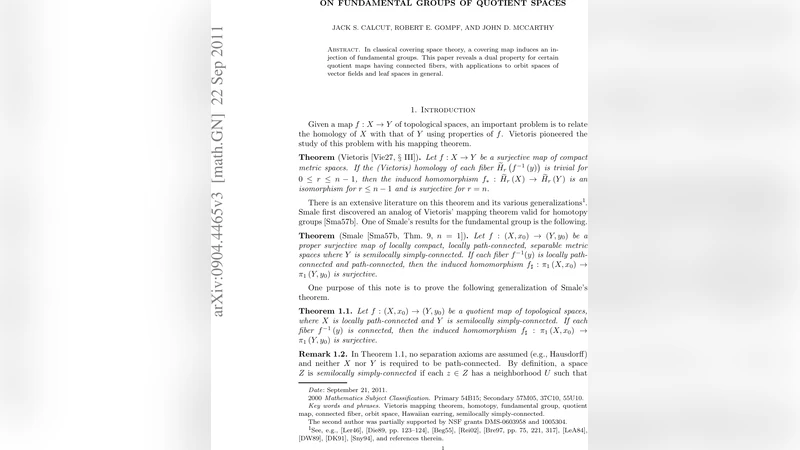
In classical covering space theory, a covering map induces an injection of fundamental groups. This paper reveals a dual property for certain quotient maps having connected fibers, with applications to orbit spaces of vector fields and leaf spaces in general.
💡 Research Summary
The paper investigates a dual phenomenon to the classical result that a covering map induces an injection on fundamental groups. While covering maps “pull apart” the space and preserve the distinctness of loops, the authors focus on quotient maps that “collapse” parts of a space and ask whether a comparable statement holds for the induced homomorphism on π₁. Their main theorem, which they call the Connected‑Fiber Surjection Theorem, asserts that if X is locally path‑connected, q : X → Y is a quotient map that is also open, and every fiber q⁻¹(y) is connected, then the induced map q_* : π₁(X, x₀) → π₁(Y, q(x₀)) is surjective. In other words, every loop in the quotient space Y can be represented as the image of a loop in the original space X.
The proof proceeds by subdividing an arbitrary loop γ in Y into small arcs whose images lie inside open sets over which q behaves nicely. Because each fiber is connected, each arc can be lifted to a path in X; the lifts can be concatenated, and the connectedness of the fibers guarantees that the endpoint of the concatenated lift can be joined back to the basepoint within the same fiber, producing a genuine loop \tilde{γ} in X. By construction, q∘\tilde{γ} is homotopic to γ, establishing surjectivity. The authors emphasize that the connectedness of fibers, not their simple‑connectedness, is sufficient, and they discuss why the openness of q and the local path‑connectedness of X are essential hypotheses. Counterexamples are provided showing that dropping any of these conditions can cause the conclusion to fail.
After establishing the core result, the paper explores two significant applications. First, consider the orbit space of a complete vector field V on a smooth manifold M. The orbits of V are connected 1‑dimensional submanifolds (either diffeomorphic to ℝ or S¹). The natural projection q : M → M/∼_V is a quotient map with connected fibers, so the theorem guarantees that π₁(M/∼_V) is a quotient of π₁(M). This is particularly valuable because orbit spaces are often non‑Hausdorff and lack a conventional covering‑space theory; nevertheless, their fundamental groups can be completely understood via the original manifold.
Second, the authors apply the theorem to leaf spaces of foliations. When every leaf of a foliation ℱ on a manifold X is connected, the leaf space L = X/ℱ inherits a quotient map with connected fibers. Consequently, the induced map on π₁ is surjective, allowing one to compute or estimate π₁(L) directly from π₁(X). This result extends earlier work that required leaves to be simply connected; the present theorem shows that simple‑connectedness is unnecessary for surjectivity.
The paper also discusses the optimality of the hypotheses. It presents examples where fibers are disconnected, leading to a failure of surjectivity, and shows that if q is not open, the lifting argument breaks down. Moreover, the authors note that while the theorem addresses π₁, analogous statements for higher homotopy groups remain open, suggesting a direction for future research.
In the concluding section, the authors propose several avenues for further investigation: (i) relaxing the openness requirement by imposing alternative local conditions, (ii) extending the surjectivity result to higher homotopy groups or to homology via spectral sequences, and (iii) applying the framework to more exotic quotient constructions arising in dynamical systems, group actions with non‑proper orbits, and non‑regular foliations. Overall, the paper provides a clear and robust dual to the classical covering‑space injection theorem, enriching the toolkit for topologists working with quotient spaces, dynamical orbit spaces, and leaf spaces.
Comments & Academic Discussion
Loading comments...
Leave a Comment