Extensions of differential representations of SL(2) and tori
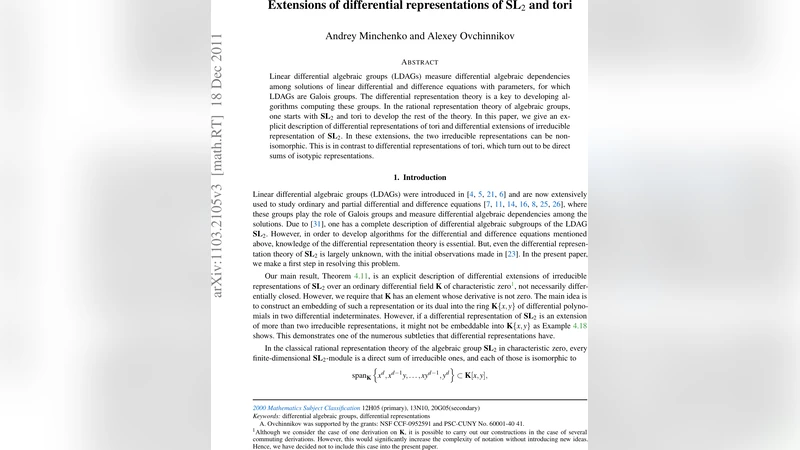
Linear differential algebraic groups (LDAGs) measure differential algebraic dependencies among solutions of linear differential and difference equations with parameters, for which LDAGs are Galois groups. The differential representation theory is a key to developing algorithms computing these groups. In the rational representation theory of algebraic groups, one starts with SL(2) and tori to develop the rest of the theory. In this paper, we give an explicit description of differential representations of tori and differential extensions of irreducible representation of SL(2). In these extensions, the two irreducible representations can be non-isomorphic. This is in contrast to differential representations of tori, which turn out to be direct sums of isotypic representations.
💡 Research Summary
The paper investigates differential representations of two fundamental linear algebraic groups—SL(2) and algebraic tori—over a differential field K of characteristic zero. Linear differential algebraic groups (LDAGs) serve as Galois groups for linear differential and difference equations with parameters, and understanding their representation theory is essential for algorithmic computation of such groups.
After recalling basic notions of differential algebra, Kolchin‑closed sets, and the definition of LDAGs, the authors introduce a categorical framework for handling non‑semisimple categories. They define a distinguished subset Rep₀(G) consisting of finite‑dimensional G‑modules that have a unique minimal and a unique maximal submodule. Every finite‑dimensional G‑module can be built from Rep₀(G) by iterated pull‑backs and push‑outs (Proposition 3.3). This reduces the classification problem to describing the indecomposable modules in Rep₀(G).
For algebraic tori the situation is remarkably simple. Theorem 4.3 shows that any indecomposable differential representation of a torus is an extension of isomorphic irreducible representations; equivalently, every differential torus representation is a direct sum of isotypic components. No non‑trivial extensions between non‑isomorphic irreducibles occur, mirroring the classical rational representation theory.
The main contribution concerns SL(2). The authors work under the mild hypothesis that K contains an element a with non‑zero derivative (a′≠0). Under this assumption they give a complete description of all differential extensions of two irreducible SL(2)‑modules (Theorem 4.11). The key idea is to embed such an extension (or its dual) into the differential polynomial ring K{ x, y }. Classical rational SL(2)‑modules correspond to homogeneous polynomial subspaces of K
Comments & Academic Discussion
Loading comments...
Leave a Comment