Biased swimming cells do not disperse in pipes as tracers: a population model based on microscale behaviour
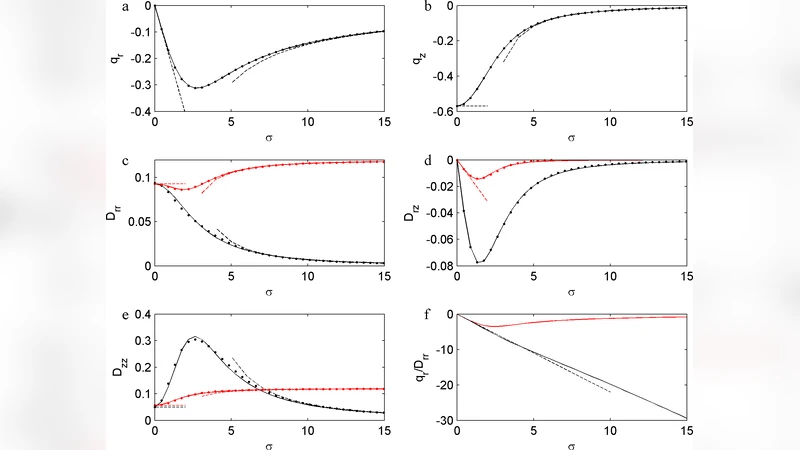
There is much current interest in modelling suspensions of algae and other micro-organisms for biotechnological exploitation, and many bioreactors are of tubular design. Using generalized Taylor dispersion theory, we develop a population-level swimming-advection-diffusion model for suspensions of micro-organisms in a vertical pipe flow. In particular, a combination of gravitational and viscous torques acting on individual cells can affect their swimming behaviour, which is termed gyrotaxis. This typically leads to local cell drift and diffusion in a suspension of cells. In a flow in a pipe, small amounts of radial drift across streamlines can have a major impact on the effective axial drift and diffusion of the cells. We present a Galerkin method to calculate the local mean swimming velocity and diffusion tensor based on local shear for arbitrary flow rates. This method is validated with asymptotic results obtained in the limits of weak and strong shear. We solve the resultant swimming-advection-diffusion equation using numerical methods for the case of imposed Poiseuille flow and investigate how the flow modifies the dispersion of active swimmers from that of passive scalars. We establish that generalized Taylor dispersion theory predicts an enhancement of gyrotactic focussing in pipe flow with increasing shear strength, in contrast to earlier models. We also show that biased swimming cells may behave very differently to passive tracers, drifting axially at up to twice the rate and diffusing much less.
💡 Research Summary
The paper addresses the transport of gyrotactic microorganisms—cells whose swimming direction is biased by a balance of gravitational and viscous torques—in vertical pipe flow, a configuration common in tubular bioreactors. Using generalized Taylor dispersion theory (GTDT), the authors develop a population‑level advection‑diffusion model that incorporates the microscale swimming behavior of individual cells into macroscopic drift and diffusion coefficients.
First, the authors formulate the orientation dynamics of a single cell with the classic gyrotactic torque balance: a restoring gravitational torque that aligns the cell upward and a viscous torque proportional to the local shear that tends to rotate the cell with the flow. This leads to a stochastic differential equation for the cell orientation vector p, which depends on the nondimensional gyrotactic parameter B (ratio of gravitational to viscous torque) and a shear‑sensitivity parameter λ. By solving the associated Fokker‑Planck equation for the steady‑state orientation distribution f(p; r, γ̇) at each radial position r, the authors obtain the local mean swimming velocity Ū(r) (the projection of the swimming speed onto the pipe axis) and the local diffusion tensor D̄(r).
To evaluate Ū and D̄ for arbitrary shear rates, the paper introduces a Galerkin method. The orientation distribution is expanded in a finite set of spherical harmonics, converting the infinite‑dimensional eigenvalue problem into a tractable matrix problem. Convergence is demonstrated by increasing the truncation order, and the numerical results are benchmarked against known asymptotic limits: in the weak‑shear regime the coefficients reduce to the classical isotropic diffusion D₀ = V_s² τ/3, while in the strong‑shear limit the diffusion collapses as D ∝ 1/γ̇, reflecting alignment of cells with the flow.
Having obtained the radial profiles of Ū and D̄, the authors average them over the pipe cross‑section to derive a one‑dimensional axial transport equation for the cell concentration C(z,t):
∂C/∂t + ∂
Comments & Academic Discussion
Loading comments...
Leave a Comment