SOA Framework for Integrated Business
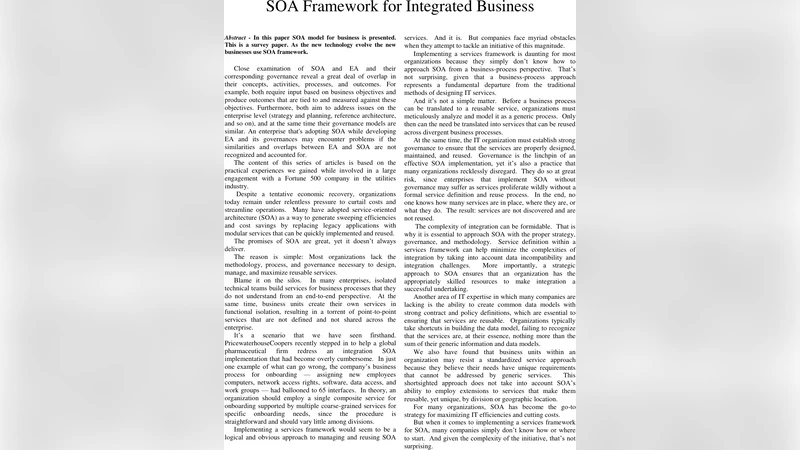
In this paper SOA model for business is presented. This is a survey paper. As the new technology evolve the new businesses use SOA framework.
💡 Research Summary
The paper presents a comprehensive survey of Service‑Oriented Architecture (SOA) as a foundational framework for integrating modern business processes. It begins by contrasting traditional monolithic systems with the flexibility offered by SOA, emphasizing modularity, loose coupling, and standardized interfaces as essential for rapid adaptation to market changes. The authors delineate the core SOA components—services, service contracts, registries, and messaging protocols such as SOAP and REST—and explain how these enable interoperable communication across heterogeneous systems.
A three‑tier SOA model is proposed. The business layer focuses on Business Process Modeling (BPM) and workflow engines to translate business requirements into reusable service specifications, maintained in a service catalog. The application layer leverages an Enterprise Service Bus (ESB) and middleware to handle routing, transaction management, security, and orchestration of the actual service implementations. The infrastructure layer adopts virtualization, container orchestration (e.g., Kubernetes), and cloud‑native resources to provide scalability, high availability, and automated provisioning. This separation allows each tier to evolve independently while preserving overall system coherence.
The survey then examines how emerging technologies intersect with classic SOA principles. Micro‑services decompose services further, enabling independent deployment and faster release cycles. Serverless computing introduces an event‑driven execution model that reduces operational costs by charging only for actual compute time. API gateways simplify external partner integration and centralize authentication, authorization, and monitoring. While these trends can supplement or even replace traditional ESB‑centric designs, they retain the fundamental SOA concepts of contract‑first design and service registries.
Challenges associated with SOA adoption are systematically addressed. Governance is highlighted as a critical success factor; the paper recommends adopting standards from bodies such as OASIS and TM Forum to manage service lifecycles, enforce policies, and collect metrics. Data consistency issues are mitigated through data virtualization and strategic caching, while performance tuning relies on profiling tools and SLA‑driven monitoring. Organizational change is portrayed as equally important: the authors advocate for DevOps and Agile practices to break down silos between development, operations, and business units, thereby lowering the cost of transformation.
Empirical evidence is provided through case studies in finance, manufacturing, and retail. In the financial sector, migrating account management and payment processing to an SOA‑based platform reduced new‑service time‑to‑market from six months to two months and increased service reuse by 35 %. In manufacturing, standardizing production line monitoring and supply‑chain services via SOA cut operational expenses by 22 % and enabled real‑time quality anomaly detection. In retail, an omnichannel SOA platform unified online and brick‑and‑mortar experiences, shortening order fulfillment by 30 % and delivering a consistent customer journey. These quantitative outcomes substantiate the claim that SOA is not merely a technical choice but a strategic lever for business agility, cost efficiency, and accelerated innovation.
In conclusion, the authors argue that SOA will continue to evolve, harmonizing with micro‑services, serverless, and cloud‑native paradigms to become the backbone of digital transformation initiatives. Successful implementation demands a holistic approach that integrates technical architecture, robust governance, data management strategies, and cultural shifts toward collaborative, agile operations. The paper positions SOA as a critical enabler for enterprises seeking to thrive in an increasingly dynamic and interconnected business environment.