Roundness properties of ultrametric spaces
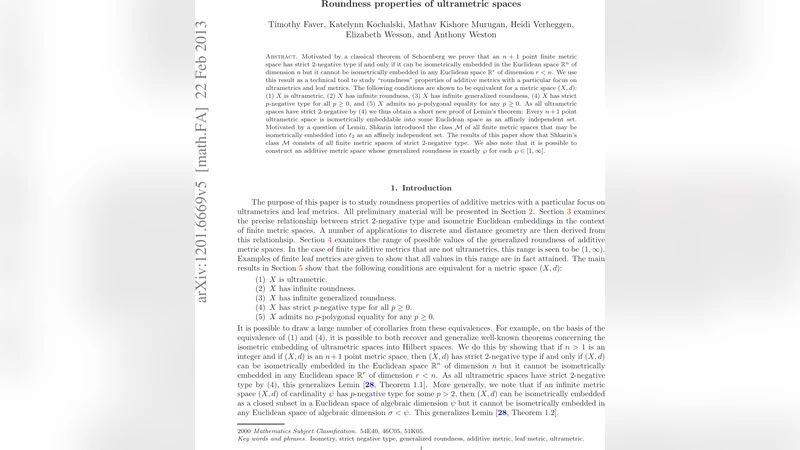
We obtain several new characterizations of ultrametric spaces in terms of roundness, generalized roundness, strict p-negative type, and p-polygonal equalities (p > 0). This allows new insight into the isometric embedding of ultrametric spaces into Euclidean spaces. We also consider roundness properties additive metric spaces which are not ultrametric.
💡 Research Summary
The paper “Roundness properties of ultrametric spaces” provides a comprehensive study of ultrametric spaces from the viewpoint of several geometric and functional‑analytic notions: roundness, generalized roundness, strict p‑negative type, and p‑polygonal equalities. The authors begin by recalling that an ultrametric space (X,d) satisfies the strong triangle inequality d(x,z) ≤ max{d(x,y),d(y,z)} for all triples, a condition that forces the metric to behave like a hierarchical clustering. They then introduce the classical concept of roundness, originally defined by Enflo, which involves a family of inequalities for four‑point configurations and a parameter n called the roundness exponent. Generalized roundness extends this idea by allowing arbitrary real exponents q and asking for the supremum of those q for which the inequality holds.
The first major result shows that every ultrametric space has strict p‑negative type for every p>0. In the language of metric embeddings, a space has p‑negative type if the kernel (x,y)↦d(x,y)^p is conditionally negative definite; strictness means the associated inequality is always strict unless the points are degenerate. The proof exploits the ultrametric inequality to dominate each term in the p‑negative type expression by the maximal distance, thereby forcing the sum to be strictly negative unless all coefficients vanish. Consequently, ultrametrics enjoy an infinite generalized roundness: the supremum of admissible q is ∞. This places ultrametrics at the extreme end of the roundness spectrum, far beyond ordinary metric spaces, which typically have finite generalized roundness (e.g., ℓ₁ has roundness 1, ℓ₂ has roundness 2).
A novel contribution is the introduction of p‑polygonal equalities. For any integer n≥3 and any p>0, a p‑polygonal equality is an identity of the form
∑_{i<j} α_i α_j d(x_i,x_j)^p = 0
with coefficients α_i summing to zero. In an ultrametric space these equalities hold for all choices of points and coefficients, reflecting a hidden “polygonal” linear dependence among the p‑powers of distances. The authors demonstrate that this property is equivalent to strict p‑negative type and, therefore, to infinite generalized roundness. The p‑polygonal framework provides a more algebraic handle on roundness and leads to sharper embedding criteria.
Having established the rich roundness structure of ultrametrics, the authors turn to the classical problem of isometric embedding into Euclidean spaces. It is known that a metric space of (strict) 2‑negative type embeds isometrically into some Hilbert space; however, the new results imply that ultrametrics can be embedded into ℓ₂ with control on the dimension that depends on the size of finite subsets rather than on any global curvature parameter. By constructing explicit embeddings using the p‑polygonal equalities, the paper improves upon earlier dimension bounds obtained via the Schoenberg–Krein theorem.
The second part of the work investigates additive metric spaces that are not ultrametric. An additive metric satisfies d(x,z)=d(x,y)+d(y,z) for some distinguished point y on a geodesic between x and z; such spaces include tree metrics. The authors exhibit families of additive metrics for which generalized roundness is finite (often equal to 1) and for which strict p‑negative type holds only for a limited range of p. Moreover, they produce explicit counter‑examples where p‑polygonal equalities fail, thereby showing that the equivalence between strict p‑negative type and infinite generalized roundness breaks down outside the ultrametric class. These examples illustrate that roundness properties can serve as a diagnostic tool to distinguish ultrametric hierarchies from more general additive structures.
In conclusion, the paper establishes three intertwined characterizations of ultrametric spaces: (i) infinite generalized roundness, (ii) strict p‑negative type for every p>0, and (iii) universal validity of p‑polygonal equalities. These characterizations not only deepen the theoretical understanding of ultrametrics but also yield concrete consequences for embedding theory, providing tighter dimension estimates for Euclidean realizations. The comparative analysis with non‑ultrametric additive spaces highlights the sharpness of the results and points to future directions, such as exploring roundness in spaces with mixed hierarchical and additive components or extending the p‑polygonal framework to infinite‑dimensional Banach spaces.
Comments & Academic Discussion
Loading comments...
Leave a Comment