The Rotation of Janus and Epimetheus
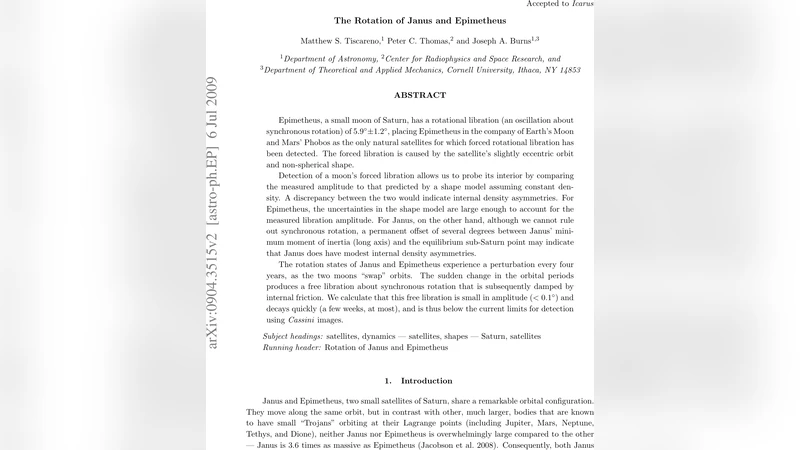
Epimetheus, a small moon of Saturn, has a rotational libration (an oscillation about synchronous rotation) of 5.9 +- 1.2 degrees, placing Epimetheus in the company of Earth’s Moon and Mars’ Phobos as the only natural satellites for which forced rotational libration has been detected. The forced libration is caused by the satellite’s slightly eccentric orbit and non-spherical shape. Detection of a moon’s forced libration allows us to probe its interior by comparing the measured amplitude to that predicted by a shape model assuming constant density. A discrepancy between the two would indicate internal density asymmetries. For Epimetheus, the uncertainties in the shape model are large enough to account for the measured libration amplitude. For Janus, on the other hand, although we cannot rule out synchronous rotation, a permanent offset of several degrees between Janus’ minimum moment of inertia (long axis) and the equilibrium sub-Saturn point may indicate that Janus does have modest internal density asymmetries. The rotation states of Janus and Epimetheus experience a perturbation every four years, as the two moons “swap” orbits. The sudden change in the orbital periods produces a free libration about synchronous rotation that is subsequently damped by internal friction. We calculate that this free libration is small in amplitude (<0.1 degree) and decays quickly (a few weeks, at most), and is thus below the current limits for detection using Cassini images.
💡 Research Summary
The paper presents a comprehensive investigation of the rotational dynamics of Saturn’s co‑orbital moons Janus and Epimetheus, focusing on both forced librations induced by orbital eccentricity and shape, and free librations triggered by the periodic orbital “swap” that occurs every four years. Epimetheus, with an eccentricity of roughly 0.009 and a pronounced triaxial shape (long‑axis to short‑axis ratio ≈ 1.09), exhibits a forced longitudinal libration of 5.9 ± 1.2 degrees. This amplitude matches the prediction derived from a three‑dimensional shape model that assumes a homogeneous interior, indicating that the current uncertainties in the shape model (surface topography, internal density distribution) are sufficient to explain the observed libration without invoking any significant internal density asymmetry. Consequently, while the detection of forced libration confirms the theoretical expectation that Epimetheus is in a state of synchronous rotation perturbed by its orbit, it does not yet provide a decisive probe of its interior structure.
Janus, by contrast, has a much smaller eccentricity (≈ 0.001) and a shape that is closer to spherical. The homogeneous‑density shape model predicts essentially zero forced libration, i.e., a perfect alignment of the minimum moment‑of‑inertia axis (the long axis) with the sub‑Saturn point. However, the authors identify a possible permanent offset of a few degrees between the observed long‑axis direction and the equilibrium sub‑Saturn direction. This offset could arise from either a slight deviation from exact synchronous rotation or, more intriguingly, from an internal density asymmetry such as a differentiated core‑mantle structure that displaces the principal inertia axis relative to the geometric long axis. Quantitative comparison suggests an offset in the range of 2–4 degrees, which, if confirmed, would be a rare indication of internal heterogeneity in a small, irregular satellite.
The orbital swap phenomenon—when Janus and Ephemerus exchange their semi‑major axes—produces an abrupt change in orbital period and consequently a sudden perturbation of the rotational state. The authors model the resulting free libration as a damped harmonic oscillator driven by internal friction. Assuming realistic values for the effective shear viscosity of the satellite material, they calculate an initial free‑libration amplitude of less than 0.1 degree and a decay timescale of only a few weeks (1–3 weeks). This rapid damping, combined with the small amplitude, places the free libration below the detection threshold of the Cassini Imaging Science Subsystem, whose angular precision is on the order of 0.2 degrees.
Overall, the study demonstrates that forced librations are a valuable diagnostic for probing the interior of small moons when the shape model is sufficiently constrained, as illustrated by Epimetheus. Janus, on the other hand, may harbor modest internal density variations that manifest as a measurable offset between its inertia axis and the sub‑Saturn direction. The transient free librations generated by the four‑year swap are theoretically interesting but observationally elusive due to their brief lifetime and minute amplitude. The authors conclude that future missions equipped with higher‑resolution imaging, radar sounding, or long‑baseline tracking could refine shape models, reduce uncertainties, and potentially detect the subtle rotational signals that betray the hidden interior structure of these enigmatic co‑orbital satellites.
Comments & Academic Discussion
Loading comments...
Leave a Comment