The Jordan-Brouwer theorem for the digital normal n-space Zn
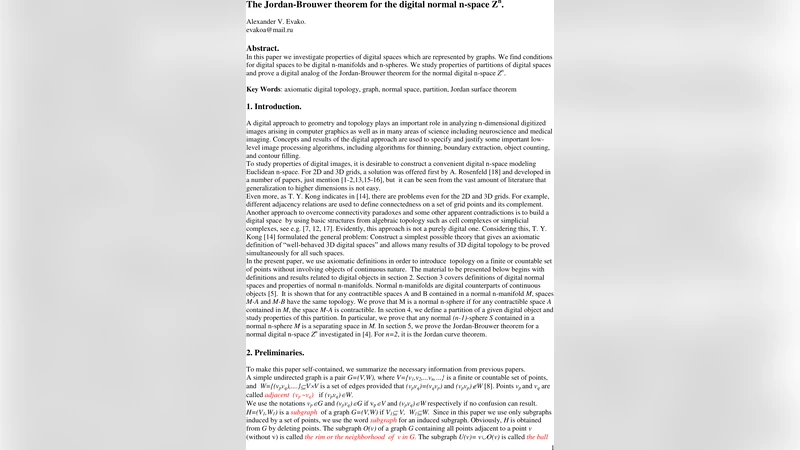
In this paper we investigate properties of digital spaces which are represented by graphs. We find conditions for digital spaces to be digital n-manifolds and n-spheres. We study properties of partitions of digital spaces and prove a digital analog of the Jordan-Brouwer theorem for the normal digital n-space Zn.
💡 Research Summary
The paper develops a purely graph‑theoretic framework for digital topology and uses it to prove a digital analogue of the Jordan‑Brouwer separation theorem in the normal digital n‑space (Z^{n}). The authors begin by recalling that a digital space can be modeled as a simple undirected graph (G=(V,W)) where vertices represent pixels (or voxels) and edges encode adjacency. They introduce the notions of rim (O(v)) (the set of neighbours of a vertex) and ball (U(v)={v}\cup O(v)). A graph is called contractible if a sequence of deletions of simple vertices (those whose rim is contractible) and simple edges reduces it to a single vertex. This notion plays the role of homotopy in classical algebraic topology.
Next, they define a normal 0‑sphere (S_{0}) as a disconnected graph consisting of two isolated vertices. Using recursion, a connected graph (M) is a normal (n)-manifold ((n>0)) if the rim of every vertex is a normal ((n-1))-sphere. Moreover, a normal (n)-manifold becomes a normal (n)-sphere when removal of any vertex yields a contractible graph. The removal of a vertex from a normal (n)-sphere produces a normal (n)-disk, whose boundary is precisely the rim of the removed vertex.
The authors prove several foundational results. Theorem 3.1 shows that the join (graph‑theoretic union with all cross‑edges) of a normal (m)-sphere and a normal (n)-sphere is a normal ((m+n+1))-sphere. This provides a constructive way to raise dimension by joining lower‑dimensional spheres. Theorem 3.2 establishes that deleting any contractible subgraph from a normal (n)-sphere leaves a contractible remainder; Theorem 3.3 shows that deleting an edge from a normal (n)-sphere yields a normal (n)-disk. These results give a robust toolbox for manipulating digital manifolds while preserving their topological type.
Section 4 introduces the concept of a partition (M=A\cup C\cup B) where (A) and (B) are non‑empty, disjoint subgraphs and (C) separates them. Theorem 4.1 proves that (M) is contractible iff both (A\cup C) and (C\cup B) are contractible. This mirrors the classical fact that a space is contractible exactly when each side of a separating subspace can be collapsed onto the separator. Theorem 4.2 and its corollary (Theorem 4.3) specialize to normal manifolds: any normal ((n-1))-sphere embedded in a normal (n)-sphere separates the ambient space into two normal (n)-disks. This is the digital counterpart of the Jordan‑Brouwer separation theorem.
The central object of the paper, the normal digital n‑space (Z^{n}), is defined in Section 5. Points are integer lattice points in (\mathbb{E}^{n}); two points are adjacent if each coordinate differs by at most one and the parity (odd/even) pattern of the coordinates coincides. Points whose coordinates are all odd or all even are called pure; all others are mixed. This adjacency coincides with the product of the Khalimsky topology on the integer line, providing a well‑studied digital topology that respects both axial and diagonal connections while avoiding paradoxes of mixed adjacency.
With the above machinery, the authors finally prove the Jordan‑Brouwer theorem for (Z^{n}): any normal ((n-1))-sphere embedded in (Z^{n}) separates the space into exactly two components, each homeomorphic (in the digital sense) to a normal (n)-disk. For (n=2) this reduces to the classic Jordan curve theorem. The proof proceeds by induction on dimension, repeatedly applying the partition results and the contractibility lemmas to show that removal of the separating sphere leaves a contractible remainder, which by definition is a digital disk.
Overall, the paper contributes a rigorous, purely combinatorial foundation for digital manifolds, establishes that the essential separation properties of Euclidean topology survive in the discrete setting, and provides constructive tools (joins, deletions of simple vertices/edges, partitions) that can be directly implemented in algorithms for image analysis, 3‑D reconstruction, and higher‑dimensional data segmentation. The normal space (Z^{n}) offers a canonical digital model of (\mathbb{R}^{n}) that avoids the ambiguities of earlier adjacency schemes, making the results broadly applicable to computational topology and digital geometry.
Comments & Academic Discussion
Loading comments...
Leave a Comment