On the relativistic unification of electricity and magnetism
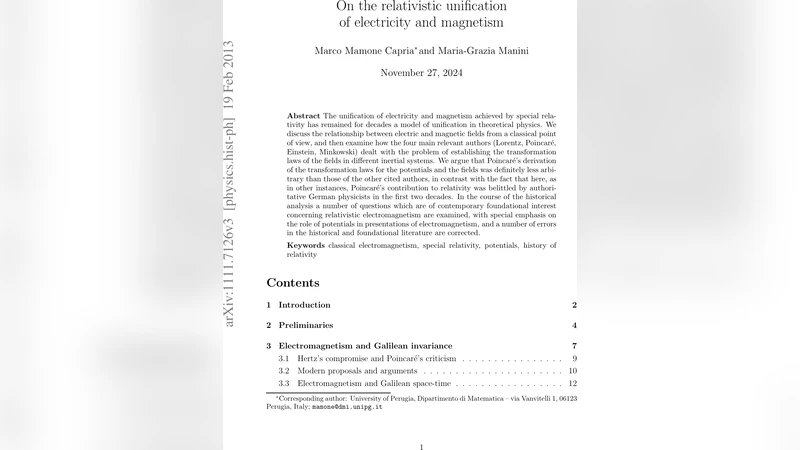
The unification of electricity and magnetism achieved by special relativity has remained for decades a model of unification in theoretical physics. We discuss the relationship between electric and magnetic fields from a classical point of view, and then examine how the four main relevant authors (Lorentz, Poincar'e, Einstein, Minkowski) dealt with the problem of establishing the transformation laws of the fields in different inertial systems. We argue that Poincar'e’s derivation of the transformation laws for the potentials and the fields was definitely less arbitrary than those of the other cited authors, contrast this with the fact that here, as in other instances, Poincar'e’s contribution to relativity was belittled by authoritative German physicists in the first two decades. In the course of the historical analysis a number of questions which are of contemporary foundational interest concerning relativistic electromagnetism are examined, with special emphasis on the role of potentials in presentations of electromagnetism, and a number of errors in the historical and foundational literature are corrected.
💡 Research Summary
The paper “On the Relativistic Unification of Electricity and Magnetism” offers a comprehensive historical‑technical study of how the electric and magnetic fields, originally described as separate three‑dimensional vectors, became unified into a single four‑dimensional entity within the framework of special relativity. After a brief classical introduction, the authors lay out Maxwell’s equations in the aether‑based MKS system, introduce the scalar and vector potentials (ψ, A), and recall the Lorenz gauge condition and the associated wave equations. They then present the Lorentz transformation (both forward and inverse) together with the induced transformation of differential operators, establishing the mathematical backbone for later discussions.
In the third section the authors demonstrate that Galilean transformations fail to preserve the form of Maxwell’s equations: while the magnetic Gauss law remains invariant, the Faraday law and the Ampère‑Maxwell law acquire extra terms involving the relative velocity V. This non‑covariance forces a revision of the classical theory and sets the stage for a relativistic treatment.
The historical core of the paper is Section 4, where the transformation laws derived by four key figures—Hendrik Lorentz, Henri Poincaré, Albert Einstein, and Hermann Minkowski—are examined in detail.
Lorentz (1904) is shown to have introduced the potentials with the Lorenz gauge and to have derived the field transformations by direct component‑wise calculation. However, his use of an arbitrary scaling factor l in the transformation matrix introduces a degree of indeterminacy that the authors deem unnecessary.
Poincaré’s 1905‑1906 work receives the most favorable assessment. He first establishes the transformation properties of the charge–current four‑vector and of the retarded potentials, then proves that the potentials themselves form a four‑vector. From this, the electric and magnetic field transformations follow automatically and match the Lorentz‑covariant form of Maxwell’s equations without any ad‑hoc assumptions. The paper highlights Poincaré’s explicit use of the retarded (or “delayed”) potentials, which makes his derivation both physically transparent and mathematically rigorous.
Einstein’s 1905 paper is acknowledged for presenting the field transformation directly from the principle of relativity, yet the authors note that Einstein does not discuss the potentials at all, leaving the underlying four‑vector structure implicit. Consequently, his derivation, while correct, relies more on intuition than on a systematic construction of the underlying geometric objects.
Minkowski (1907‑1908) is praised for introducing the four‑dimensional spacetime formalism and the electromagnetic field tensor F_{μν}. By treating the fields as components of an antisymmetric tensor, Minkowski achieves a fully covariant formulation. However, he does not revisit the potentials, so the link between the four‑potential and the tensor is not made explicit in his original work.
Section 5 critiques modern textbook presentations that often downplay the role of the potentials or present the transformation laws as “arbitrary” rather than as consequences of a well‑defined four‑vector structure. The authors correct several misconceptions that have propagated in the historical and foundational literature.
An appendix (Section 6) investigates the origin of the phrase “Lorentz’s theorem of relativity,” showing how early German physicists promoted Lorentz’s name while marginalizing Poincaré’s contributions, a bias the authors argue has persisted in some secondary sources.
In the concluding remarks, the authors argue that Poincaré’s derivation is the least arbitrary and most conceptually clear, providing the earliest complete demonstration that the electromagnetic potentials constitute a four‑vector and that the Maxwell equations are Lorentz‑covariant. They call for a reassessment of historical credit, emphasizing that accurate attribution matters for both the philosophy of science and the teaching of modern physics.
Comments & Academic Discussion
Loading comments...
Leave a Comment