Vertex unfoldings of tight polyhedra
An unfolding of a polyhedron along its edges is called a vertex unfolding if adjacent faces are allowed to be connected at not only an edge but also a vertex. Demaine et al showed that every triangulated polyhedron has a vertex unfolding. We extend t…
Authors: Toshiki Endo, Yuki Suzuki
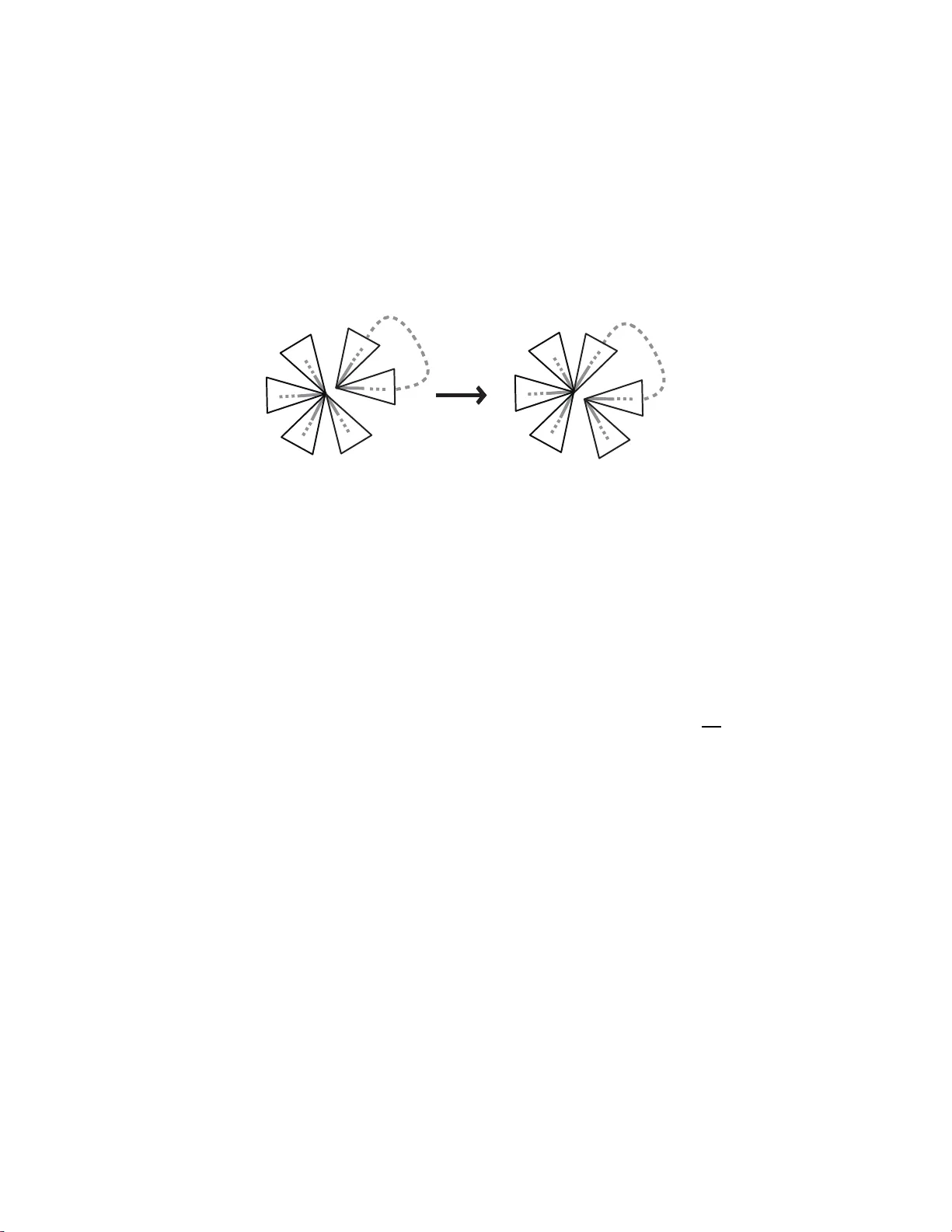
V ertex unfoldings of tigh t p olyhedra T oshiki Endo ∗ Y uki Suzuki † Abstract The unfolding of a p olyhedr on a long its edges is known a s a vertex unfolding if adjacent faces are allow ed to b e connected not only at an e dg e but als o at a vertex. Demaine et al. [1] showed t hat e v ery triang ula ted poly hedron has a vertex unfolding. W e extend this r esult to a tight p olyhedron, wher e a po lyhedron is tight if its non- triangular faces are m utually non-inciden t. 1 In tro duction W e in v estigate a pro cedur e to cut op en a p olyhedron along its ed ges and un fold it to a connected flat p iece without o v erlap. The unfolding needs to consist of th e faces of the p olyhedron joined along the edges. This t yp e of un f olding has b een r eferred to as e dge unfolding or simply unfolding . It is kno wn that some non-con v ex p olyhedra h av e no edge unfoldings. Ho we v er, no example of a conv ex p olyhedron th at h as no edge u nfolding is kno wn. Th e determination of w hether ev ery conv ex p olyhedron has an edge u nfolding is a long-standing op en pr oblem. The difficult y of this qu estion led to the exploration of other unfoldings that ha v e a broader d efinition of edge u nfolding. W e pay atten tion to a vertex unfolding that p ermits t wo faces joined not only at an edge but also at a v ertex, that is, the resulting piece may ha ve a disconnected interior. See [2, § 22] for details of edge un folding and v ertex un folding. In [1], Demaine et al. show ed the follo wing, w here they pro ved conclusiv ely that P do es not n eed to b e a p olyhedron, but ma y b e a connected triangulated 2-manifold, p ossib ly with b oundaries. Theorem 1.1 (Demaine et al [1]) L et P b e a p olyhe dr on. If P is triangulate d, then it has a vertex unfolding. W e br oadly describ e the p r o of of Theorem 1.1 here and describ e it in detail in the follo wing sections. Their algorithm [1] first fi nds a spanning p ath from triangle to triangle on the surface of th e p olyhed ron, connecting through common v ertices, and fu rther, la ys out the triangles along a line without o verla p. Their metho d is b ased on the condition that all faces are triangular, and the existences of the face path and the lin e-la y ou t of it might actually fail for a p olyhedr on with n on- triangular faces. F or example, the truncated cub e has no face path since its six o ctagons are inadequate to la y out eigh t triangles along a line, an d if a face path consists of isosceles trap ezoids, a local o v erlap migh t occur in a long strip. ∗ Jiyu Gakuen College, end@prf.jiyu. ac.jp † F acult y of Science Division I I, T ok yo Univ ersit y of Science, j2111076@ed.tus.ac .jp 1 In t his paper, w e fix these problems and mak e progress on Theorem 1.1 for a p olyhedron with non-triangular faces. A (p ossibly non-con v ex) p olyhedr on P is tight if no t wo non- triangular faces share a v ertex. Examples of tigh t p olyhedra are the snub cub e, snub do decahedron, p yramids, and ant iprisms. The main theorem in this pap er is as follo ws. Theorem 1.2 L et P b e a p olyhe dr on. If P is tig ht, then it has a vertex unfolding. Figure 1 sho ws a v ertex u nfolding of the p ent agonal anti prism. Our pro of basically dep end on the metho d in [1]. W e will d escrib e it in Sections 2-4. Ou r new r esult is a graph theoretical part of it, wh ic h is con tained in Section 2. Figure 1: V ertex un folding of the p entag onal an tiprism 2 Hamiltonian v ertex-face tour In this section, we observe tight p olyhedra from a graph theoretical standp oint. W e u s e standard terminology and notations of graph theory , for examples, see [3]. By S teinitz’s theorem, a surf ace of a p olyhedron corresp onds to a 3-connected p lane graph. Thus, we also call a 3-connected plane graph tight if its non-triangular faces are mutually non-incident. W e prepare some m ore definitions. Let G b e a tigh t graph. A d isjoin t union T of closed alternating sequences of v ertices v i and faces f i of G is called a sp anning vertex-fac e tour if eac h face of G app ears exactly once in T and eac h closed comp onent ( v 1 , f 1 , v 2 , f 2 , · · · , v k , f k , v 1 ) satisfies that v i and v i +1 are distinct and b oth are inciden t to the face f i for i = 1 , 2 , · · · , k (indices are tak en mo d ulo k ). Some vertex of G may b e rep eated in T ; con v er s ely , some v ertex ma y not app ear in T . If a spanning vertex- face tour T is connected, th en T is called a Hamiltonian vertex-fac e tour . Next, we define t wo op er ations on a spannin g vertex-fac e tour T . Le t f = uv x and f ′ = uv y b e tw o adjacen t triangular faces of G . W e refer to the op eration of replacing ( u, f , x ) and ( v , f ′ , y ) with ( v , f , x ) and ( u, f ′ , y ), resp ectiv ely , as th e switching op eration, and the op eration of replacing ( u, f , x ) and ( u, f ′ , y ) w ith ( v , f , x ) and ( v , f ′ , y ), resp ectiv ely , as the r efle cting op eration (Figure 2). Note that sim ultaneous c h anging of com binations b et w een v ertices and faces at sev eral triangular faces of T , suc h as in a switching op eration or reflecting op eration, ma y p ro duce another spannin g verte x-face tour T ′ . In general, we refer to su c h op erations as triangular r e c ombinations . First, w e p ro ve the follo wing lemma. Lemma 2.1 L e t G b e a tight gr aph. L et F ∗ = { f 1 , f 2 , · · · , f m } b e the set of al l non- triangular fac es of G , and let v i and v ′ i b e distinct vertic es of f i for i = 1 , 2 , · · · , m . If G has a sp anning v e rtex-fac e tour T , then G has a sp anning vertex-fac e tour T ′ c ontaining e ach ( v i , f i , v ′ i ) for i = 1 , 2 , · · · , m . 2 u u u u v v v v x x x x y y y y Figure 2: S witc hin g op eration (left) and reflecting op eration (righ t) Pr oof. F or simplicit y , let f = v 1 v 2 · · · v n denotes an y n on-triangular face of G . Let g i b e the triangular f ace adjacen t to f b y sharin g v i v i +1 for i = 1 , 2 , · · · n (ind ices are tak en mo dulo n ), and let u i b e the remaining vertex of g i for i = 1 , 2 , · · · n . W e only h av e to sho w that if T con tains ( v 1 , f , v k ) for some 2 ≤ k ≤ n − 1, then T can b e con verted to a spanning vertex- face tour T ′ con taining ( v 1 , f , v k +1 ) instead of ( v 1 , f , v k ) b y p erforming only triangular r ecombinatio ns. Case 1: T con tains ( u k , g k , v k ) or ( u k , g k , v k +1 ). In this case, we can obtain T ′ from T by r eplacing ( v 1 , f , v k ) with ( v 1 , f , v k +1 ), and sim ultaneously b y replacing ( u k , g k , v k ) with ( u k , g k , v k +1 ) in the form er case and ( u k , g k , v k +1 ) with ( u k , g k , v k ) in the latter case. Case 2: T con tains ( v k , g k , v k +1 ). In this case, we c h eck the triangular faces inciden t to v i from i = k + 1 , k + 2 , · · · , n − 1 , n , 1 , 2 , · · · , k in tu r n. F or i = k + 1 , k + 2 , · · · , n − 1 , n, 1 , 2 , · · · , k , if they exist, let h 1 i , · · · , h p i − 3 i b e the triangular faces incident to v i b et w een g i − 1 and g i and opp osite to f in cyclic order, wh ere p i = deg v i , and let w 1 i , w 2 i , · · · , w p i − 4 i b e the ve rtices in ciden t to v i from u i − 1 to u i . First, we examine the triangular faces in ciden t to v k +1 . If T con tains ( u k , h 1 k +1 , w 1 k +1 ), then th e sw itc hing op eration at g k and h 1 k +1 leads this case to Case 1. I f T conta ins ( v k +1 , h 1 k +1 , w 1 k +1 ), th en th e reflecting op eration at g k and h 1 k +1 again leads this case to Case 1. T h us, T m ust conta in ( v k +1 , h 1 k +1 , u k ). By rep eating this argument, w e can sa y that T con tains ( v k +1 , g k +1 , u k +1 ). Second, we chec k the triangular faces incident to v k +2 , and we can sa y that T con- tains ( v k +2 , g k +2 , u k +2 ). Rep eating this argu m en t, we fi nally deduce that T con tains ( v k , h p k − 3 k , w p k − 4 k ). Thus, w e can apply the r eflecting op eration at h p k − 3 k and g k , whic h leads this case to Case 1. Remark 2.2 In the pro of of Lemma 2.1 , we can choose a triangular face f as a mem b er of F ∗ if the f aces incident to f are all triangular faces. Next, w e pr ov e the follo wing lemma. Lemma 2.3 L e t G b e a plane triangulation. Then G has a sp anning vertex-fac e tour T . In order to pro v e Lemma 2.3, we use W agner’s theorem [4 ], which states that eve ry triangulation can b e tran s formed into the stand ard triangulation b y a fi nite sequence of diagonal fl ips. Here, the op eration diagonal flip is defined as follo ws. Let uv b e an edge of a triangulation G . Let uv x and uv y b e the faces inciden t to uv . Then x and y are d istinct v ertices unless = K 3 . If x an d y are n ot adj acen t, then a diagonal fl ip is p erformed to 3 obtain a new triangulation G ′ from G by deleting uv and adding th e edge xy (Figure 3). The standard triangulation is defin ed as illustrated in Figure 4. Note that the standard triangulation has a Hamiltonian ve rtex-face tour. u v x y u v x y Figure 3: Diagonal fl ip Figure 4: S tandard triangulation and Hamiltonian verte x-face tour (gra y line) Pr oof. Let f 1 = v 1 v 2 v 3 and f 2 = v 3 v 4 v 1 b e t w o adjacen t faces of G , G ′ b e the trian- gulation obtained fr om G by p erforming the diagonal flip at v 1 v 3 , and f ′ 1 = v 2 v 3 v 4 and f ′ 2 = v 4 v 1 v 2 b e the n ew faces of G ′ . F rom W ag ner’s theorem and the f act in Figure 4, w e only ha v e to show that if G h as a spanning v ertex-face tour T then G ′ has a spann ing v ertex-face tour T ′ . Let g 1 and g 2 b e triangular faces of G that are adjacent to f 1 b y sharing v 1 v 2 and v 2 v 3 , resp ectiv ely , let g 3 and g 4 b e triangular faces of G that are adjacen t to f 2 b y sharing v 3 v 4 and v 4 v 1 , r esp ectiv ely , and let u i b e the remaining vertex of g i for i = 1 , 2 , 3 , 4. If they exist, let h 1 i , h 2 i , · · · , h p i − 3 i for i = 2 , 4 and h 1 i , h 2 i , · · · , h p i − 4 i for i = 1 , 3 b e the triangular faces that are incident to v i and b et ween g i − 1 and g i but opp osite to f 1 and f 2 in cyclic order, where p i = deg G v i . Let w 1 i , w 2 i , · · · , w p i − 4 i for i = 2 , 4 and w 1 i , w 2 i , · · · , w p i − 5 i for i = 1 , 3 b e the vertic es incident to v i from u i − 1 to u i . W e divide the p ro of into four cases. Case 1: T con tains ( v 2 , f 1 , v 3 ) and ( v 4 , f 2 , v 1 ). In this case, w e can obtain T ′ from T by replacing ( v 2 , f 1 , v 3 ) and ( v 4 , f 2 , v 1 ) with ( v 2 , f ′ 1 , v 3 ) and ( v 4 , f ′ 2 , v 1 ), resp ectiv ely . Case 2: T con tains ( v 1 , f 1 , v 3 ) and ( v 4 , f 2 , v 1 ). W e consider the triangular faces incident to v 2 from g 1 to g 2 in turn. If T con tains ( u 1 , g 1 , v 2 ), then the switc hing op eration at f 1 and g 1 leads the case to C ase 1. I f T con tains ( u 1 , g 1 , v 1 ), then the reflecting op er ation at f 1 and g 1 again leads th e case to Case 1. T h us, T m u s t con tain ( v 2 , g 1 , v 1 ). Next, w e consider h 1 2 and similarly w e can sa y that T m ust conta in ( v 2 , h 1 2 , u 1 ); b y rep eating this argument until we reac h g 2 , w e can say that T con tains ( v 2 , g 2 , u 2 ). 4 F urther, w e examine the triangular faces inciden t to v 3 , and similarly we can sa y that T con tains ( v 3 , h 1 3 , u 2 ) , ( v 3 , h 2 3 , w 1 3 ) , · · · , ( v 3 , g 3 , u 3 ). Rep eating this argument for v 3 , v 4 , and finally v 1 in turn , w e can say that T cont ains ( v 1 , h p 1 − 4 1 , w p 1 − 5 1 ). Thus, we can apply th e reflecting op eration at g 1 and h p 1 − 4 1 . Case 3: T con tains ( v 1 , f 1 , v 2 ) and ( v 4 , f 2 , v 1 ). In this case, w e consid er the triangular faces incident to v 3 from g 2 to g 3 in turn. If T con tains ( u 2 , g 2 , v 3 ), then the switching op eration at f 1 and g 2 leads the case to Case 2. If T con tains ( u 2 , g 2 , v 2 ), then th e reflecting op eration at f 1 and g 2 again leads the case to C ase 2. Th us, T m us t con tain ( v 3 , g 2 , v 2 ). S im ilarly , w e can say that T con tains ( v 3 , h 1 3 , u 2 ) , ( v 3 , h 2 3 , w 1 3 ) , · · · , ( v 3 , g 3 , u 3 ). Th us, if we p erform the switching op eration at g 3 and f 2 , the situation b ecomes a symmetric v ersion of Case 2. Case 4: T con tains ( v 1 , f 1 , v 3 ) and ( v 3 , f 2 , v 1 ). In this case, w e consid er the triangular faces incident to v 3 from g 2 to g 3 in turn. If T conta ins ( u 2 , g 2 , v 2 ), th en the switc hing op eration at f 1 and g 2 leads the case to the symmetric ve rsion of Case 2. If T cont ains ( u 2 , g 2 , v 3 ), then the r efl ecting op eration at f 1 and g 2 again leads the case to the s y m metric v ers ion of Case 2. Thus, T must conta in ( v 3 , g 2 , v 2 ). S imilarly , we can say that T conta ins ( v 3 , h 1 3 , u 2 ) , ( v 3 , h 2 3 , w 1 3 ) , · · · , ( v 3 , g 3 , u 3 ). Th us, if we apply the r eflecting op eration at g 3 and f 2 , the situation b ecomes the same as Case 2. Lemma 2.4 L e t G b e a tight gr aph. Then G has a sp anning vertex-fac e tour T . Pr oof. W e p r o ve this b y applying a double-induction on the size and the num b er of the maxim u m face of G . Case 1: G has no non-triangular f aces. This case follo ws fr om Lemma 2.3. Case 2: Th e maximum face size of G is at least four. Let f = v 1 v 2 · · · v n b e a f ace with the maximum size ( n ≥ 4). F rom the planarity of G , w e m a y assum e that G ′ = G + v 1 v 3 is tight. Let f ′ = v 1 v 2 v 3 and f ′′ = v 3 v 4 · · · v n v 1 b e the new f aces of G ′ . F rom the inductive h yp othesis, G ′ has a spann ing v ertex-face tour T ′ . W e sho w that G has a spanning vertex-fac e tour T . F rom Lemma 2.1 and Remark 2.2, w e ma y assume that T ′ con tains ( v 1 , f ′′ , v 3 ). There- fore, if T ′ con tains ( v 2 , f ′ , v 1 ), then w e can obtain T fr om T ′ b y replacing ( v 2 , f ′ , v 1 ) and ( v 1 , f ′′ , v 3 ) with ( v 2 , f , v 3 ); the case where T ′ con tains ( v 2 , f ′ , v 3 ) is similar. Thus, w e ma y assume that T ′ con tains ( v 1 , f ′ , v 3 ). W e consider the tr iangular faces incident to v i from i = 3 , 4 , · · · , n in turn. Let g 2 b e the triangular face adjacen t to f ′ sharing v 2 v 3 , and for i = 3 , 4 , · · · , n , let g i b e the triangular face adjacen t to f ′′ sharing v i v i +1 (indices are take n m o d ulo n ). F urth er , let u i b e the remaining vertex of g i for i = 2 , 3 , · · · n . First, we examine th e triangular faces in ciden t to v 3 from g 2 to g 3 . If they exist, let h 1 3 , h 2 3 , · · · , h p 3 − 4 3 b e the tr iangular faces b et w een g 2 and g 3 in cyclic order, where p 3 = deg G ′ v 3 , and let h 1 3 = v 3 u 2 w 1 3 , h j 3 = v 3 w j − 1 3 w j 3 for j = 2 , 3 , · · · , p − 6, and h p − 4 3 = v 3 w p − 5 3 u 3 . If T ′ con tains ( v 2 , g 2 , u 2 ), then the switc h ing op eration at f ′ and g 2 yields a new spann ing v ertex-face tour contai ning ( v 1 , f ′ , v 2 ), and if T ′ con tains ( v 3 , g 2 , u 2 ), th en the reflecting op eration at f ′ and g 2 yields a new v ertex-face tour con taining ( v 1 , f ′ , v 2 ), and in b oth cases, we can obtain T by replacing ( v 1 , f ′ , v 2 ) and ( v 1 , f ′′ , v 3 ) with ( v 2 , f , v 3 ). Th us, T ′ 5 m ust con tain ( v 3 , g 2 , v 2 ). By rep eating this argumen t from h 1 3 to g 3 , w e can sa y that T ′ con tains ( v 3 , g 3 , u 3 ). Thus, w e can obtain a new v ertex-face tour by replacing ( v 1 , f ′′ , v 3 ) and ( v 3 , g 3 , u 3 ) with ( v 1 , f ′′ , v 4 ) and ( v 4 , g 3 , u 3 ), resp ectiv ely . I n this case, w e can obtain T b y r ep lacing ( v 1 , f ′ , v 3 ), ( v 1 , f ′′ , v 4 ) with ( v 3 , f , v 4 ). Lemma 2.5 L e t G b e a tight gr aph. L et F ∗ = { f 1 , f 2 , · · · , f m } b e the set of al l non- triangular fac es of G , and let v i and v ′ i b e distinct vertic es of f i for i = 1 , 2 , · · · , m . If G has a sp anning vertex-fac e tour T ′ c ontaining e ach ( v i , f i , v ′ i ) for i = 1 , 2 , · · · , m , then G has a Hamiltonian vertex-fac e tour T ′′ c ontaining e ach ( v i , f i , v ′ i ) for i = 1 , 2 , · · · , m . Pr oof. W e sho w that T ′ can b e con v erted to b e a conn ected s p anning v ertex-face tour b y p erforming only a ser ies of triangular recom b inations. Sup p ose that T ′ is disconnected at t wo adjacen t faces g 1 and f 1 . W e m a y assume that g 1 = v 1 v 2 u 1 is a triangular face. Let f 1 = v 1 v 2 · · · v n . W e d ivide th e p ro of int o t w o cases. Case 1: n = 3. In this case, we ma y assume that t w o comp onen ts of T ′ con taining ( v 1 , g 1 , u 1 ) and ( v 2 , f 1 , v 3 ) are disconnected. Th us, we can mak e the t wo comp onent s connected by p er- forming the switc hing op eration at g 1 and f 1 . Case 2: n ≥ 4. Supp ose that T ′ con tains ( v k 1 , f 1 , v k 2 ) for some k 1 and k 2 . Then T ′ m ust con tain ( v k 1 , h l k 1 , w l ) for some triangular face h l k 1 inciden t to v k 1 , and for some vertex w l of h l k 1 . No w, h l k 1 is connected to g 1 b y a p ath of triangular faces, and it holds from C ase 1 that they can b ecome connected by triangular recom binations. Our goal is the follo win g. Theorem 2.6 L et G b e a tight gr aph . L et F ∗ = { f 1 , f 2 , · · · , f m } b e the set of al l non- triangular fac es of G , and let v i and v ′ i b e distinct vertic es of f i for i = 1 , 2 , · · · , m . Then G has a Hamiltonian vertex-fac e tour c ontaining e ach ( v i , f i , v ′ i ) for i = 1 , 2 , · · · , m . Pr oof. Let G b e a tigh t graph. F r om Lemma 2.4, G has a spann ing v ertex-face tour T . Then, f rom Lemma 2.1, G has a spannin g v ertex-face tour T ′ con taining eac h ( v i , f i , v ′ i ). Th us, from Lemma 2.5, G has a Hamiltonian v ertex-face tour T ′′ con taining eac h ( v i , f i , v ′ i ). 3 Non-crossing Hamiltonian face p ath F or a p olyhedron P and its graph G , a Hamiltonian v ertex-face tour of G guarantee s an exis- tence of a path of the faces of P . W e call it a Hamiltonian fac e p ath of P . How ev er, the path migh t cross itself in the sense th at it con tains th e pattern ( · · · , f 1 , v , f 3 , · · · , f 2 , v , f 4 , · · · ) with the faces f 1 , f 2 , f 3 , f 4 inciden t to a v ertex v app earing in cyclic order. T h is mak e it physic ally imp ossible for the faces of an unf olding to b e a sin gle piece. Hence, w e need to detect a non-crossing p ath. A face p ath of P (lik ewise, a vertex-fac e tour of G ) is non-cr ossing if it h as n o patterns as that describ ed ab o ve. Lemma 3.1 In The or em 2 . 6 , any H amiltonian vertex-f ac e tour of G c an b e c onverte d to a non-cr ossing one. 6 Pr oof. This is conta ined in [1]. The key p oint of the p ro of is as follo ws. Supp ose that a Hamiltonian v ertex-face tour T crosses at a vertex v . Let f 1 , f 2 , · · · b e the faces passing through v in T in cyclic order. W e remo v e the face path of ( · · · , f 1 , v , f 2 , · · · ) from T as depicted in Figure 5. If the resulting tour is disconn ected, then w e r emo ve the face path of ( · · · , f 2 , v , f 3 , · · · ) instead of the ab o ve from T suc h that the resu lting tour is connected. By rep eating this op eration at ev ery v ertex of G , w e obtain a n on-crossing Hamiltonian v ertex-face tour. f 1 f 2 f 3 f 1 f 2 f 3 Figure 5: Conv erting a Hamiltonian v ertex-face tour in to a non-crossing one 4 La y out of a face path In this section, we exhibit the pro cedure to lay out the faces of a tight p olyhedron P to form a vertex un folding. First, we show the follo win g. Lemma 4.1 L e t F b e a (p ossibly non-c onvex) p olygon with four sides or mor e . Then, ther e ar e two vertic es u, v of F and an arr angement of F in a vertic al interval of the plane with u and v on i ts left and right b oundaries, r esp e ctively. Pr oof. W e only ha v e to choose u and v su c h th at the length of segmen t uv is longest among all diagonals and edges of F . Pr oof of Theorem 1.2. Let P b e a tight p olyhedron. Consider the graph G of P . F rom L emm a 3.1, G has a non-crossing Hamiltonian verte x-face tour T . Let T b e the corresp onding face path of P . W e may assume from Theorem 2.6 that T uses the v ertices of Lemma 4.1 in eac h non-triangular face. No w, w e can arrange the f aces as follo ws; this is a consequence of Lemma 22.6.2 in textb o ok [2]. S upp ose indu ctivel y that P has b een laid out along a line up to face f i − 1 with all faces left of v ertex v i , wh ic h is the righ tmost v ertex of f i − 1 . Let ( v i , f i , v i +1 ) b e the next face in T . If f i is a triangular face, rotate f i around v i suc h that f i lies horizonta lly b et w een or at the same horizon tal coord inate as v i and v i +1 . If f i is a non-triangular face, w e can use Lemma 4.1. Rep eating this pro cess along T pro du ces a non-ov erlapping lay out of the faces of P . Thus, P has a v ertex u nfolding. References [1] E. D. Demaine, D. Ep pstein, G. W. Hart, and J. O’Rourke , V ertex-unfoldings of simpli- cial m an if olds , in Discrete Geometry (ed. And ras Bezdek), Marcel Dekk er, New Y ork, 2003, 215–2 28. 7 [2] E. D. Demaine and J. O’Rour k e, Geometric F olding Algorithms: Link ages, Origami, P olyhedra, Cam b r idge Univ ersity Pr ess, Cam b ridge (2007). [3] R. Diestel, Graph Th eory (3e), Graduate T exts in Mathematics No. 173, S pringer (2005 ). [4] K. W agner, Bemerkung zum Vierfarb enpr oblem, Jb er. Deutsch. Math.-V erein. 46 (1936 ), 26–32. 8
Original Paper
Loading high-quality paper...
Comments & Academic Discussion
Loading comments...
Leave a Comment