High-Resolution X-ray Spectroscopy of the Interstellar Medium
The interstellar medium (ISM) has a multiphase structure characterized by gas, dust and molecules. The gas can be found in different charge states: neutral, low-ionized (warm) and high-ionized (hot).
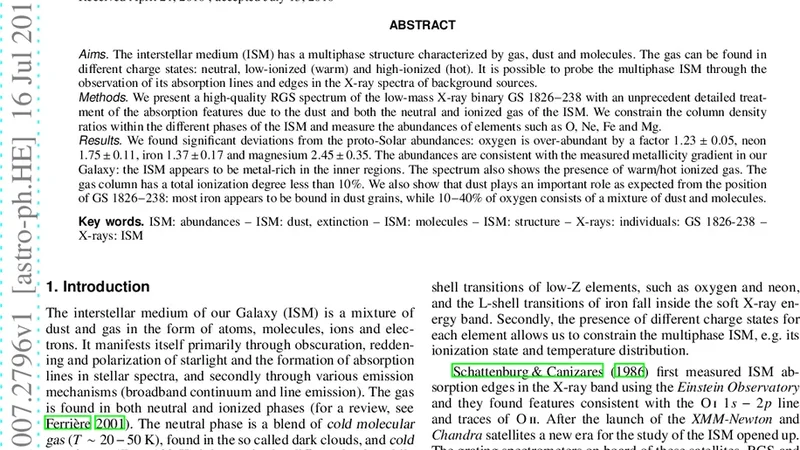
The interstellar medium (ISM) has a multiphase structure characterized by gas, dust and molecules. The gas can be found in different charge states: neutral, low-ionized (warm) and high-ionized (hot). It is possible to probe the multiphase ISM through the observation of its absorption lines and edges in the X-ray spectra of background sources. We present a high-quality RGS spectrum of the low-mass X-ray binary GS 1826-238 with an unprecedent detailed treatment of the absorption features due to the dust and both the neutral and ionized gas of the ISM. We constrain the column density ratios within the different phases of the ISM and measure the abundances of elements such as O, Ne, Fe and Mg. We found significant deviations from the proto-Solar abundances: oxygen is over-abundant by a factor 1.23 +/- 0.05, neon 1.75 +/- 0.11, iron 1.37 +/- 0.17 and magnesium 2.45 +/- 0.35. The abundances are consistent with the measured metallicity gradient in our Galaxy: the ISM appears to be metal-rich in the inner regions. The spectrum also shows the presence of warm/hot ionized gas. The gas column has a total ionization degree less than 10%. We also show that dust plays an important role as expected from the position of GS 1826-238: most iron appears to be bound in dust grains, while 10-40% of oxygen consists of a mixture of dust and molecules.
💡 Research Summary
The authors present a comprehensive high‑resolution X‑ray spectroscopic study of the interstellar medium (ISM) along the line of sight to the low‑mass X‑ray binary GS 1826‑238, using the Reflection Grating Spectrometer (RGS) aboard XMM‑Newton. The long exposure (≈200 ks) yields a spectrum with a signal‑to‑noise ratio of ~30 across the 6–38 Å band, allowing the detection and precise modeling of absorption features from neutral gas, warm (low‑ionized) gas, hot (high‑ionized) gas, and interstellar dust.
The analysis proceeds in several steps. First, the intrinsic continuum of GS 1826‑238 is modeled with a combination of a blackbody and a Comptonized component, ensuring that residuals are attributable to ISM absorption. Next, the neutral gas column is constrained by the depths of the O I K‑edge (≈23.5 Å) and the Fe L‑edge (≈17–18 Å). Warm gas is traced by He‑like and H‑like lines of O VII, O VIII, and Ne IX, while hot gas contributes only weakly through higher‑ionization lines such as Fe XXV, indicating that the total ionized fraction of the line‑of‑sight column is below 10 %.
A key novelty of the work is the explicit treatment of dust. The authors build a composite dust model using laboratory‑measured X‑ray optical constants for silicates, iron oxides, graphite, and other astrophysically relevant minerals. By fitting the fine structure around the O K‑edge, Fe L‑edge, and Mg K‑edge, they determine that roughly 70–80 % of the iron resides in solid grains, while 10–40 % of the oxygen is bound in dust or molecular compounds (e.g., H₂O, CO, SiO₂). This result is consistent with the source’s low Galactic latitude (l≈9°, b≈−6°), which implies a dust‑rich sight line.
Elemental abundances are derived by jointly fitting the edge depths and line equivalent widths, taking into account the contributions from all gas phases and dust. Relative to proto‑solar abundances (Lodders 2003), the ISM along this sight line is enriched in oxygen (1.23 ± 0.05), neon (1.75 ± 0.11), iron (1.37 ± 0.17), and magnesium (2.45 ± 0.35). These over‑abundances match the expected metallicity gradient of the Milky Way, where inner‑Galaxy regions exhibit higher metal content (∂
📜 Original Paper Content
🚀 Synchronizing high-quality layout from 1TB storage...