Higher dimensional algebras via colored PROPs
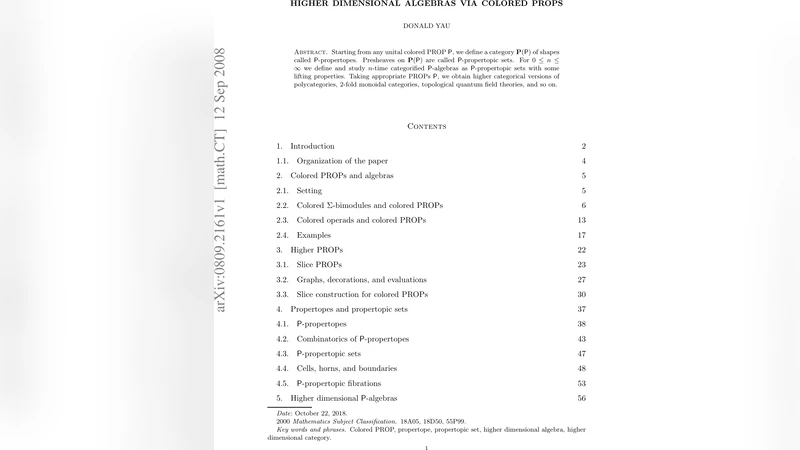
Starting from any unital colored PROP $P$, we define a category $P(P)$ of shapes called $P$-propertopes. Presheaves on $P(P)$ are called $P$-propertopic sets. For $0 \leq n \leq \infty$ we define and study $n$-time categorified $P$-algebras as $P$-propertopic sets with some lifting properties. Taking appropriate PROPs $P$, we obtain higher categorical versions of polycategories, 2-fold monoidal categories, topological quantum field theories, and so on.
💡 Research Summary
The paper introduces a unified framework for constructing and studying higher‑dimensional algebraic structures by exploiting the flexibility of colored PROPs. Starting from an arbitrary unital colored PROP P, the authors first define a small category P(P) whose objects are “P‑propertopes”, combinatorial shapes that encode the input‑output arities and the colors (or types) of the operations in P. Morphisms in P(P) are generated by face inclusions and compositions that respect both the horizontal and vertical composition laws of the PROP as well as the color‑preserving constraints. In this way P(P) plays the role of an indexing category for higher‑dimensional cells, analogous to the simplex category for simplicial sets or the opetopic shape category for opetopic sets, but enriched by the algebraic data of P.
Presheaves on P(P) are called P‑propertopic sets. Concretely, a P‑propertopic set X assigns to each propertopic shape σ a set X(σ) of “σ‑cells” and to each morphism α:σ→τ a restriction map X(τ)→X(σ). This presheaf viewpoint provides a natural setting for defining higher‑dimensional objects because the combinatorial structure of the shapes already records the typing information required for the operations of P. The authors verify that the presheaf category is complete and cocomplete, and they describe representable propertopic sets via the Yoneda embedding, which will serve as the basic building blocks for free constructions.
The central innovation is the notion of an “n‑times categorified P‑algebra” (or n‑fold categorified P‑algebra). For a fixed integer n with 0 ≤ n ≤ ∞, an n‑times categorified P‑algebra is a P‑propertopic set that satisfies a family of horn‑filling conditions up to dimension n. A horn in this context is a partial propertopic cell where all but one of its faces have been specified; a filler is a full cell extending the horn. The required lifting property generalizes the inner‑horn condition of quasi‑categories (Joyal) and the Kan condition of simplicial sets, but it is refined to respect the colored PROP structure: a filler must exist only when the colors of the missing face match those dictated by the surrounding data. When n = ∞, the object is an ∞‑P‑algebra, i.e. a fully weak higher‑dimensional algebra over P.
By choosing particular PROPs, the authors recover many familiar higher‑categorical structures as special cases.
-
Polycategories: Taking P to be the PROP that encodes polycategorical composition yields, for n = 1, precisely the usual notion of a polycategory.
-
2‑fold monoidal categories: Selecting a PROP that presents two independent monoidal products (with appropriate interchange constraints) gives, for n = 2, a model of a 2‑fold monoidal ∞‑category.
-
Topological quantum field theories: Using the cobordism PROP (objects are (d‑1)‑manifolds, morphisms are d‑dimensional cobordisms) produces n‑times categorified algebras that model d‑dimensional TQFTs at all higher categorical levels; the k‑cells correspond to k‑dimensional cobordisms with prescribed boundary data.
-
Higher operadic algebras: When P is an operadic PROP (e.g., the little‑disks PROP), the framework yields higher‑dimensional versions of operad algebras, with homotopy‑coherent compositions encoded by the horn‑filling conditions.
To handle the infinite‑dimensional case, the authors equip the presheaf category with a model structure. Cofibrations are monomorphisms, fibrations are maps with the right lifting property against a set of generating horn inclusions, and all objects are fibrant. This model structure mirrors the Joyal model structure on simplicial sets but is adapted to the colored PROP context. Consequently, homotopy‑theoretic tools such as derived mapping spaces, homotopy limits, and colimits become available for studying ∞‑P‑algebras.
The paper also discusses technical subtleties, such as defining “colored horns” (partial cells respecting color matching) and proving that the horn‑filling axioms are stable under composition and base change. The authors provide explicit combinatorial descriptions of low‑dimensional propertopes, illustrate how the face maps interact with the PROP’s horizontal and vertical compositions, and give detailed proofs that the lifting conditions indeed recover the intended algebraic structures in the examples above.
In the concluding section, several avenues for future work are outlined: (i) concrete calculations of ∞‑TQFTs using specific cobordism PROPs, (ii) connections with higher‑dimensional modular functors and factorization homology, (iii) comparisons with existing ∞‑operad and ∞‑properad theories, and (iv) implementation of the framework in proof assistants to support computer‑verified higher‑dimensional algebra.
Overall, the article provides a powerful, flexible language that unifies a wide variety of higher‑dimensional algebraic objects under the umbrella of colored PROPs, offering both a combinatorial indexing system (the propertopes) and a homotopical foundation (the model structure) for systematic study.
Comments & Academic Discussion
Loading comments...
Leave a Comment