Integrability and Hamiltonian system in isotropic turbulence
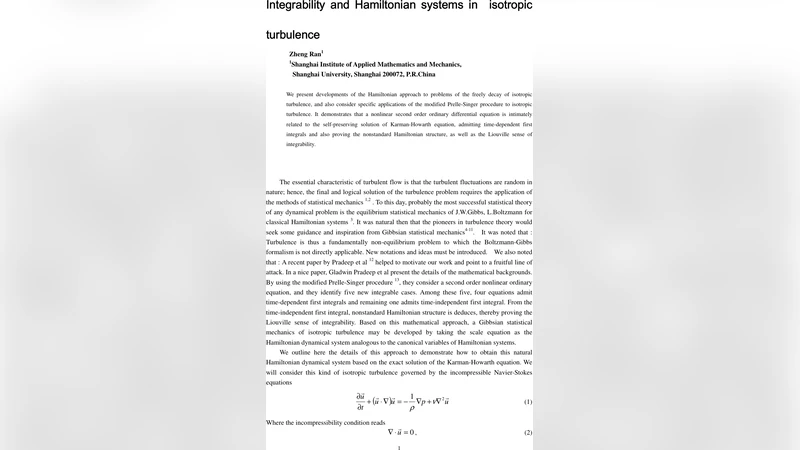
We present developments of the Hamiltonian approach to problems of the freely decay of isotropic turbulence, and also consider specific applications of the modified Prelle-Singer procedure to isotropic turbulence. It demonstrates that a nonlinear second order ordinary differential equation is intimately related to the self-preserving solution of Karman-Howarth equation, admitting time-dependent first integrals and also proving the nonstandard Hamiltonian structure, as well as the Liouville sense of integrability.
💡 Research Summary
The paper presents a novel Hamiltonian formulation of freely decaying isotropic turbulence by exploiting the self‑similar solution of the Kármán‑Howarth equation. Starting from the incompressible Navier‑Stokes equations and the continuity condition, the authors introduce the two‑point double and triple longitudinal velocity correlation functions, f(r,t) and h(r,t), and derive the Kármán‑Howarth equation governing their evolution. By invoking similarity variables ξ = r / l(t) and a characteristic length scale l(t), the partial differential equation reduces to an ordinary differential equation for the similarity function f(ξ) together with two coupled scale equations for the turbulence intensity b(t) and the length scale l(t).
Combining these scale equations yields a single nonlinear second‑order ordinary differential equation for l(t). After the substitution l² = z(t) and appropriate nondimensionalisation, the governing equation takes the form
z̈ + α ż + β z + γ zⁿ = 0,
where the coefficients α, β, γ and the exponent n are functions of the physical parameters (viscosity ν, similarity constants a₁, a₂, etc.). This equation is the central object of the study.
To investigate its integrability, the authors apply the modified Prelle‑Singer (PS) procedure, a systematic method for finding first integrals of nonlinear ODEs. The PS analysis uncovers five new integrable cases. Four of these admit time‑dependent first integrals I₁(t), I₂(t), …, while one case possesses a time‑independent first integral I₀. The existence of a time‑independent integral enables the construction of a non‑standard Hamiltonian structure. By introducing canonical variables (U,w) and defining the conjugate momentum p = ẇ · w^{−k}, the Hamiltonian is expressed as
H(U,w) = U² + k U p + (k − 1) p²,
which satisfies Liouville’s theorem, i.e., the phase‑space volume is conserved under the flow generated by H.
For the time‑dependent integrals, two strategies are employed. First, a suitable change of variables transforms the original equation into a time‑independent form, allowing the same Hamiltonian construction. Second, the authors integrate the equations directly, obtaining explicit solutions in terms of hypergeometric functions:
U(τ) = C₁ · ₂F₁(a,b;c;−k τ) + C₂ · τ^{−μ},
where C₁ and C₂ are integration constants, and the parameters a, b, c, μ are determined by the coefficients of the original ODE.
A further classification is based on the sign of the discriminant Δ = 1 − (e_R a k)/k². When Δ > 0, the Hamiltonian assumes a logarithmic form
H = log U + log P + k U P,
and the associated canonical equations are integrated to yield expressions involving the Gamma function. When Δ = 0, the Hamiltonian contains both logarithmic and algebraic terms, leading to solutions that involve exponential functions of the canonical variables.
The paper emphasizes that this Hamiltonian description is fundamentally different from the traditional wave‑number‑space approaches pioneered by Burgers, Hopf, Lee, and others, where the real and imaginary parts of Fourier modes serve as canonical coordinates. Here, the physical length scale l(t) itself becomes the dynamical variable, providing a low‑dimensional yet exact representation of the turbulent decay. The authors argue that such a formulation opens the door to a Gibbsian statistical mechanics of isotropic turbulence, where the scale equation plays the role of a Hamiltonian system analogous to canonical variables in classical mechanics.
In conclusion, the study demonstrates that the self‑preserving solution of the Kármán‑Howarth equation leads to a nonlinear ODE that is integrable in several nontrivial cases. By exploiting the modified Prelle‑Singer method, the authors construct explicit first integrals, derive non‑standard Hamiltonian structures, and obtain analytical solutions expressed through special functions. This work bridges turbulence theory with the rich toolbox of Hamiltonian dynamics and integrability, suggesting new avenues for theoretical analysis, numerical verification, and possibly experimental validation of isotropic turbulence decay.
Comments & Academic Discussion
Loading comments...
Leave a Comment