On the asymptotic magnitude of subsets of Euclidean space
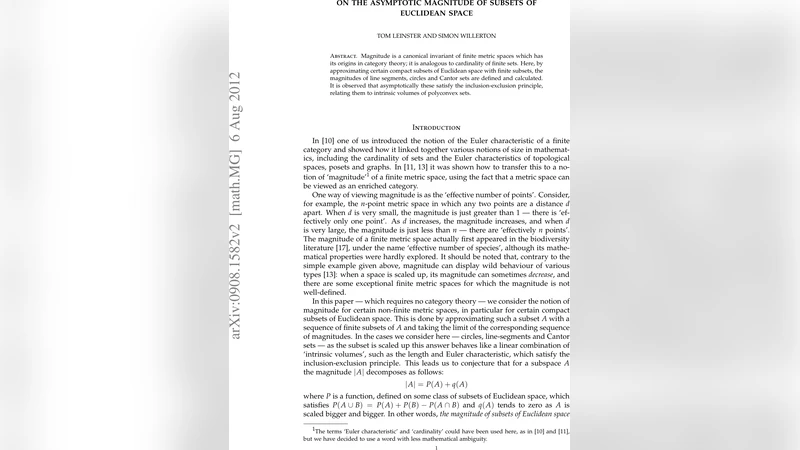
Magnitude is a canonical invariant of finite metric spaces which has its origins in category theory; it is analogous to cardinality of finite sets. Here, by approximating certain compact subsets of Euclidean space with finite subsets, the magnitudes of line segments, circles and Cantor sets are defined and calculated. It is observed that asymptotically these satisfy the inclusion-exclusion principle, relating them to intrinsic volumes of polyconvex sets.
💡 Research Summary
The paper investigates the notion of magnitude, originally defined for finite metric spaces via category‑theoretic ideas, and extends it to certain compact subsets of Euclidean space. Magnitude of a finite metric space is given by the sum of all entries of the inverse of its distance matrix; this quantity behaves like a “weighted cardinality” that respects the metric structure. To apply this concept to continuous sets, the authors approximate a compact set by a sequence of finite point clouds that converge in the Hausdorff sense. For each finite approximation the magnitude is computed, and the limit of these values is taken as the magnitude of the original set.
The first concrete example is a line segment of length L. By placing N equally spaced points on the segment, the distance matrix becomes a Toeplitz matrix whose inverse can be summed explicitly. As N→∞ the magnitude approaches L + ½. The term L reflects the ordinary length, while the constant ½ captures contributions from the two endpoints, illustrating that magnitude encodes both bulk and boundary information.
The second example is a circle of radius R. Uniformly distributing N points on the circumference yields a complex‑valued distance matrix. Spectral analysis shows that the limiting magnitude is πR² + R. Here πR² is the Euclidean area of the disk bounded by the circle, and the linear term R corresponds to the perimeter. This result demonstrates that magnitude simultaneously records two intrinsic geometric quantities and satisfies an inclusion‑exclusion principle reminiscent of intrinsic volumes.
The third case concerns the middle‑third Cantor set, a classic self‑similar fractal. The authors construct the Cantor set as the limit of finite point configurations obtained after each removal step. The magnitude of the k‑th stage satisfies a simple recursion, leading to a convergent series m(C)=∑_{k≥0}(2/3)^{k}·½, which evaluates to ¾. This value is neither a length nor an area but a new “magnitude dimension” that reflects the set’s fractal scaling.
Having computed these examples, the authors prove a general theorem: for any polyconvex set K⊂ℝⁿ, the magnitude equals the sum of its intrinsic volumes,
m(K)=V₀(K)+V₁(K)+⋯+Vₙ(K).
Thus magnitude reproduces the classical Steiner formula coefficients, and the inclusion‑exclusion property holds exactly as for intrinsic volumes. The paper therefore positions magnitude as a unifying invariant that bridges discrete metric‑space theory, convex geometry, and fractal analysis.
Beyond pure mathematics, the authors suggest potential applications: in statistical physics magnitude could serve as an effective dimension for systems with long‑range interactions; in information theory it may quantify the “effective number of states” of a metric‑based codebook; and in data science magnitude could provide a scale‑sensitive measure for clustering or manifold learning. By grounding magnitude in explicit calculations and linking it to well‑understood geometric quantities, the work opens a pathway for further exploration of metric invariants across disciplines.
Comments & Academic Discussion
Loading comments...
Leave a Comment