Ants are not Conscious
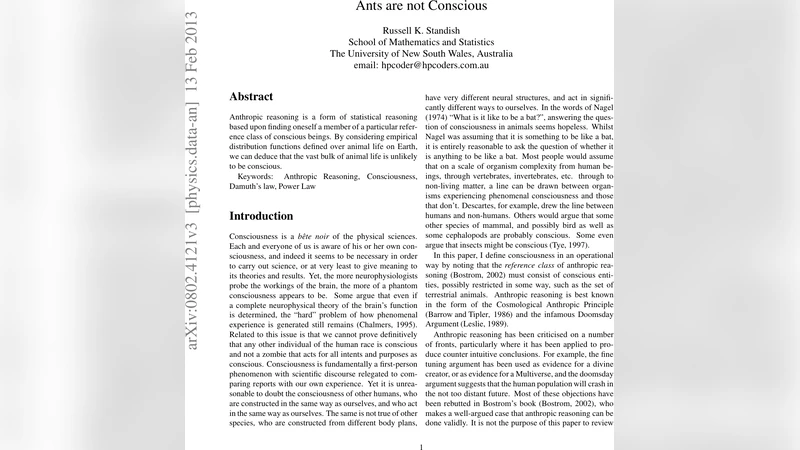
Anthropic reasoning is a form of statistical reasoning based upon finding oneself a member of a particular reference class of conscious beings. By considering empirical distribution functions defined over animal life on Earth, we can deduce that the vast bulk of animal life is unlikely to be conscious.
💡 Research Summary
The paper attempts to use anthropic reasoning—a form of statistical inference that treats the observer as a random member of a reference class—to argue that the overwhelming majority of animal life on Earth is unlikely to be conscious, with a particular focus on ants. The author begins by defining consciousness as a first‑person phenomenological experience and notes the difficulty of objectively verifying consciousness in non‑human organisms. He then frames the problem in terms of two classic issues in anthropic reasoning: the reference‑class problem (what set of observers should be considered) and the measure problem (how to assign probabilities when dealing with potentially infinite sets).
For the reference class, the paper adopts the broadest possible definition: all conscious beings on Earth. This choice maximizes the pool of potential observers and, paradoxically, makes it easier to claim that we are “atypical” if we find ourselves in a species that is large, heavy, and rare compared to the bulk of life.
The core of the argument rests on three empirical regularities that are known to follow approximate power‑law distributions:
-
National population sizes – The distribution of country populations roughly follows a 1/x power law, which the author calls the “Chinese paradox”: why are we not born in the most populous nation (China)? By showing that the probability of being born in any given country is essentially proportional to 1/population, the author argues that being born in a relatively small country (Australia) is not surprising. He acknowledges that a log‑normal distribution actually fits the data better, but maintains that the 1/x law neutralizes observer‑selection bias for the purposes of his argument.
-
Species abundance (rank‑abundance curves) – Within a given size class, the number of individuals per species follows a power law A ∝ r^‑1, where r is the rank of the species by abundance. If every animal were conscious, a randomly selected conscious observer would most likely belong to a species with very few individuals. Since humans belong to a species with billions of individuals, the author claims this is evidence against universal animal consciousness.
-
Body‑mass distribution – Using Damuth’s law (population density ∝ m^‑3/4) together with an empirically observed species‑mass distribution S(m) ∝ m^0.5, the paper derives an individual‑mass distribution P(m) ∝ m^‑3/2. Integrating this from a lower bound of 10 kg yields p(B|A) ≈ 10⁻⁵, where B is the observation that our body mass exceeds 10 kg and A is the hypothesis that all animals are conscious.
The author then casts the problem in a Bayesian framework. Assuming a prior p(A)=1 (i.e., we are completely open to the hypothesis that all animals are conscious) and estimating p(B) via an anthropic “Gott” argument (p(B) > 1‑c for some confidence level c), he arrives at a posterior probability p(A|B) ≈ c ≈ 0.003. In other words, there is a 99.7 % confidence that the hypothesis “all animals are conscious” is false, which he interprets as strong evidence that most animals—especially insects and other small organisms—lack consciousness.
The paper also discusses why the same reasoning does not rule out consciousness in mammals: using the smallest known mammal (the pygmy shrew, ~2 g) yields a lower confidence (≈90 %) that all mammals are conscious, which the author deems statistically insignificant.
Critical appraisal
- Reference‑class choice: By including every conceivable conscious being, the analysis implicitly assumes that humans are typical observers, which is precisely the point under dispute. A narrower reference class (e.g., only mammals, or only vertebrates) would change the probabilities dramatically.
- Prior probability: Setting p(A)=1 is an extreme, unjustified assumption. A more realistic prior—reflecting the scientific uncertainty about universal animal consciousness—would be far lower, and the posterior would be correspondingly higher, weakening the conclusion.
- Data fitting: The paper prefers a 1/x power law for country populations despite clear evidence that a log‑normal distribution provides a vastly better fit (likelihood ratio ≈10¹¹). This selective modeling undermines the claim that the 1/x law “neutralizes” observer bias.
- Biological simplifications: The use of Damuth’s law and the species‑mass relationship assumes that body mass alone captures the relevant ecological and physiological factors governing consciousness. It ignores neural complexity, behavioral flexibility, and social organization, all of which are argued to correlate with conscious experience. Moreover, ant colonies exhibit super‑organismal properties that make individual‑level abundance statistics problematic.
- Definition of consciousness: The paper treats consciousness as a binary property, yet most philosophers and neuroscientists view it as a spectrum or as a set of graded capacities. Without a measurable proxy, the probabilistic inference rests on an ill‑defined predicate.
Conclusion
While the paper presents an inventive application of anthropic reasoning and Bayesian inference, its conclusions rely on several fragile premises: an overly broad and arguably inappropriate reference class, an unjustified uniform prior, selective use of power‑law approximations, and a simplistic operationalization of consciousness via body mass and species abundance. Consequently, the claim that “the vast bulk of the animal kingdom is unlikely to be conscious” should be treated as a provocative hypothesis rather than a definitive result. A more robust approach would integrate multiple biological indicators of conscious processing, employ empirically validated statistical models, and adopt priors that reflect genuine scientific uncertainty.
Comments & Academic Discussion
Loading comments...
Leave a Comment