Extending modularity by capturing the similarity attraction feature in the null model
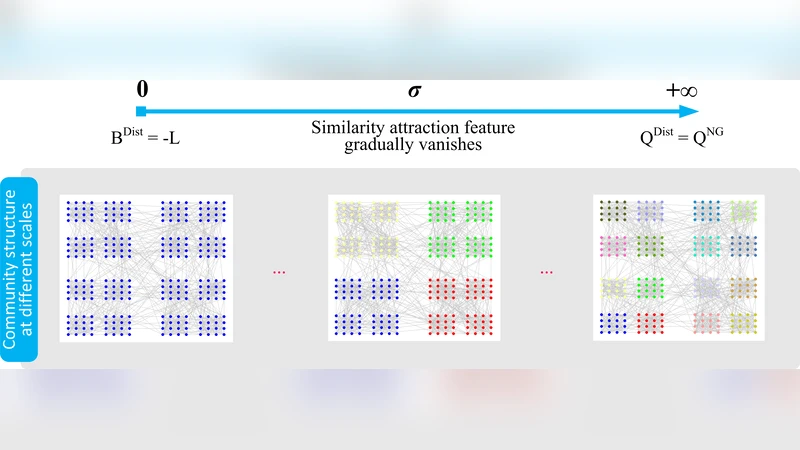
Modularity is a widely used measure for evaluating community structure in networks. The definition of modularity involves a comparison of within-community edges in the observed network and that number in an equivalent randomized network. This equivalent randomized network is called the null model, which serves as a reference. To make the comparison significant, the null model should characterize some features of the observed network. However, the null model in the original definition of modularity is unrealistically mixed, in the sense that any node can be linked to any other node without preference and only connectivity matters. Thus, it fails to be a good representation of real-world networks. A common feature of many real-world networks is “similarity attraction”, i.e., edges tend to link to nodes that are similar to each other. We propose a null model that captures the similarity attraction feature. This null model enables us to create a framework for defining a family of Dist-Modularity adapted to various networks, including networks with additional information on nodes. We demonstrate that Dist-Modularity is useful in identifying communities at different scales.
💡 Research Summary
The paper addresses a fundamental limitation of the classic modularity measure used for community detection in networks. Traditional modularity compares the number of intra‑community edges in the observed graph with the expected number under a null model that preserves only the degree sequence. This null model assumes that any pair of nodes can be linked with equal probability, ignoring the pervasive “similarity attraction” phenomenon in real‑world systems, where edges are more likely to connect nodes that are similar in attributes, spatial proximity, or functional role. Consequently, standard modularity often fails to capture attribute‑driven or geographically constrained community structures and suffers from resolution issues.
To remedy this, the authors propose a similarity‑aware null model. For any pair of nodes i and j, the expected number of edges is defined as
E_{ij} = (k_i k_j / 2m) · f(d_{ij}) / Z,
where k_i and k_j are the degrees, d_{ij} quantifies dissimilarity (e.g., Euclidean distance, attribute distance, or any domain‑specific metric), f(·) is a decreasing kernel (Gaussian, inverse‑distance, etc.), and Z is a normalizing constant ensuring Σ_{i≠j}E_{ij}=m. By incorporating f(d_{ij}), the model explicitly biases the random graph toward linking similar nodes, thereby embedding the similarity attraction feature into the reference ensemble.
Substituting this expectation into the modularity formula yields Dist‑Modularity:
Q_{Dist} = (1/2m) ∑_{i,j}
Comments & Academic Discussion
Loading comments...
Leave a Comment