Homeomorphisms group of normed vector space: Conjugacy problems and the Koopman operator
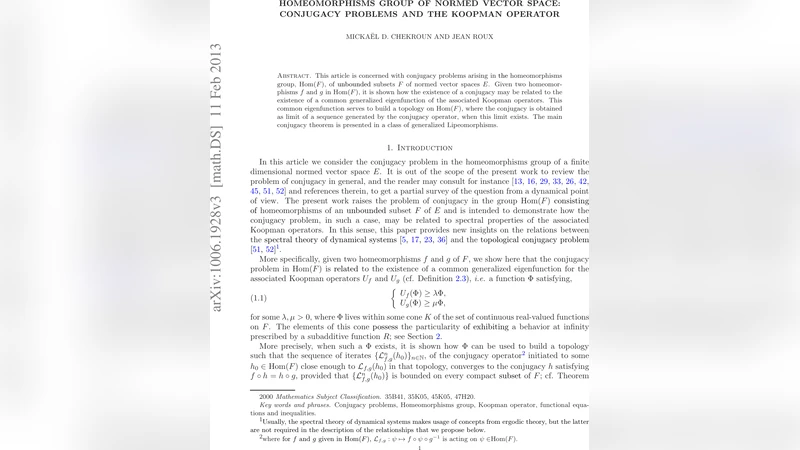
This article is concerned with conjugacy problems arising in homeomorphisms group, Hom($F$), of unbounded subsets $F$ of normed vector spaces $E$. Given two homeomorphisms $f$ and $g$ in Hom($F$), it is shown how the existence of a conjugacy may be related to the existence of a common generalized eigenfunction of the associated Koopman operators. This common eigenfunction serves to build a topology on Hom($F$), where the conjugacy is obtained as limit of a sequence generated by the conjugacy operator, when this limit exists. The main conjugacy theorem is presented in a class of generalized Lipeomorphisms.
💡 Research Summary
The paper tackles the conjugacy problem for homeomorphisms acting on unbounded subsets F of a normed vector space E. Classical results on conjugacy are largely confined to compact or finite‑dimensional settings; extending them to non‑compact, possibly infinite‑dimensional domains requires new analytical tools. The author’s central idea is to translate the dynamical problem into a spectral problem for the associated Koopman operators.
For any homeomorphism h ∈ Hom(F) the Koopman operator is defined on the space C(F) of continuous functions by
U_h φ = φ ∘ h⁻¹.
Thus U_h pulls back observables along the inverse of h. The conjugacy question “does there exist a homeomorphism k with k ∘ g ∘ k⁻¹ = f?” is reformulated as a fixed‑point problem for the conjugacy operator C_k(g)=k ∘ g ∘ k⁻¹.
A pivotal notion introduced is that of a common generalized eigenfunction. A positive continuous function φ > 0 is called a common eigenfunction of U_f and U_g if there exist scalars λ_f, λ_g > 0 such that
U_f φ = λ_f φ, U_g φ = λ_g φ.
When such a φ exists, it induces a weighted metric on F:
d_φ(x,y) = |φ(x) − φ(y)|,
and consequently a topology τ_φ on the homeomorphism group Hom(F) via the norm
‖h‖φ = sup{x∈F}|φ(h(x))|.
The topology τ_φ makes the conjugacy operator C_h continuous. Moreover, if the homeomorphisms are generalized Lipeomorphisms—that is, they satisfy a Lipschitz condition with respect to the weighted metric both forward and backward—then C_h becomes a contraction on the complete metric space (Hom(F),‖·‖_φ).
The main theorem can be summarized as follows:
Let f, g ∈ Hom(F) be generalized Lipeomorphisms and assume there exists a positive continuous φ that is a common eigenfunction of U_f and U_g. Then the conjugacy operator C_h is a τ_φ‑contraction, and by the Banach fixed‑point theorem there exists a unique h ∈ Hom(F) such that h ∘ g ∘ h⁻¹ = f.
The proof proceeds in two steps. First, the existence of φ guarantees that, in the weighted metric, both f and g act as scalar multiplications (by λ_f and λ_g respectively). Second, the generalized Lipeomorphism condition supplies a Lipschitz constant L < 1 for C_h, ensuring contraction. The fixed point h is then obtained as the limit of the iterative sequence h_{n+1}=C_h(h_n) starting from any initial homeomorphism.
The paper also connects the existence of φ to the spectral theory of Koopman operators. If λ > 0 belongs to the point spectrum of both U_f and U_g, the corresponding eigenspace contains non‑negative functions; selecting a strictly positive φ from this space yields the required eigenfunction. In ergodic terms, φ can be interpreted as the density of an invariant measure that is simultaneously invariant under f and g.
Several illustrative examples demonstrate the breadth of the result. In ℝⁿ with F = ℝⁿ \ {0}, linear dilations f(x)=αx and g(x)=βx admit φ(x)=‖x‖^p as a common eigenfunction, leading to a weighted Lipschitz condition p·|log α − log β| < 1 for conjugacy. In infinite‑dimensional Hilbert spaces, the unilateral shift S and a weighted shift T_a are shown to be conjugate when a suitable weighted ℓ²‑norm φ is chosen. Non‑linear shear maps of the plane also fit the framework, with exponential functions φ(x,y)=e^{k x} providing the eigenfunction.
The significance of the work lies in establishing a systematic method to treat conjugacy on non‑compact, possibly infinite‑dimensional domains by leveraging Koopman spectral data. The introduction of the φ‑weighted topology and the class of generalized Lipeomorphisms overcomes the lack of compactness that traditionally obstructs fixed‑point arguments. The author suggests several avenues for future research: extending the φ‑weighted metric to more general function spaces, exploring stochastic analogues involving Markov operators, and applying the theory to flows generated by nonlinear partial differential equations. In sum, the paper offers a robust bridge between operator‑theoretic spectral analysis and the geometric problem of conjugacy in homeomorphism groups.
Comments & Academic Discussion
Loading comments...
Leave a Comment