Spatial patterns of tidal heating
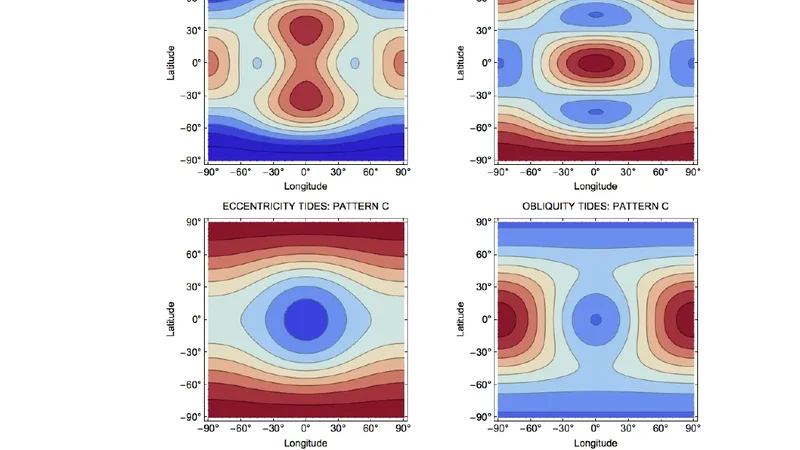
In a body periodically strained by tides, heating produced by viscous friction is far from homogeneous. I show here that the distribution of the dissipated power within a spherically stratified body is a linear combination of three angular functions. These angular functions depend only on the tidal potential whereas the radial weights are specified by the internal structure of the body. The 3D problem of predicting spatial patterns of dissipation at all radii is thus reduced to the 1D problem of computing weight functions. I compute spatial patterns in various toy models without assuming a specific rheology: a viscoelastic thin shell stratified in conductive and convective layers, an incompressible homogeneous body and a two-layer model of uniform density with a liquid or rigid core. For a body in synchronous rotation undergoing eccentricity tides, dissipation in a mantle surrounding a liquid core is highest at the poles. Within a softer layer (asthenosphere or icy layer), the same tides generate maximum heating in the equatorial region with a significant degree-four structure if the layer is thin. Tidal heating patterns are thus of three main types: mantle dissipation (including the case of a floating icy crust), dissipation in a thin soft layer and dissipation in a thick soft layer. I illustrate the method with applications to Europa, Titan and Io. The formalism described in this paper applies to dissipation within solid layers of planets and satellites for which internal spherical symmetry and viscoelastic linear rheology are good approximations.
💡 Research Summary
The paper develops a compact analytical framework for describing how tidal dissipation is distributed inside a spherically stratified body. Starting from the linear visco‑elastic equations governing tidal deformation, the author shows that the local power density can be written as a linear combination of three angular basis functions that depend solely on the external tidal potential (essentially the ℓ = 2 spherical harmonics and their derivatives). The radial dependence is carried by three weight functions, w₁(r), w₂(r), and w₃(r), which are determined uniquely by the body’s internal density, shear modulus, bulk modulus and viscosity profiles. Consequently, the full three‑dimensional problem of mapping heating at every radius and latitude/longitude collapses to a one‑dimensional problem of solving for these weight functions, a task that can be performed with the same numerical tools used for Love‑number calculations.
To illustrate the method, the author evaluates wᵢ(r) for several idealized configurations: (i) a thin visco‑elastic shell overlying a conductive‑convective mantle, (ii) a homogeneous incompressible sphere, and (iii) a two‑layer model with a uniform‑density mantle and either a liquid or rigid core. In each case the resulting heating patterns fall into three distinct categories. For a mantle surrounding a liquid core, the dissipation peaks at the poles because the tidal strain is amplified at the core‑mantle boundary in those regions. In a thin, low‑viscosity layer (e.g., an icy crust or asthenosphere) the same eccentricity tide produces maximum heating near the equator, and if the layer is sufficiently thin a noticeable degree‑four component appears, giving rise to four longitudinal “hot spots.” When the soft layer is thick, the pattern becomes a mixture of polar and equatorial enhancements, with the relative amplitude controlled by the layer’s thickness and rheology.
The formalism is then applied to three solar‑system satellites. For Europa, a thin ice shell over a subsurface ocean yields an equatorial heating maximum that can explain observed surface cracking and localized thinning. Titan’s thick icy mantle over a liquid core leads to polar‑focused heating, consistent with the concentration of methane lakes and polar weather patterns. Io, essentially a solid mantle with a negligible soft layer, exhibits the classic polar‑dominant heating that drives its intense volcanism. Throughout, the analysis assumes linear visco‑elastic behavior and spherical symmetry, which are reasonable approximations for many planetary interiors. The paper concludes that the three‑function decomposition provides a powerful, computationally inexpensive way to link internal structure models with observable surface heat fluxes, and it can be readily extended to any solid layer where the assumptions hold.
Comments & Academic Discussion
Loading comments...
Leave a Comment