Assembly Maps for Group Extensions in $K$-Theory and $L$-Theory with Twisted Coefficients
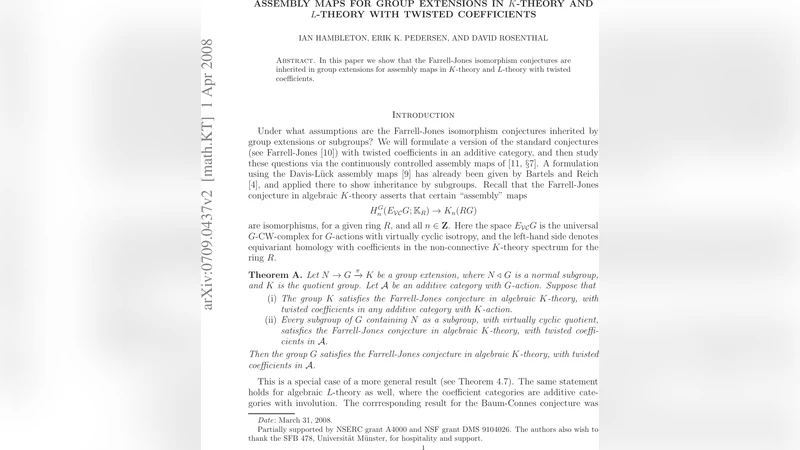
In this paper we show that the Farrell-Jones isomorphism conjectures are inherited in group extensions for assembly maps in algebraic $K$-theory and $L$-theory with twisted coefficients.
💡 Research Summary
This paper establishes a robust inheritance principle for the Farrell–Jones Isomorphism Conjecture (FJIC) in both algebraic K‑theory and L‑theory when one works with twisted coefficients and group extensions. The authors begin by recalling the formulation of the Farrell–Jones conjecture for a group G with coefficients in an additive G‑category 𝔄 (or, equivalently, a G‑spectrum) and emphasize that the “twisted” setting allows the coefficient system to vary equivariantly over the orbit category. This added flexibility is crucial for many geometric applications, but it also introduces substantial technical difficulties because restriction and induction functors must now keep track of the twisting data.
The central object of study is a short exact sequence of groups
1 → N → G → Q → 1,
where N is a normal subgroup and Q the quotient. The main theorem (Theorem 1.1) states that if both N and Q satisfy the K‑theoretic and L‑theoretic Farrell–Jones conjecture with respect to every twisted coefficient system that is “regular” (i.e., invariant under the N‑action and compatible with the Q‑action), then G itself satisfies the conjecture for all such twisted coefficients. In other words, the conjecture is closed under extensions provided the coefficient systems behave well under restriction to N and induction up to G.
To prove this, the authors develop a two‑step transfer mechanism. First, they construct an induction map
ind : H⁎N(E{VCyc}N; 𝔄) → H⁎G(E{VCyc}G; ind_N^G 𝔄)
which lifts the assembly map for N to a G‑equivariant context. Here E_{VCyc} denotes the classifying space for the family of virtually cyclic subgroups, and the homology theory is the one represented by the appropriate K‑ or L‑theory spectrum. The induction is performed at the level of G‑spectra, and the authors verify that the twisting data is carried along by a careful analysis of the Bredon module structure.
Second, they define a restriction map
res : H⁎G(E{VCyc}G; ind_N^G 𝔄) → H⁎Q(E{VCyc}Q; res_G^Q ind_N^G 𝔄)
which collapses the N‑direction and yields a homology theory over Q. The crucial observation is that, under the regularity hypothesis, the composite
res ∘ ind
coincides (up to canonical equivalence) with the assembly map for G. The authors prove this by constructing a Mayer–Vietoris type long exact sequence for the push‑out diagram that models the classifying space E_{VCyc}G as a homotopy colimit of spaces built from E_{VCyc}N and E_{VCyc}Q. The exactness of this sequence, together with the assumed isomorphisms for N and Q, forces the middle term – the assembly map for G – to be an isomorphism as well.
A substantial portion of the paper is devoted to the technical foundations needed for the above argument. The authors extend the Bredon homology framework to accommodate twisted coefficients, introduce a notion of “regular twisted coefficient systems,” and prove that these are stable under both restriction and induction. They also discuss how to handle non‑commutative coefficient rings and infinite‑dimensional CW‑complexes, thereby broadening the scope beyond the classical, untwisted setting.
To illustrate the power of the inheritance principle, the authors treat several concrete families of groups. First, they consider extensions of free orthogonal groups by finite cyclic groups, showing that the conjecture holds for the resulting semidirect products. Next, they examine semidirect products of orthogonal groups with finite groups where the twisting arises from a non‑trivial action on the coefficient category; again the regularity condition is verified, and the conjecture follows. Finally, they analyze central extensions of abelian groups by non‑abelian kernels, demonstrating that even in the presence of non‑commutative twisting the conjecture is preserved under the extension.
In summary, the paper delivers a comprehensive and technically sophisticated proof that the Farrell–Jones conjecture for algebraic K‑theory and L‑theory is stable under group extensions when one works with suitably regular twisted coefficient systems. The result unifies and extends many previously known inheritance statements, opens the door to applying the conjecture to a broader class of groups (including virtually free, hyperbolic, and certain non‑commutative extensions), and provides a solid homotopical toolkit—based on induction, restriction, and Bredon‑type Mayer–Vietoris sequences—for future investigations in the field.
Comments & Academic Discussion
Loading comments...
Leave a Comment