Equivariant Bundles and Isotropy Representations
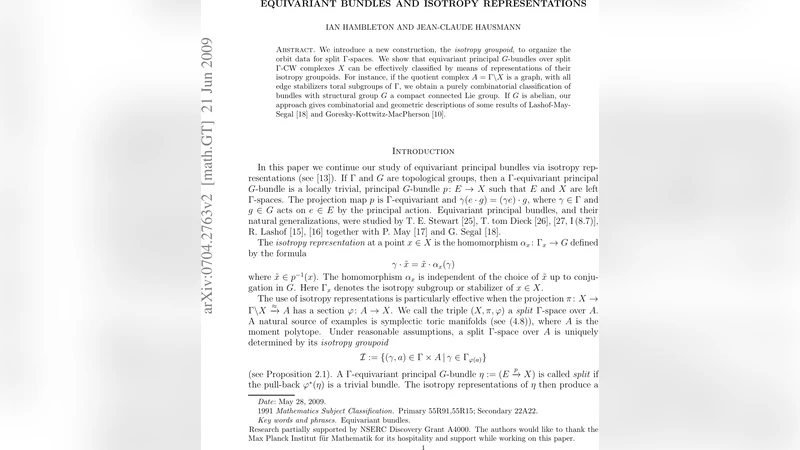
We introduce a new construction, the isotropy groupoid, to organize the orbit data for split $\Gamma$-spaces. We show that equivariant principal $G$-bundles over split $\Gamma$-CW complexes $X$ can be effectively classified by means of representations of their isotropy groupoids. For instance, if the quotient complex $A=\Gamma\backslash X$ is a graph, with all edge stabilizers toral subgroups of $\Gamma$, we obtain a purely combinatorial classification of bundles with structural group $G$ a compact connected Lie group. If $G$ is abelian, our approach gives combinatorial and geometric descriptions of some results of Lashof-May-Segal and Goresky-Kottwitz-MacPherson.
💡 Research Summary
The paper introduces a categorical device called the isotropy groupoid to encode the orbit data of a split Γ‑space and uses it to obtain a complete classification of equivariant principal G‑bundles. A split Γ‑space X is defined by a continuous projection π : X → A onto a CW‑complex A together with a Γ‑equivariant section σ : A → X, so that each point a∈A determines an isotropy subgroup Γ_a = Stab_Γ(σ(a)). Collecting all Γ_a together with the natural conjugation maps between them yields a groupoid ℐ_X whose objects are the points of A and whose morphisms are the Γ‑equivariant maps between isotropy subgroups. The first major result shows that ℐ_X captures the entire equivariant homotopy type of X: any Γ‑equivariant map between split spaces corresponds uniquely to a functor between their isotropy groupoids.
The second, and central, construction is that of an ℐ_X‑representation. An ℐ_X‑representation ρ assigns to each object a a continuous homomorphism ρ_a : Γ_a → G and to each morphism γ : a→b an element g(γ) ∈ G satisfying the compatibility condition
ρ_b ∘ Ad_γ = Ad_{g(γ)} ∘ ρ_a.
In other words, the representation records how the G‑structure twists when one moves along the orbit data. The authors prove a bijective correspondence
ℐ_X‑representations ↔ equivariant principal G‑bundles over X,
by constructing a bundle from a representation (gluing together the local G‑bundles over each isotropy subgroup using the elements g(γ)) and, conversely, extracting a representation from a given bundle by restriction to the isotropy subgroups.
A particularly transparent case occurs when the quotient A is a graph and every edge stabilizer Γ_e is a toral subgroup of Γ (i.e., a maximal torus). Then ℐ_X reduces to a very simple combinatorial groupoid: vertices correspond to objects, edges to morphisms, and each edge carries a toral isotropy group. If G is a compact connected Lie group, each toral subgroup admits a standard representation determined by a weight lattice. Consequently, an equivariant G‑bundle is completely described by:
- A weight (an element of the weight lattice) attached to each vertex, encoding the restriction of the bundle to the vertex isotropy.
- An integral matrix (or homomorphism) attached to each edge, describing how the weights at the two ends are related via the edge isotropy.
Thus the classification becomes a purely combinatorial problem on the graph, avoiding the need for classifying spaces or spectral sequences. This yields an explicit, calculable description of all equivariant bundles in this setting.
When G is abelian, especially a torus T^n, the ℐ_X‑representation simplifies further: each ρ_a is just a character of Γ_a, and the compatibility data are integer matrices. The authors show that their framework recovers and refines the results of Lashof–May–Segal on equivariant K‑theory and the Goresky‑Kottwitz‑MacPherson (GKM) description of equivariant cohomology for torus actions. In the GKM language, the vertex labels correspond to the restriction of a class to fixed points, while the edge labels encode the linear relations imposed by one‑dimensional orbits; the isotropy groupoid formalism packages these data into a single functorial object.
The paper also discusses extensions beyond graphs. If A has higher‑dimensional cells or edge stabilizers are non‑toral but still Lie subgroups, the isotropy groupoid remains well‑defined, and ℐ_X‑representations still classify bundles, though the combinatorial description becomes more intricate. The authors hint at possible applications to equivariant stable homotopy theory, where one replaces bundles by equivariant spectra and the isotropy groupoid would control the Mackey functor structure.
In summary, the authors provide a new categorical perspective on equivariant bundle theory: the isotropy groupoid encodes all orbit‑wise stabilizer information, and its representations give a concrete, often combinatorial, classification of equivariant principal bundles. This approach unifies and extends several known results, offers computational advantages in torus‑action settings, and opens avenues for further exploration in equivariant topology and representation theory.
Comments & Academic Discussion
Loading comments...
Leave a Comment