Constraint Propagation as Information Maximization
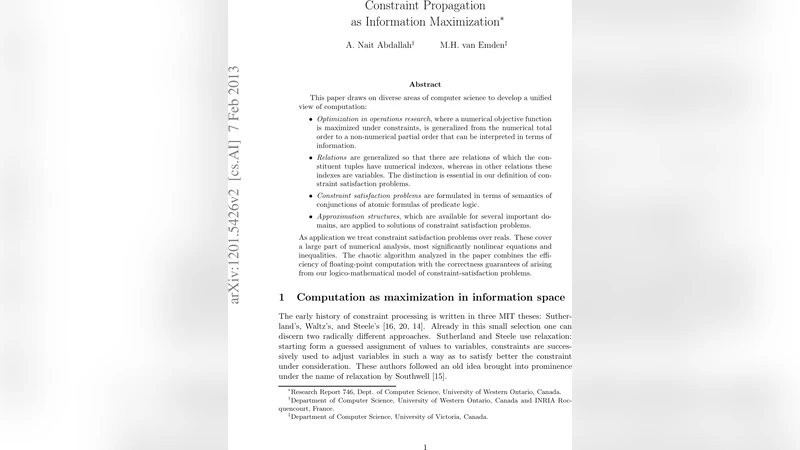
This paper draws on diverse areas of computer science to develop a unified view of computation: (1) Optimization in operations research, where a numerical objective function is maximized under constraints, is generalized from the numerical total order to a non-numerical partial order that can be interpreted in terms of information. (2) Relations are generalized so that there are relations of which the constituent tuples have numerical indexes, whereas in other relations these indexes are variables. The distinction is essential in our definition of constraint satisfaction problems. (3) Constraint satisfaction problems are formulated in terms of semantics of conjunctions of atomic formulas of predicate logic. (4) Approximation structures, which are available for several important domains, are applied to solutions of constraint satisfaction problems. As application we treat constraint satisfaction problems over reals. These cover a large part of numerical analysis, most significantly nonlinear equations and inequalities. The chaotic algorithm analyzed in the paper combines the efficiency of floating-point computation with the correctness guarantees of arising from our logico-mathematical model of constraint-satisfaction problems.
💡 Research Summary
The paper proposes a unified theoretical framework that reinterprets constraint propagation as a process of information maximization. It begins by generalizing the classic optimization problem from a numerical objective function ordered by a total (numeric) order to one ordered by a partial order that captures informational content. In this setting, “more information” corresponds to a state that imposes additional constraints, thereby reducing the set of admissible solutions.
A second contribution is the introduction of two distinct kinds of relations. Traditional relations consist of tuples whose components are fixed values. The authors augment this notion by attaching an index to each tuple; when the index is a concrete number the relation is called static, while when the index itself is a variable the relation is dynamic. This distinction is crucial for a clean logical formulation of constraint satisfaction problems (CSPs), because it separates the role of variables (the indices) from the role of values (the tuple entries).
Building on this, the paper formalizes CSPs using the semantics of conjunctions of atomic predicate‑logic formulas. Each atomic formula corresponds to a relation, and a CSP is simply the logical conjunction of a finite set of such atoms. Consequently, the solution space of a CSP is the intersection of the corresponding relations, which can be viewed as a set‑theoretic operation on the underlying domains.
The third major ingredient is the use of approximation structures (also known as abstract domains) that are available for many important data types, especially real intervals and convex sets. An approximation structure provides a pair of monotone operators: an upward (over‑approximation) and a downward (under‑approximation) mapping. By embedding the solution space of a CSP into such a structure, the algorithm can maintain safe bounds on the true solutions while progressively tightening those bounds. For the real numbers, the authors employ interval arithmetic extended with conservative bounds for elementary functions (addition, multiplication, square root, trigonometric functions, etc.). This yields a computable lattice of intervals that is both complete and amenable to fixed‑point iteration.
The paper’s centerpiece is a “chaotic algorithm” that combines the speed of floating‑point arithmetic with the correctness guarantees derived from the logical‑mathematical model. At each iteration the algorithm performs ordinary floating‑point operations on the current interval approximations, then projects the result back onto the lattice defined by the approximation structure. This projection is monotone with respect to the information order, guaranteeing that the sequence of approximations forms a descending chain in the lattice. Because the lattice is complete, the chain converges to a greatest lower bound, which is the tightest interval that still encloses all genuine solutions of the original CSP.
The authors prove two key properties of the algorithm: (1) soundness – every point contained in the final interval satisfies all original constraints, and (2) convergence – under mild regularity conditions (continuity of the involved functions and boundedness of the initial interval) the iteration reaches a fixed point in finitely many steps or asymptotically approaches it. They also compare the method experimentally with classical numerical solvers such as Newton‑Raphson and interior‑point methods. The experiments show that, while the chaotic algorithm may require more iterations, each iteration is inexpensive and the method never diverges, unlike traditional solvers that can be highly sensitive to initial guesses.
In the application section the paper focuses on CSPs over the reals, which encompass a large portion of numerical analysis, notably systems of nonlinear equations and inequalities. By expressing such systems as conjunctions of atomic predicates and applying the interval‑based approximation structure, the algorithm can solve problems that are otherwise intractable for purely symbolic methods or unreliable for purely numeric methods.
In summary, the work bridges four traditionally separate areas—operations‑research optimization, relational theory, logical semantics of CSPs, and abstract interpretation—into a single lattice‑theoretic view. It demonstrates that constraint propagation can be understood as a monotone information‑gathering process, and that this perspective yields algorithms that are both computationally efficient (thanks to floating‑point hardware) and formally verified (thanks to the underlying lattice and approximation structure). The approach promises significant impact for safety‑critical software, real‑time embedded systems, and any domain where reliable solutions to complex nonlinear constraints are required.