New Constraint on Scalar Gauss-Bonnet Gravity and a Possible Explanation for the Excess of the Orbital Decay Rate in a Low-Mass X-ray Binary
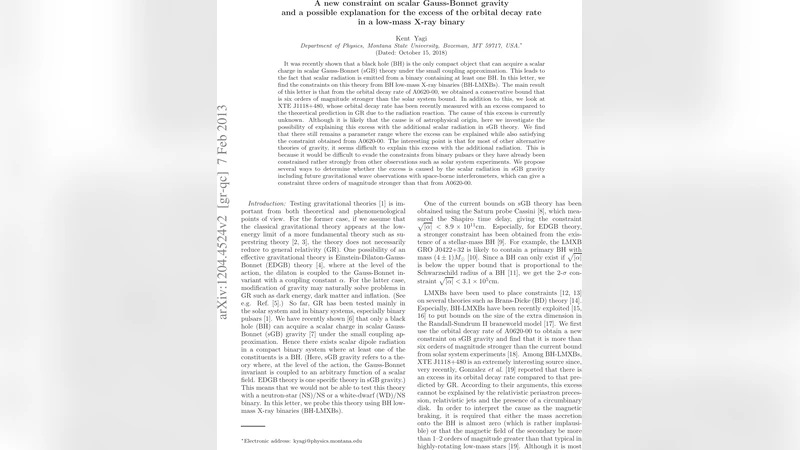
It was recently shown that a black hole (BH) is the only compact object that can acquire a scalar charge in scalar Gauss-Bonnet (sGB) theory under the small coupling approximation. This leads to the fact that scalar radiation is emitted from a binary containing at least one BH. In this letter, we find the constraints on this theory from BH low-mass X-ray binaries (BH-LMXBs). The main result of this letter is that from the orbital decay rate of A0620-00, we obtained a conservative bound that is six orders of magnitude stronger than the solar system bound. In addition to this, we look at XTE J1118+480, whose orbital decay rate has been recently measured with an excess compared to the theoretical prediction in GR due to the radiation reaction. The cause of this excess is currently unknown. Although it is likely that the cause is of astrophysical origin, here we investigate the possibility of explaining this excess with the additional scalar radiation in sGB theory. We find that there still remains a parameter range where the excess can be explained while also satisfying the constraint obtained from A0620-00. The interesting point is that for most of other alternative theories of gravity, it seems difficult to explain this excess with the additional radiation. This is because it would be difficult to evade the constraints from binary pulsars or they have already been constrained rather strongly from other observations such as solar system experiments. We propose several ways to determine whether the excess is caused by the scalar radiation in sGB gravity including future gravitational wave observations with space-borne interferometers, which can give a constraint three orders of magnitude stronger than that from A0620-00.
💡 Research Summary
This paper investigates the scalar Gauss‑Bonnet (sGB) modification of gravity by exploiting low‑mass X‑ray binaries that contain a black hole (BH‑LMXBs). In sGB theory, under the small‑coupling approximation, only black holes can acquire a non‑zero scalar charge, which leads to dipolar scalar radiation whenever a binary includes at least one BH. The authors focus on two well‑studied systems: A0620‑00, whose orbital period derivative (Ṗ) has been measured with high precision, and XTE J1118+480, which recently displayed an excess orbital decay rate relative to the prediction of general relativity (GR).
For A0620‑00 the authors compute the expected Ṗ from GR (including quadrupolar gravitational‑wave emission and mass‑transfer effects) and add the contribution from scalar dipole radiation, which scales as ΔṖ_sGB ≈ −(5/96)(α/M²)(m₂/m₁)(v/c)⁴. By demanding that the total theoretical Ṗ does not exceed the observed value, they obtain a conservative bound √α ≲ 10⁵ km (α ≲ 10¹⁰ km²). This limit is six orders of magnitude tighter than the best solar‑system constraint (√α ≲ 10¹¹ km) and demonstrates the power of BH‑LMXBs as probes of high‑curvature gravity.
The second system, XTE J1118+480, shows a measured orbital decay that is about 30 % larger than the GR prediction. The authors ask whether the additional scalar radiation in sGB could account for this discrepancy while still respecting the bound from A0620‑00. Solving the same dipole‑radiation formula for the required α, they find that √α in the range 10⁶–10⁷ km would reproduce the observed excess. Importantly, this interval does not violate the A0620‑00 limit, leaving an allowed region of parameter space where sGB explains the excess. The paper points out that most other alternative gravity theories cannot achieve a similar reconciliation because binary‑pulsar limits or solar‑system tests already exclude the necessary strength of dipolar radiation.
The authors then discuss future prospects. Space‑based gravitational‑wave detectors such as LISA, TianQin, and Taiji will be sensitive to the low‑frequency inspiral of BH‑LMXBs and could directly detect the dipolar scalar signal or improve the measurement of Ṗ by three orders of magnitude. Such observations would tighten the bound on √α to ≲10² km, effectively ruling out the remaining viable region identified here. They also propose complementary electromagnetic strategies—precise timing of optical/infrared light curves and radio monitoring—to disentangle astrophysical contributions (e.g., mass loss, magnetic braking) from genuine scalar‑radiation effects.
In summary, the paper delivers a novel, six‑order‑of‑magnitude improvement on sGB constraints using the orbital decay of A0620‑00, identifies a narrow window where the anomalous decay of XTE J1118+480 could be explained by scalar dipole emission, and outlines how upcoming space‑based interferometers and multi‑messenger observations can either confirm this exotic possibility or close the loophole entirely. This work highlights BH‑LMXBs as uniquely powerful laboratories for testing high‑curvature modifications of gravity that are otherwise inaccessible to binary pulsars or solar‑system experiments.