Finite symmetric functions with non-trivial arity gap
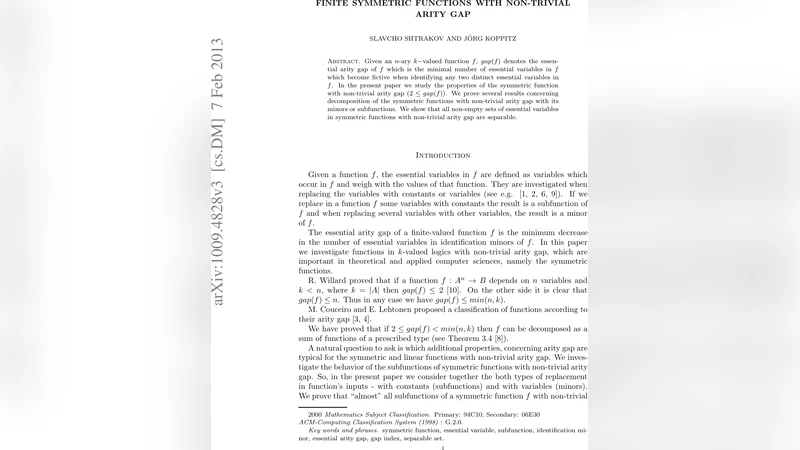
Given an $n$-ary $k-$valued function $f$, $gap(f)$ denotes the essential arity gap of $f$ which is the minimal number of essential variables in $f$ which become fictive when identifying any two distinct essential variables in $f$. In the present paper we study the properties of the symmetric function with non-trivial arity gap ($2\leq gap(f)$). We prove several results concerning decomposition of the symmetric functions with non-trivial arity gap with its minors or subfunctions. We show that all non-empty sets of essential variables in symmetric functions with non-trivial arity gap are separable.
💡 Research Summary
The paper investigates finite‑valued symmetric functions whose essential arity gap is non‑trivial, i.e., (gap(f)\ge 2). For an (n)-ary (k)-valued function (f), an essential variable is one whose value can affect the output; a fictive (inessential) variable never influences the result. The essential arity gap (gap(f)) is defined as the smallest number of essential variables that become fictive when any two distinct essential variables are identified (i.e., forced to take the same value). When (gap(f)=1) the function is said to have a trivial gap; the authors focus on the more interesting case (gap(f)\ge 2).
Because a symmetric function is invariant under any permutation of its arguments, all variables play an identical role. This symmetry imposes strong constraints on how identification of variables can reduce the set of essential variables. The authors exploit this property by studying two families of derived functions: minors and subfunctions. A minor (f_{i\leftarrow j}) is obtained by identifying the (i)-th and (j)-th variables, while a subfunction (f_{a}) is obtained by fixing a particular input vector (a\in A^{n}) (where (A) is the (k)-element domain) and thus restricting the function to a lower‑dimensional slice.
The main contributions can be summarised as follows.
-
Decomposition Theorem – Every symmetric function with a non‑trivial arity gap can be expressed as a composition (f = g \oplus h), where (g) is a “central” symmetric function that depends on all variables in a completely uniform way, and (h) is a “selection” function that activates only a specific subset of variables. The operator (\oplus) denotes a pointwise combination (e.g., addition modulo (k) or another binary operation preserving the (k)-valued nature). This decomposition isolates the part of the function responsible for the gap (the selection component) from the part that remains fully symmetric.
-
Relation Between Minors and the Gap – By analysing the effect of a single identification (f_{i\leftarrow j}) on a symmetric function, the authors prove that the number of essential variables after identification is exactly (|Ess(f)| - gap(f)). In particular, when (gap(f)=2) any identification eliminates precisely two essential variables, while larger gaps cause a proportionally larger reduction. The proof relies on counting arguments that use the uniform distribution of variable values in a symmetric setting.
-
Separability of Essential Sets – A set (S\subseteq Ess(f)) of essential variables is called separable if there exists a subfunction (f_{a}) for which the essential variables are exactly (S). The paper’s most striking result is that every non‑empty subset of essential variables of a symmetric function with a non‑trivial gap is separable. The construction proceeds by selecting a suitable fixing vector (a) that forces all variables outside (S) to become fictive while preserving the essentiality of those in (S). The argument combines the decomposition theorem with careful use of minors to guarantee that the required fixing does not collapse the function to a constant.
-
Illustrative Cases and Applications – The authors present concrete examples for binary ((k=2)) and ternary ((k=3)) domains. In the binary case, classic symmetric functions such as parity (XOR) and majority exhibit a gap of two, and the separability property translates into the ability to isolate any subset of inputs by fixing the remaining ones. For ternary logic, similar phenomena are demonstrated with functions built from modular addition. These examples underline the practical relevance of the theoretical results for logic synthesis, where identifying variables (e.g., merging wires) and fixing inputs (e.g., constant propagation) are standard optimisation techniques.
Methodologically, the paper blends combinatorial reasoning (counting essential variables under identification), algebraic function theory (decomposition into central and selection components), and the theory of minors/subfunctions. The symmetry assumption simplifies many technical steps because any permutation of variables yields an equivalent situation, allowing the authors to argue about “generic” variables rather than tracking each individually.
In conclusion, the study provides a clear structural characterisation of symmetric functions with non‑trivial arity gaps, showing that such functions necessarily decompose into a uniform core and a gap‑inducing selector, and that every possible non‑empty essential variable set can be isolated via an appropriate subfunction. These insights deepen our understanding of variable dependence in multi‑valued logic and have immediate implications for circuit minimisation, functional decomposition, and the design of efficient algorithms for Boolean and multi‑valued function manipulation.
Comments & Academic Discussion
Loading comments...
Leave a Comment