Quantum quenches and thermalization in one-dimensional fermionic systems
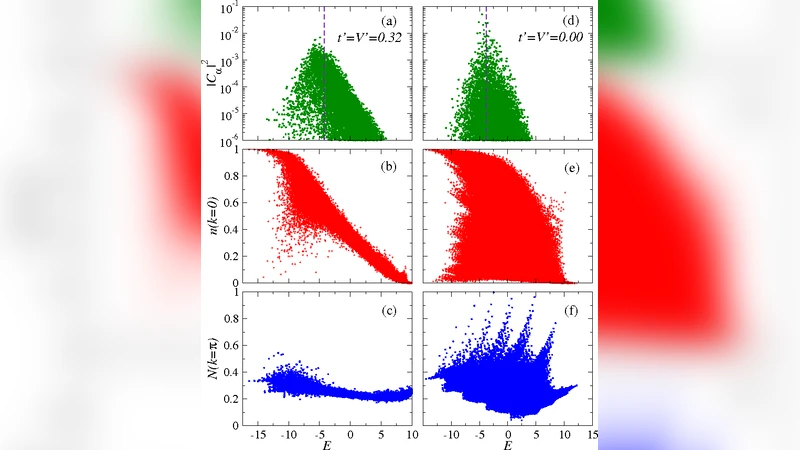
We study the dynamics and thermalization of strongly correlated fermions in finite one-dimensional lattices after a quantum quench. Our calculations are performed using exact diagonalization. We focus on one- and two-body observables such as the momentum distribution function [n(k)] and the density-density structure factor [N(k)], respectively, and study the effects of approaching an integrable point. We show that while the relaxation dynamics and thermalization of N(k) for fermions is very similar to the one of hardcore bosons, the behavior of n(k) is distinctively different. The latter observable exhibits a slower relaxation dynamics in fermionic systems. We identify the origin of this behavior, which is related to the off-diagonal matrix elements of n(k) in the basis of the eigenstates of the Hamiltonian. More generally, we find that thermalization occurs far away from integrability and that it breaks down as one approaches the integrable point.
💡 Research Summary
The paper investigates the nonequilibrium dynamics and thermalization of strongly correlated spin‑½ fermions confined to finite one‑dimensional lattices after a sudden quantum quench. Using exact diagonalization the authors obtain the full many‑body spectrum and eigenstates, allowing them to follow the time evolution of two representative observables: the one‑body momentum distribution n(k) and the two‑body density‑density structure factor N(k). By varying the strength of the next‑nearest‑neighbor interaction they can continuously tune the model from a non‑integrable (quantum‑chaotic) regime to an integrable point where the system becomes exactly solvable.
In the non‑integrable regime the level‑spacing statistics follow the Wigner‑Dyson distribution, indicating quantum chaos. Consequently the eigenstate thermalization hypothesis (ETH) holds: the long‑time averages of both observables coincide with the predictions of the microcanonical (or canonical) ensemble at the same energy. N(k) relaxes rapidly; its expectation value decays on a time scale of a few tunneling periods and its time‑averaged value matches the thermal prediction to within numerical accuracy. This fast relaxation is attributed to the fact that N(k) couples strongly to many eigenstates, i.e., its off‑diagonal matrix elements in the energy eigenbasis are sizable and broadly distributed.
By contrast, the fermionic momentum distribution n(k) exhibits a markedly slower approach to equilibrium. Even after hundreds of tunneling times the deviation from the thermal value remains appreciable for several momentum modes. The authors trace this behavior to the structure of the off‑diagonal matrix elements of n(k): they are much smaller and more irregular than those of N(k). Because n(k) is a one‑body operator obeying Fermi statistics, its dynamics is constrained by Pauli blocking, which suppresses transitions between eigenstates that would otherwise redistribute momentum. As a result, thermalization of n(k) is delayed, although the system still satisfies ETH in the sense that the diagonal matrix elements follow a smooth function of energy.
When the interaction parameters are tuned toward the integrable limit (the next‑nearest‑neighbor term is turned off), the level‑spacing statistics cross over to a Poisson distribution, reflecting the emergence of an extensive set of conserved quantities. In this regime both N(k) and n(k) fail to thermalize: their long‑time averages retain a memory of the initial state and deviate systematically from the thermal ensemble. The off‑diagonal matrix elements of both observables become vanishingly small, so that the unitary dynamics cannot efficiently mix eigenstates. This breakdown of ETH demonstrates that thermalization is a property of the chaotic region of parameter space and disappears as the model approaches integrability.
Overall, the study provides a clear comparative picture: (i) two‑body observables such as N(k) thermalize quickly and behave similarly for fermions and hard‑core bosons; (ii) one‑body observables like n(k) relax much more slowly in fermionic systems due to the specific structure of their matrix elements; (iii) thermalization is robust far from integrability but deteriorates continuously as the system approaches an integrable point. These findings have direct relevance for cold‑atom experiments in optical lattices, where quenches and measurements of momentum distributions are routinely performed, and they contribute to the broader understanding of when and how isolated quantum many‑body systems can be described by conventional statistical mechanics.
Comments & Academic Discussion
Loading comments...
Leave a Comment