A Not-So-Fundamental Limitation on Studying Complex Systems with Statistics: Comment on Rabin (2011)
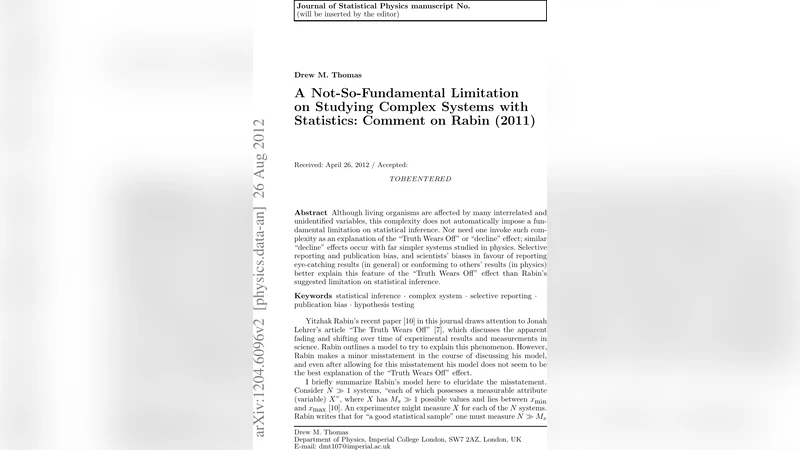
Although living organisms are affected by many interrelated and unidentified variables, this complexity does not automatically impose a fundamental limitation on statistical inference. Nor need one invoke such complexity as an explanation of the “Truth Wears Off” or “decline” effect; similar “decline” effects occur with far simpler systems studied in physics. Selective reporting and publication bias, and scientists’ biases in favour of reporting eye-catching results (in general) or conforming to others’ results (in physics) better explain this feature of the “Truth Wears Off” effect than Rabin’s suggested limitation on statistical inference.
💡 Research Summary
The paper is a pointed commentary on Rabin’s 2011 claim that the inherent complexity of living systems imposes a fundamental limitation on statistical inference. The authors argue that complexity alone does not preclude reliable statistical conclusions; rather, the “Truth Wears Off” or “decline” effect observed in many scientific domains is better explained by human and institutional biases such as selective reporting, publication bias, and the tendency of researchers to favor striking or confirmatory results.
First, the authors acknowledge that biological systems involve many interrelated, often unidentified variables, but they emphasize that modern statistical tools—multivariate regression, Bayesian networks, agent‑based models, and other sophisticated techniques—are expressly designed to handle such complexity. When sample sizes are adequate and measurement error is controlled, statistical estimators remain unbiased and consistent, regardless of the underlying system’s intricacy.
Second, the paper surveys the “decline effect” across disciplines. While Rabin attributes the fading of previously reported effects to the fluctuating nature of complex biological phenomena, the authors demonstrate that similar patterns appear in physics, chemistry, and psychology. Classic examples include the gradual revision of nuclear decay half‑life measurements, the refinement of superconducting transition temperatures, and the adjustment of fundamental constants. These cases involve systems that are mathematically simple and experimentally well‑controlled, indicating that the phenomenon is not a product of complexity per se.
Third, the authors present a quantitative argument that selective reporting and publication bias are sufficient to generate the observed decline. They model the probability that a study reaches publication as a function of its p‑value, showing that early studies with marginally significant results are over‑represented in the literature, inflating the apparent effect size. Subsequent, more rigorous replications then reveal smaller or null effects, creating the illusion of a systematic “wear‑off.” Cognitive biases—such as the allure of novel, eye‑catching findings and the pressure to conform to prevailing theories— further skew experimental design, data analysis, and interpretation.
Fourth, the paper proposes concrete remedial measures. Preregistration of hypotheses and analysis plans, mandatory sharing of raw data in public repositories, and journals adopting policies that welcome null or replication studies are highlighted as effective strategies to curb bias. Statistical corrections for publication bias (e.g., trim‑and‑fill, p‑curve analysis) should become standard practice in meta‑analyses.
In conclusion, the authors reject the notion that statistical inference is fundamentally limited by the complexity of the system under study. Instead, they argue that the “Truth Wears Off” effect is a symptom of the broader reproducibility crisis, driven by human and systemic factors that affect all scientific fields. By enhancing transparency, encouraging open data, and correcting for selective reporting, researchers can obtain reliable statistical inferences even in the most intricate biological contexts.
Comments & Academic Discussion
Loading comments...
Leave a Comment