Confinement induces conformational transition of semiflexible polymer rings to figure eight form
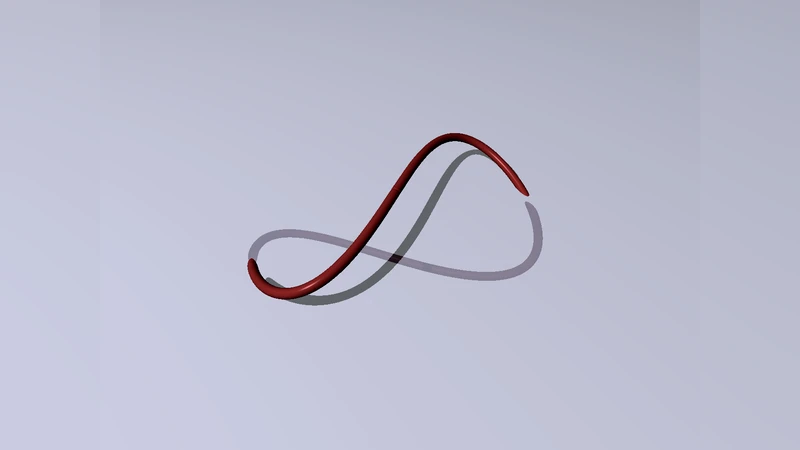
Employing Monte Carlo simulations of semiflexible polymer rings in weak spherical confinement a conformational transition to figure eight shaped, writhed configurations is discovered and quantified.
💡 Research Summary
The paper investigates how weak spherical confinement influences the conformational landscape of semiflexible polymer rings, using extensive Monte Carlo simulations based on the worm‑like chain model. The authors begin by highlighting that while the behavior of linear semiflexible polymers under confinement has been widely studied, the structural response of closed loops—particularly the transition from a planar circular configuration to more complex shapes—remains poorly understood, despite its relevance to biological systems such as plasmid DNA confined within viral capsids or cellular compartments.
In the computational approach, a polymer ring of total contour length (L) is discretized into (N) segments, each subject to bending energy (E_{\text{bend}} = (\kappa/2)\int C(s)^2 ds), where (\kappa) is the bending rigidity and (C(s)) the local curvature. The persistence length (\ell_p = \kappa/k_{\text{B}}T) serves as the primary measure of semiflexibility. Confinement is imposed by a hard spherical wall of radius (R); any trial move that places a bead outside the sphere is rejected. The Metropolis algorithm is employed to generate equilibrium ensembles for a range of (\ell_p/L) ratios (0.1, 0.2, 0.3) and confinement radii (R/L) from 0.2 to 1.0 in steps of 0.05. For each state point, (10^6) Monte Carlo steps are performed, and statistical observables are collected from the final (10^4) configurations after equilibration.
Key observables include the global writhe (a topological measure of self‑crossing) and the shape anisotropy expressed by the ratio of the principal axes of the gyration tensor. In the absence of confinement, the writhe distribution is sharply peaked at zero, reflecting the planar circular ground state. As (R) decreases, a critical confinement radius (R_c) emerges (approximately (0.45L) for (\ell_p/L = 0.1) and shifting to (0.38L) for more flexible rings). Below (R_c), the writhe mean rises sharply from near‑zero to values around 2, and the distribution becomes bimodal, indicating the coexistence of planar and highly writhed conformations. Simultaneously, the principal‑axis ratio drops from unity to roughly 0.6, signifying a pronounced flattening and the formation of a figure‑eight geometry.
Free‑energy reconstructions, obtained via umbrella sampling across the writhe coordinate, reveal a double‑well landscape: one well corresponds to the original circular state, the other to the figure‑eight state. The barrier separating them is modest (≈ 1.5 (k_{\text{B}}T)), allowing thermal fluctuations to drive frequent transitions near the critical confinement. The authors interpret the transition as a balance between bending energy, which favors smooth curvature, and confinement‑induced entropic loss, which is alleviated by allowing the polymer to fold onto itself, thereby reducing the spatial volume it occupies.
The discussion connects these findings to experimental contexts. For plasmid DNA with a persistence length of ~50 nm, confinement within capsids of comparable size would likely induce similar figure‑eight conformations, potentially influencing processes such as transcription, replication, or packaging efficiency. The authors propose that fluorescence microscopy with labeled DNA, combined with cryo‑electron tomography, could directly observe the predicted shape transition. They also suggest that the phenomenon should persist under alternative confinement geometries (cylindrical, ellipsoidal) and for polymers with additional topological constraints (knots, supercoils).
In conclusion, the study demonstrates that even weak spherical confinement can trigger a distinct conformational transition in semiflexible polymer rings, from a planar circle to a writhed figure‑eight configuration. This transition is quantified by critical confinement parameters, writhe statistics, and shape anisotropy, and it is rationalized through a simple energetic competition. The results provide a new design principle for nanotechnological applications involving closed polymer loops, and they open avenues for future work on multi‑ring interactions, dynamic confinement, and external field effects.
Comments & Academic Discussion
Loading comments...
Leave a Comment