Binary Darboux Transformations in Bidifferential Calculus and Integrable Reductions of Vacuum Einstein Equations
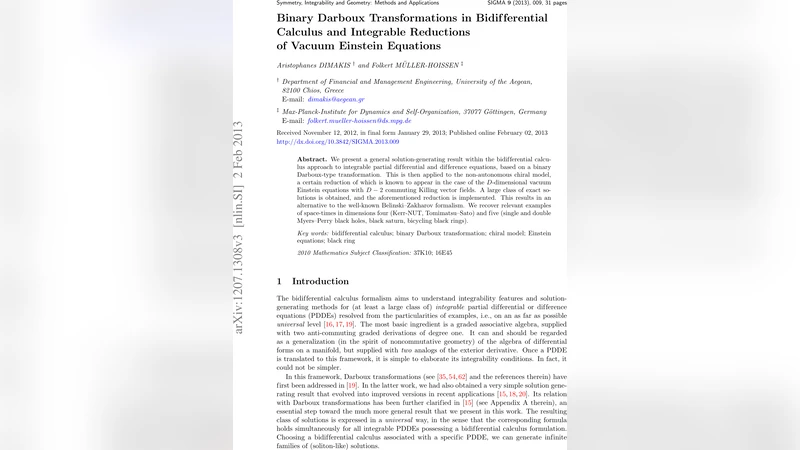
We present a general solution-generating result within the bidifferential calculus approach to integrable partial differential and difference equations, based on a binary Darboux-type transformation. This is then applied to the non-autonomous chiral model, a certain reduction of which is known to appear in the case of the D-dimensional vacuum Einstein equations with D-2 commuting Killing vector fields. A large class of exact solutions is obtained, and the aforementioned reduction is implemented. This results in an alternative to the well-known Belinski-Zakharov formalism. We recover relevant examples of space-times in dimensions four (Kerr-NUT, Tomimatsu-Sato) and five (single and double Myers-Perry black holes, black saturn, bicycling black rings).
💡 Research Summary
The paper develops a unified, algebraic framework for generating exact solutions of integrable nonlinear partial differential and difference equations, based on a binary Darboux‑type transformation within the bidifferential calculus formalism. The authors first recall the bidifferential calculus setting, where two commuting differential (or difference) operators (d) and (\bar d) act on matrix‑valued functions and satisfy a compatibility condition that encodes the integrability of the underlying nonlinear system. In this language the nonlinear equation can be written compactly as
(d\Phi = \Phi,\Omega,\qquad \bar d\Phi = \Phi,\Lambda)
with (\Omega) and (\Lambda) matrix‑valued 1‑forms.
The core contribution is the construction of a binary Darboux transformation (BDT). Unlike the classical Darboux transformation, which uses a single seed solution and a single gauge matrix, the BDT employs two independent seed solutions (\Phi_{1},\Phi_{2}) together with two auxiliary matrices (X) and (Y) that satisfy linear auxiliary equations of the form
(dX = \Phi_{2}\Omega_{1},\qquad \bar dY = \Phi_{1}\Lambda_{2}).
When these auxiliary equations hold, the transformed field
(\Phi’ = \Phi - \Phi_{1}X^{-1}\Phi_{2})
again satisfies the original bidifferential system. The authors prove that the transformation preserves the zero‑curvature condition, the associated Lax pair, and all conserved quantities. This guarantees that the BDT is an auto‑Bäcklund transformation for the whole hierarchy of equations generated by the bidifferential calculus.
Having established the general BDT, the authors apply it to the non‑autonomous chiral model, a matrix‑valued field theory that reduces, under the presence of (D-2) commuting Killing vectors, to the effective two‑dimensional system governing the vacuum Einstein equations in (D) dimensions. The non‑autonomous character means that the spectral parameter (or, equivalently, the independent variables) enters explicitly, which makes the model richer than the standard autonomous chiral model. By inserting appropriate seed solutions that correspond to flat space or known simple metrics, and by iterating the BDT, the authors generate a large family of multi‑soliton configurations. Each soliton is encoded in the choice of the auxiliary matrices and carries physical parameters such as mass, angular momenta, NUT charge, and possible rod‑structure data.
The paper then demonstrates the power of the method by reconstructing several celebrated exact space‑times:
- Four‑dimensional examples – the Kerr‑NUT metric and the Tomimatsu‑Sato family (including the classic (n=2) and higher‑order deformations). These solutions emerge from one‑ and two‑soliton BDTs with appropriately chosen spectral parameters.
- Five‑dimensional examples – the singly and doubly rotating Myers‑Perry black holes, the Black Saturn configuration (a black ring surrounding a spherical black hole), and the “bicycling” black ring solution, which features two concentric rings with opposite angular momenta. All of these are obtained by multi‑soliton BDTs, where the matrix structure naturally encodes the rod diagram of the solution.
In each case the authors compare the resulting metric functions with those obtained by the classic Belinski‑Zakharov inverse‑scattering method. While the Belinski‑Zakharov technique relies on a sophisticated Riemann‑Hilbert problem and a dressing matrix built from rational functions of a complex spectral parameter, the binary Darboux approach works directly with finite‑dimensional matrix algebra. Consequently the expressions for the potentials are more transparent, and the parameter space is easier to explore. Moreover, the BDT automatically yields the determinant (or Gram‑type) formulas that guarantee regularity conditions such as the absence of conical singularities on the axis.
Beyond the explicit examples, the authors discuss the broader implications of their work. The binary Darboux transformation provides a systematic “solution‑generating engine” that can be applied to any integrable system admitting a bidifferential calculus formulation, including lattice equations, discrete Painlevé equations, and even certain quantum integrable models. In the context of general relativity, the method offers an alternative route to constructing higher‑dimensional black objects with multiple horizons, exotic topologies, and nontrivial NUT charges, without resorting to the more cumbersome inverse‑scattering machinery.
The paper concludes by outlining future directions: extending the BDT to include matter fields (e.g., Maxwell or scalar fields), coupling to supersymmetric extensions, and exploring the interplay with twistor constructions. The authors also suggest that the algebraic nature of the binary Darboux transformation could be advantageous for numerical implementations, allowing one to generate large families of exact metrics for testing conjectures about stability, uniqueness, and holographic dualities in higher‑dimensional gravity.