Properties and applications of Fisher distribution on the rotation group
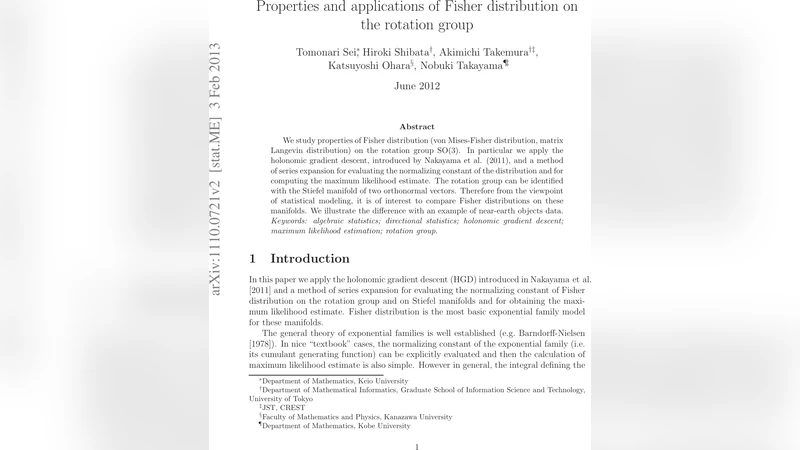
We study properties of Fisher distribution (von Mises-Fisher distribution, matrix Langevin distribution) on the rotation group SO(3). In particular we apply the holonomic gradient descent, introduced by Nakayama et al. (2011), and a method of series expansion for evaluating the normalizing constant of the distribution and for computing the maximum likelihood estimate. The rotation group can be identified with the Stiefel manifold of two orthonormal vectors. Therefore from the viewpoint of statistical modeling, it is of interest to compare Fisher distributions on these manifolds. We illustrate the difference with an example of near-earth objects data.
💡 Research Summary
This paper investigates the Fisher distribution (also known as the von Mises‑Fisher or matrix Langevin distribution) on the three‑dimensional rotation group SO(3). The authors focus on two computational challenges that arise for exponential‑family models on manifolds: (1) evaluating the normalizing constant c(Θ)=∫_{SO(3)}exp(tr(ΘᵀX)) dμ(X) and its derivatives, and (2) obtaining the maximum‑likelihood estimate (MLE) of the parameter matrix Θ.
To address (1), the authors adopt the holonomic gradient descent (HGD) framework introduced by Nakayama et al. (2011). HGD exploits the fact that c(Θ) satisfies a system of linear partial differential equations (a Pfaffian system) derived from D‑module theory. By solving this system numerically along a path in the parameter space, one can compute c(Θ) and all required partial derivatives from a single set of initial values. For the one‑dimensional case (the von Mises‑Fisher distribution on the circle S¹) the governing ODE reduces to the modified Bessel equation ∂²C+(1/κ)∂C−C=0, whose solution is the familiar Bessel function I₀(κ). The authors show how the same idea extends to the multivariate case by constructing a Pfaffian system of the form ∂_{θ_i} G = P_i(θ) G, where G collects c(θ) and its partial derivatives and the matrices P_i(θ) contain rational functions of the parameters.
In parallel, the paper derives an explicit infinite‑series expansion for c(Θ) on SO(3). By exploiting the known relationship between the Fisher distribution on SO(3) and the Bingham distribution on the real projective space ℝP³, the normalizing constant can be expressed as a hypergeometric function ₀F₁(3/2; ΘᵀΘ/4). The series terms involve elementary symmetric polynomials of the eigenvalues of ΘᵀΘ, providing a rapidly convergent representation suitable for high‑precision computation.
For (2), the authors develop an MLE procedure that leverages the invariance of the likelihood under left‑ and right‑multiplication by orthogonal matrices. By performing a sign‑preserving singular value decomposition (SVD) of the sample mean matrix \bar X (so that \bar X = Q diag(g₁,…,g_p) R with Q,R∈SO(p) and ordered singular values g_i), the parameter matrix can be restricted to a diagonal form Θ = Q diag(φ₁,…,φ_p) R. The log‑likelihood then simplifies to
ℓ(Φ)=tr(Φᵀ diag(g))−log c(Φ),
which is strictly convex in the diagonal entries φ_i. The optimality conditions become
∂_{φ_i} log c(Φ)=g_i, i=1,…,p,
i.e., the sample singular values must match the expectations of the corresponding sufficient statistics under the model. Because these expectations are expressed through the normalizing constant, the HGD machinery supplies the necessary derivatives, allowing a simple fixed‑point or gradient‑descent iteration to converge to the MLE.
A key theoretical contribution is the clarification of the relationship between Fisher distributions on the Stiefel manifold V_{p−1}(ℝ^p) (the set of p×(p−1) orthonormal columns) and those on SO(p). Lemma 1 proves that for p≥3 the former constitutes a strict submodel of the latter: setting the last column of Θ to zero yields a Fisher distribution on V_{p−1}(ℝ^p), but the converse is not true because SO(p) admits an additional degree of freedom. Lemma 2 then provides the explicit MLE formula for SO(p) using the sign‑preserving SVD, and discusses subtleties such as the possibility that the determinant of \bar X or of the estimated Θ may be negative even when all data lie in SO(p).
The methodology is illustrated with a real data set of near‑Earth objects (NEOs). The authors compute rotation matrices from orbital elements, obtain the sample mean matrix, and apply both the Stiefel‑based and the SO(3)‑based Fisher models. The SO(3) model yields a higher log‑likelihood and captures asymmetries that the Stiefel model cannot, confirming the practical relevance of the theoretical distinction.
In conclusion, the paper demonstrates that holonomic gradient descent, combined with a series‑expansion representation, provides a powerful and systematic tool for exact likelihood inference on rotation groups. The approach is computationally efficient, scales to higher dimensions, and opens the door to Bayesian extensions, robust estimation, and applications in fields such as robotics, computer vision, and structural biology where orientations on SO(3) play a central role.
Comments & Academic Discussion
Loading comments...
Leave a Comment