Operated semigroups, Motzkin paths and rooted trees
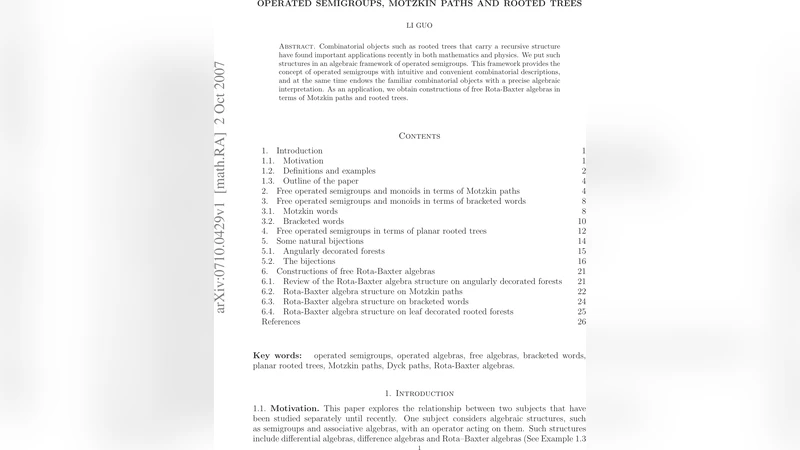
Combinatorial objects such as rooted trees that carry a recursive structure have found important applications recently in both mathematics and physics. We put such structures in an algebraic framework of operated semigroups. This framework provides the concept of operated semigroups with intuitive and convenient combinatorial descriptions, and at the same time endows the familiar combinatorial objects with a precise algebraic interpretation. As an application, we obtain constructions of free Rota-Baxter algebras in terms of Motzkin paths and rooted trees.
💡 Research Summary
The paper introduces a unified algebraic framework called an “operated semigroup” to capture the recursive nature of combinatorial objects such as rooted trees and Motzkin paths. An operated semigroup is a semigroup (S,·) equipped with a unary operator P:S→S that interacts with the semigroup multiplication in a prescribed way. The authors first formalize this notion categorically, defining morphisms that preserve both the multiplication and the operator, and then construct the free operated semigroup on a set of generators. The construction proceeds by representing elements as words over the generators together with a formal “bracketing” operation that records the application of P; concatenation of words gives the semigroup product, while inserting a pair of brackets around a sub‑word implements P.
Having set up the abstract algebraic machinery, the authors turn to two concrete combinatorial models that instantiate free operated semigroups. The first model uses Motzkin paths, which are lattice paths consisting of up‑steps, down‑steps, and horizontal steps. In this representation an up‑step corresponds to applying the operator P, a down‑step to “undoing” an application, and a horizontal step to the identity element. Concatenation of paths yields the semigroup product, and the operation of surrounding a contiguous segment of a path with a matching pair of up‑ and down‑steps implements P. The authors prove that the set of all Motzkin paths equipped with these operations forms the free operated semigroup on the set of elementary horizontal steps.
The second model employs rooted trees. Each internal node of a tree is decorated with the operator P, while leaves correspond to generators. The semigroup product is given by grafting the root of one tree onto the root of another, and the operator P acts by creating a new root node above a given tree (i.e., by “wrapping” the tree with a P‑node). Again, the authors verify that this construction yields the free operated semigroup on the set of leaf labels.
The central application of these constructions is to free Rota‑Baxter algebras. A Rota‑Baxter algebra of weight λ is a vector space equipped with a binary product and a linear operator P satisfying the identity
P(x)·P(y) = P(P(x)·y + x·P(y) + λ·x·y).
The paper shows that the operated semigroup structures arising from Motzkin paths and rooted trees can be lifted to associative algebras by linear extension, and that the defining Rota‑Baxter identity holds precisely because of the way concatenation and bracketing (or grafting and wrapping) have been defined. Consequently, the linear span of Motzkin paths (or rooted trees) equipped with the induced product and operator provides an explicit construction of the free Rota‑Baxter algebra on a given set of generators.
Beyond the construction, the authors analyze bases and dimensions. For Motzkin paths, a basis consists of “flat” horizontal segments interleaved with nested up‑down pairs, while for trees the basis consists of planar rooted trees with a prescribed ordering of sub‑trees. Generating functions are derived to enumerate basis elements by degree, confirming that the combinatorial dimensions match those known for free Rota‑Baxter algebras obtained by other methods. Special cases are examined: when λ=0 the operator behaves like a derivation, and when λ≠0 it mimics an integral operator, illustrating the algebra’s relevance to differential and integral calculus.
Finally, the paper discusses potential applications in mathematics and physics. Operated semigroups provide a language for describing recursive combinatorial processes, and the explicit tree and path models give a visual and computational handle on free Rota‑Baxter algebras, which appear in renormalization theory, multiple zeta values, and the algebraic study of integrable systems. By bridging combinatorial structures with algebraic identities, the work opens avenues for further exploration of operated algebraic systems in both theoretical and applied contexts.
Comments & Academic Discussion
Loading comments...
Leave a Comment