Elections, Protest, and Alternation of Power
Despite many examples to the contrary, most models of elections assume that rules determining the winner will be followed. We present a model where elections are solely a public signal of the incumbent popularity, and citizens can protests against leaders that do not step down from power. In this minimal setup, rule-based alternation of power as well as “semi-democratic” alternation of power independent of electoral rules can both arise in equilibrium. Compliance with electoral rules requires there to be multiple equilibria in the protest game, where the electoral rule serves as a focal point spurring protest against losers that do not step down voluntarily. Such multiplicity is possible when elections are informative and citizens not too polarized. Extensions to the model are consistent with the facts that protests often center around accusations of electoral fraud and that in the democratic case turnover is peaceful while semi-democratic turnover often requires citizens to actually take to the streets.
💡 Research Summary
This paper, “Elections, Protest, and Alternation of Power,” by Andrew T. Little, Joshua A. Tucker, and Tom LaGatta, presents a parsimonious game-theoretic model that re-conceptualizes elections not as binding contracts but as public signals of an incumbent’s popularity. The central puzzle it addresses is why incumbents ever voluntarily relinquish power after elections, even when they could technically hold on.
The model features an incumbent leader and a continuum of citizens. The fundamental state of the world is the incumbent’s average popularity, ω. Citizens observe a private signal of this popularity (θj = ω + νj). Subsequently, all actors observe a public signal in the form of an election result, e = ω + x + νe, where x represents electoral fraud (if any) and νe is random noise. After seeing the election result, the incumbent decides whether to yield (step down) or stand firm. If she stands firm, citizens simultaneously decide whether to protest (aj=1) or not (aj=0).
Payoffs are structured to capture key incentives. The incumbent receives a fixed payoff yI for yielding and a payoff of (1 - ρ) for standing firm, where ρ is the proportion of citizens who protest. Thus, her payoff decreases linearly with protest size. Citizens receive a payoff yC if the incumbent yields. If she stands firm, a citizen’s base payoff is v(ω)(1-ρ), which increases with the incumbent’s popularity (ω) and decreases with protest size (ρ). If a citizen chooses to protest, they incur a fixed cost (c), a coordination cost proportional to the fraction of non-protesters (k(1-ρ)), and an “expressive” component (-bθj). This last term is crucial: it implies that citizens who personally dislike the regime (low θj) derive positive utility from protesting against it.
The analysis treats this as a global game of regime change. The key finding is that the model can generate two distinct regimes of power alternation, depending on parameters:
-
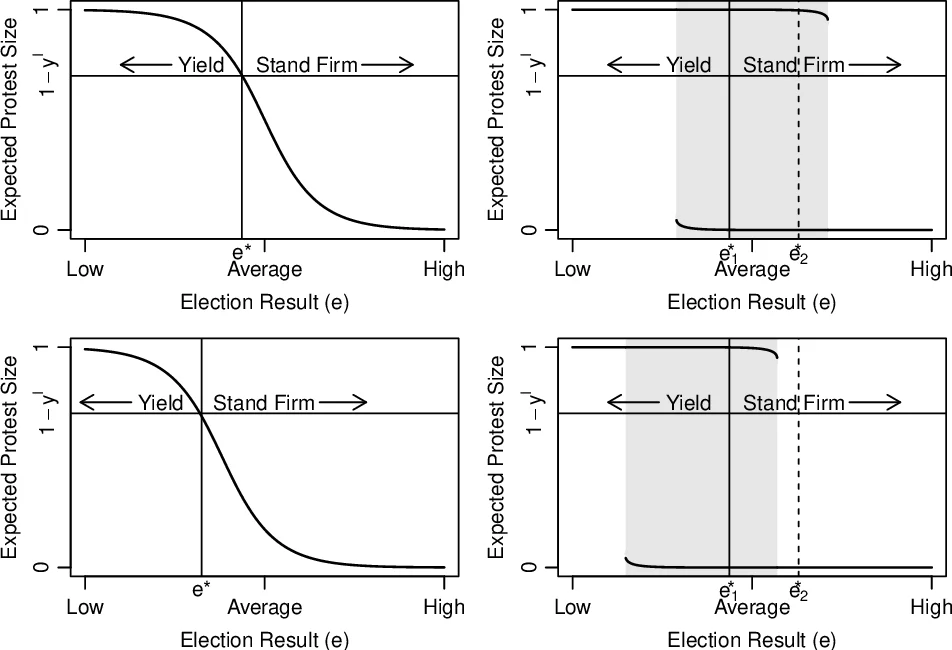
Unique Equilibrium Regime (Semi-Democratic Alternation): When elections are not very informative (high variance of νe), private signals are relatively precise (low variance of νj), or citizens are highly polarized (high b), the protest stage has a unique Bayesian Nash equilibrium. In this equilibrium, the incumbent yields if and only if the election result e falls below an endogenously determined threshold, τ. This threshold τ need not correspond to any formal electoral rule (like 50%). This captures “semi-democratic” turnover: an election is held, but the incumbent may step down following a surprisingly poor result—even if it technically meets a legal victory threshold—because it reveals widespread discontent and predicts massive protest. Conversely, she may cling to power after a fraud-inflated “win” if the true underlying popularity is high enough to deter protest.
-
Multiple Equilibria Regime (Democratic Alternation): The more novel result occurs when elections are highly informative (low variance of νe), private signals are noisy enough (high variance of νj), and polarization is not too severe (low b). Under these conditions, for a range of election results e, there are two equilibria in the protest stage: a “high-protest” equilibrium and a “low-protest” equilibrium. This multiplicity is essential. Here, a codified electoral rule (e.g., 50% of the vote) can serve as a powerful focal point. It coordinates citizens to play the high-protest equilibrium if the incumbent is announced to have lost (e < 50%) and the low-protest equilibrium if she is announced to have won (e > 50%). Anticipating this, the incumbent will yield voluntarily upon losing (as defined by the rule) to avoid the certain high protest. This yields rule-based, peaceful alternation of power that appears “democratic,” even though the incumbent has no inherent respect for the rule—compliance emerges endogenously from the equilibrium selection.
The paper extends the basic model in two insightful ways. First, introducing uncertainty about the level of fraud (x) and a public signal about it (like media reports) shows that signals of high fraud make protest more likely, aligning with the empirical observation that protests often center on fraud allegations. Second, allowing the incumbent to yield after observing protest (rather than only before) generates a compelling distinction: in the democratic focal-point equilibrium, losers yield preemptively and peacefully, while in the semi-democratic unique equilibrium, incumbents are more uncertain and often “wait and see,” yielding only if protest actually materializes on a large scale. This matches the pattern where democratic turnover is administrative, while semi-democratic turnover frequently requires street action.
In conclusion, the model provides a unified framework explaining both democratic and semi-democratic power transitions. Its core theoretical contribution is to demonstrate that compliance with electoral rules is not a primitive assumption but an equilibrium phenomenon that depends critically on the information structure of elections and the society’s capacity for coordinated action around a focal point.
Comments & Academic Discussion
Loading comments...
Leave a Comment