An Evolutionary Reduction Principle for Mutation Rates at Multiple Loci
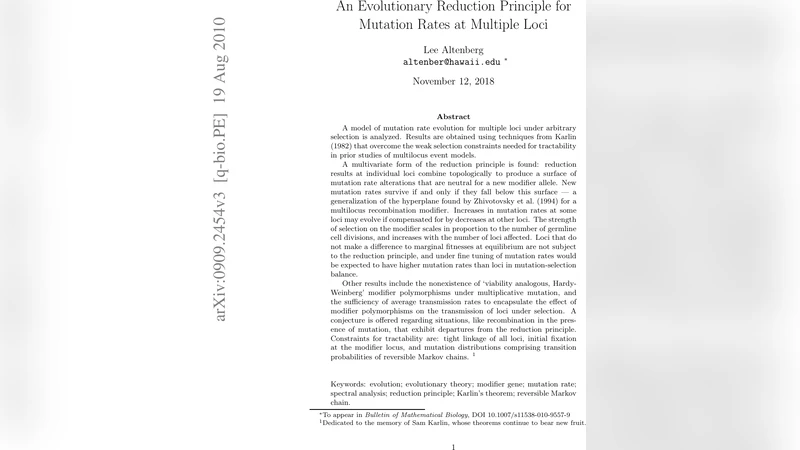
A model of mutation rate evolution for multiple loci under arbitrary selection is analyzed. Results are obtained using techniques from Karlin (1982) that overcome the weak selection constraints needed for tractability in prior studies of multilocus event models. A multivariate form of the reduction principle is found: reduction results at individual loci combine topologically to produce a surface of mutation rate alterations that are neutral for a new modifier allele. New mutation rates survive if and only if they fall below this surface - a generalization of the hyperplane found by Zhivotovsky et al. (1994) for a multilocus recombination modifier. Increases in mutation rates at some loci may evolve if compensated for by decreases at other loci. The strength of selection on the modifier scales in proportion to the number of germline cell divisions, and increases with the number of loci affected. Loci that do not make a difference to marginal fitnesses at equilibrium are not subject to the reduction principle, and under fine tuning of mutation rates would be expected to have higher mutation rates than loci in mutation-selection balance. Other results include the nonexistence of ‘viability analogous, Hardy-Weinberg’ modifier polymorphisms under multiplicative mutation, and the sufficiency of average transmission rates to encapsulate the effect of modifier polymorphisms on the transmission of loci under selection. A conjecture is offered regarding situations, like recombination in the presence of mutation, that exhibit departures from the reduction principle. Constraints for tractability are: tight linkage of all loci, initial fixation at the modifier locus, and mutation distributions comprising transition probabilities of reversible Markov chains.
💡 Research Summary
The paper presents a rigorous theoretical analysis of how mutation‑rate modifiers evolve when they affect multiple loci under arbitrary selection. Previous multilocus studies were constrained by the weak‑selection assumption, which limited their generality. By employing the matrix‑theoretic framework of Karlin (1982), the author bypasses this restriction and derives results that hold for any strength of selection, provided that the mutation process can be represented as a reversible Markov chain and that all loci are tightly linked.
The central contribution is a multivariate version of the classic reduction principle. At each locus i a modifier can change the mutation rate μi. A decrease in any μi raises the mean fitness of the population, and the individual fitness gains from separate loci combine topologically to form a high‑dimensional neutral surface. This surface delineates the set of mutation‑rate vectors for which a new modifier allele is selectively neutral. A modifier can invade only if its vector of mutation rates lies strictly below this surface; equivalently, increases in mutation rate at some loci are permissible only when they are compensated by sufficiently large decreases at other loci. This generalizes the hyperplane identified by Zhivotovsky et al. (1994) for recombination modifiers.
Selection on the modifier scales with two biologically intuitive quantities. First, the number of germ‑line cell divisions that experience the modified mutation process: more divisions generate more mutational opportunities, amplifying the selective advantage of a lower mutation rate. Second, the number of loci simultaneously affected: the more loci a modifier controls, the larger the cumulative fitness effect, and thus the stronger the selection.
Loci that do not influence marginal fitnesses at the equilibrium—so‑called neutral loci—are exempt from the reduction principle. Because changes in their mutation rates do not alter mean fitness, they can drift to higher rates under fine‑tuning, offering a plausible explanation for observed heterogeneity in mutation rates across a genome.
The analysis also proves two ancillary results. Under a multiplicative mutation model, “viability‑analogous, Hardy‑Weinberg” polymorphisms of the modifier cannot exist; the mathematics precludes a stable polymorphic equilibrium that simultaneously satisfies Hardy‑Weinberg proportions and differential viabilities. Moreover, the average transmission rates of the loci under selection are sufficient statistics for the effect of any modifier polymorphism, meaning that the full distribution of modifier genotypes can be collapsed into a single mean‑field parameter without loss of predictive power.
A conjecture is offered concerning scenarios that may violate the reduction principle, such as when recombination operates together with mutation. In those cases the interaction between a recombination modifier and a mutation modifier can generate non‑linear effects that warp the neutral surface, potentially creating new equilibria where higher mutation rates persist. This points to a rich area for future empirical and theoretical work.
The paper’s tractability rests on three key constraints: (1) all selected loci are tightly linked, (2) the modifier locus is initially fixed, and (3) mutation distributions are transition matrices of reversible Markov chains. While these assumptions simplify the mathematics, they also delineate the boundary within which the results are directly applicable. Nonetheless, the work provides a comprehensive, generalizable framework for understanding the evolution of mutation‑rate modifiers across multiple loci, extending the classic reduction principle to a multivariate setting and highlighting the interplay between mutation, selection, and genome architecture.
Comments & Academic Discussion
Loading comments...
Leave a Comment