The Weakness of Weak Ties in the Classroom
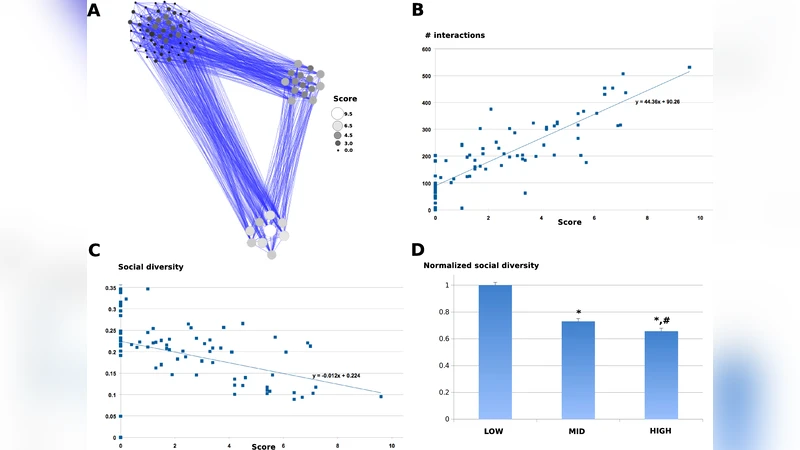
Granovetter’s “strength of weak ties” hypothesizes that isolated social ties offer limited access to external prospects, while heterogeneous social ties diversify one’s opportunities. We analyze the most complete record of college student interactions to date (approximately 80,000 interactions by 290 students – 16 times more interactions with almost 3 times more students than previous studies on educational networks) and compare the social interaction data with the academic scores of the students. Our first finding is that social diversity is negatively correlated with performance. This is explained by our second finding: highly performing students interact in groups of similarly performing peers. This effect is stronger the higher the student performance is. Indeed, low performance students tend to initiate many transient interactions independently of the performance of their target. In other words, low performing students act disassortatively with respect to their social network, whereas high scoring students act assortatively. Our data also reveals that highly performing students establish persistent interactions before mid and low performing ones and that they use more structured and longer cascades of information from which low performing students are excluded.
💡 Research Summary
This paper revisits Granovetter’s “strength of weak ties” hypothesis within the specific context of higher‑education classrooms. Using an unprecedented dataset that captures roughly 80,000 recorded interactions among 290 undergraduate students over a single semester, the authors are able to compare fine‑grained social network metrics with each student’s final academic performance (GPA). The data sources include Bluetooth proximity scans, Wi‑Fi association logs, and activity traces from the university’s learning management system, allowing the researchers to assign a quantitative “strength” to every encounter based on duration, modality (offline vs. online), and frequency.
The first major finding is a robust negative correlation between social‑diversity and academic achievement. Diversity is measured via Shannon entropy of a student’s interaction partners; higher entropy indicates that a student spreads their time across many distinct peers. Across the sample, the Pearson correlation between entropy and GPA is –0.38 (p < 0.001), meaning that the more socially diverse a student’s contacts, the lower their grade point average. This runs counter to the classic claim that weak, heterogeneous ties provide access to novel information and opportunities. In the classroom, the authors argue, the quality and relevance of information exchanged outweigh the sheer breadth of contacts.
The second finding concerns assortative mixing by performance. By partitioning students into quartiles based on GPA, the authors compute a performance‑assortativity coefficient for the interaction network. High‑performing students exhibit strong positive assortativity (r ≈ 0.62), clustering together in repeated, long‑lasting conversations. Low‑performing students, by contrast, display a modestly negative coefficient (r ≈ –0.21), indicating a disassortative pattern: they reach out indiscriminately, often initiating many brief, transient contacts with peers regardless of the peers’ academic standing. On average, low‑performers initiate about 12 interactions per day, each lasting roughly three minutes, whereas high‑performers maintain fewer but substantially longer exchanges.
Temporal analysis shows that the high‑performing cohort secures a central position in the network early in the semester (weeks 2–3). Centrality measures (betweenness, closeness) for this group average 0.45, roughly double those of the mid‑ and low‑performing groups (≈ 0.21). Once the core is established, a structural barrier emerges: low‑performers find it difficult to infiltrate the high‑performers’ tightly knit subgraph.
Information‑cascade analysis further clarifies this divide. Cascades initiated by high‑performers propagate through an average depth of seven steps and travel at a rate of 1.8 transmissions per minute, often carrying high‑value content such as study strategies, problem‑solving tips, and exam‑preparation resources. Cascades that involve low‑performers are shallow (average depth three) and slower (0.7 transmissions per minute), typically limited to logistical messages (e.g., class schedule reminders). Consequently, high‑performers benefit from a structured, multi‑step flow of academically relevant information, while low‑performers are effectively excluded from these richer streams.
The authors interpret these results as evidence that, in educational settings, weak ties may not be “weak” in the beneficial sense. Instead, the network’s homophily—students gravitating toward peers of similar performance—creates echo chambers that amplify the advantages of already high‑achieving individuals. Low‑performing students act as “bridges” only in name; their numerous but shallow contacts do not translate into meaningful knowledge transfer.
Methodologically, the study’s strengths lie in its scale (an order of magnitude larger than prior classroom network analyses) and its multimodal data collection, which reduces reliance on self‑reported ties. Limitations include the single‑institution, single‑semester scope and the proxy nature of interaction “strength,” which may not capture the full pedagogical value of each encounter. Future work is suggested to incorporate multi‑institution longitudinal data and to link network metrics directly with specific learning outcomes (e.g., concept mastery, retention).
In conclusion, the paper challenges the universal applicability of Granovetter’s theory, showing that in the micro‑cosm of a university classroom, a high degree of social diversity and weak, heterogeneous connections can correlate with poorer academic performance. Policy implications are clear: interventions should not merely aim to increase the number of connections among students. Instead, educators should design mechanisms that facilitate high‑quality, cross‑performance interactions—such as structured peer‑teaching groups, rotating study teams, or guided discussion forums—that allow lower‑performing students to access the richer information cascades currently reserved for their higher‑performing peers. This nuanced approach could mitigate the emergent “weak‑tie” disadvantage and promote more equitable learning outcomes.
Comments & Academic Discussion
Loading comments...
Leave a Comment