How people interact in evolving online affiliation networks
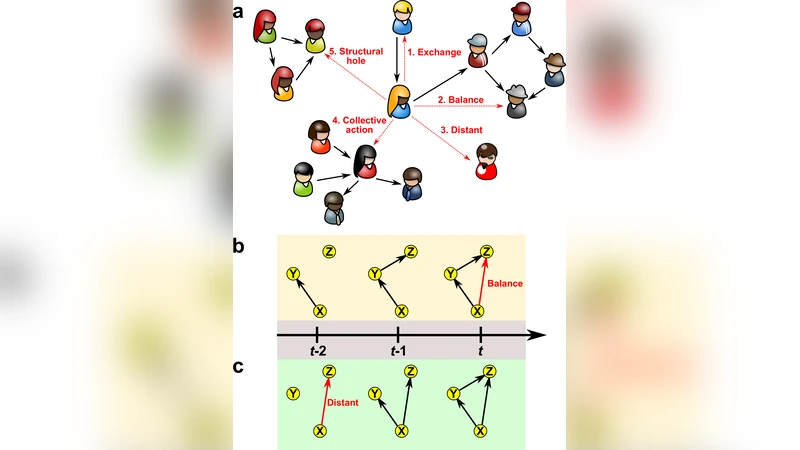
The study of human interactions is of central importance for understanding the behavior of individuals, groups and societies. Here, we observe the formation and evolution of networks by monitoring the addition of all new links and we analyze quantitatively the tendencies used to create ties in these evolving online affiliation networks. We first show that an accurate estimation of these probabilistic tendencies can only be achieved by following the time evolution of the network. For example, actions that are attributed to the usual friend of a friend mechanism through a static snapshot of the network are overestimated by a factor of two. A detailed analysis of the dynamic network evolution shows that half of those triangles were generated through other mechanisms, in spite of the characteristic static pattern. We start by characterizing every single link when the tie was established in the network. This allows us to describe the probabilistic tendencies of tie formation and extract sociological conclusions as follows. The tendencies to add new links differ significantly from what we would expect if they were not affected by the individuals’ structural position in the network, i.e., from random link formation. We also find significant differences in behavioral traits among individuals according to their degree of activity, gender, age, popularity and other attributes. For instance, in the particular datasets analyzed here, we find that women reciprocate connections three times as much as men and this difference increases with age. Men tend to connect with the most popular people more often than women across all ages. On the other hand, triangular ties tendencies are similar and independent of gender. Our findings can be useful to build models of realistic social network structures and discover the underlying laws that govern establishment of ties in evolving social networks.
💡 Research Summary
The paper investigates how human interactions shape the formation and evolution of online affiliation networks by tracking every new link as it appears in two Swedish communities: POK (a youth‑oriented friendship and dating site) and QX (a large LGBTQ+ platform). The authors define five probabilistic mechanisms that may drive link creation: (1) Social exchange (reciprocity), where a new directed link points back to an existing link; (2) Balance (friend‑of‑a‑friend), where the new link connects to a node at directed distance ℓ = 2; (3) Distant, where the target is at ℓ ≥ 3, i.e., no close common neighbors; (4) Collective action, where the target is a “hub” whose total degree lies in the top 5 % of the degree distribution at that moment; and (5) Structural hole, where the link bridges two clusters of at least three members each that would otherwise remain disconnected.
Using timestamped data, each newly formed link is classified according to these mechanisms based on the network state at the moment of creation. The probabilities P_exc, P_bal, P_dis, P_ca, and P_sh are then computed as the fraction of all links formed up to a given time that belong to each mechanism. This dynamic, link‑by‑link approach allows the authors to reconstruct the entire history of the directed interaction network for both sites.
Key findings are:
-
Dynamic analysis is essential. When only a static snapshot is examined, the balance (friend‑of‑a‑friend) mechanism appears to account for roughly twice as many links as it truly does. The authors show that many links initially created via the distant mechanism later become part of a triangle, leading static analyses to mislabel them as balance.
-
Dominance of the distant mechanism. Approximately 80 % of all newly created links are classified as distant, indicating that users most often connect to people with whom they have no immediate common contacts. Social exchange, balance, and collective action each account for roughly 15–30 % of links, while structural holes are rare.
-
Demographic differences. Women perform reciprocal exchanges about three times more often than men, and this gender gap widens with age. Men, on the other hand, are consistently more likely to link to popular hubs regardless of age. The propensity to close triangles (balance) shows little gender difference but increases with age for both sexes. Users with higher activity levels tend to favor balance and collective‑action links over distant ones, suggesting that activity modulates strategic link choice.
-
Implications for network modeling. Traditional static models or simple random‑graph approaches cannot capture the observed mixture of mechanisms. Realistic generative models should incorporate a dominant distant attachment rule, a moderate probability of reciprocity and balance, a gender‑ and age‑dependent bias toward hub attachment, and a low but non‑zero chance of creating structural holes.
Overall, the study demonstrates that the evolution of online affiliation networks is governed by a complex interplay of five identifiable mechanisms, each modulated by individual attributes such as gender, age, and activity. By emphasizing the necessity of temporal data, the authors provide a methodological blueprint for future research aiming to uncover the underlying “laws” of social tie formation and to build more accurate, behavior‑driven network models.
Comments & Academic Discussion
Loading comments...
Leave a Comment