Using nonequilibrium fluctuation theorems to understand and correct errors in equilibrium and nonequilibrium discrete Langevin dynamics simulations
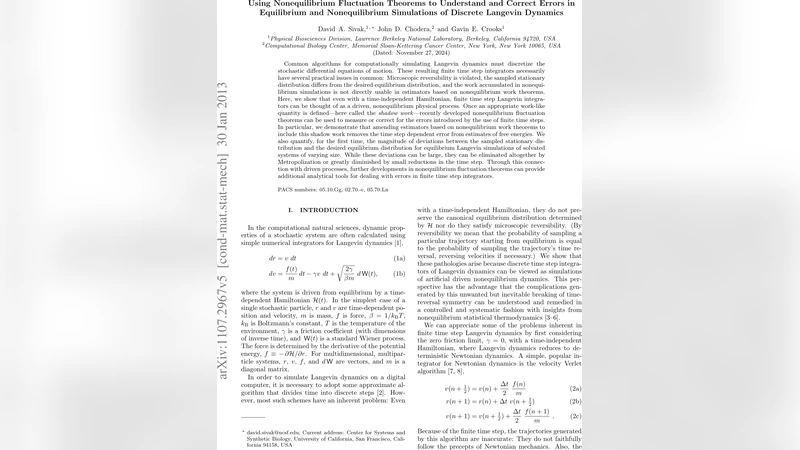
Common algorithms for computationally simulating Langevin dynamics must discretize the stochastic differential equations of motion. These resulting finite time step integrators necessarily have several practical issues in common: Microscopic reversibility is violated, the sampled stationary distribution differs from the desired equilibrium distribution, and the work accumulated in nonequilibrium simulations is not directly usable in estimators based on nonequilibrium work theorems. Here, we show that even with a time-independent Hamiltonian, finite time step Langevin integrators can be thought of as a driven, nonequilibrium physical process. Once an appropriate work-like quantity is defined – here called the shadow work – recently developed nonequilibrium fluctuation theorems can be used to measure or correct for the errors introduced by the use of finite time steps. In particular, we demonstrate that amending estimators based on nonequilibrium work theorems to include this shadow work removes the time step dependent error from estimates of free energies. We also quantify, for the first time, the magnitude of deviations between the sampled stationary distribution and the desired equilibrium distribution for equilibrium Langevin simulations of solvated systems of varying size. While these deviations can be large, they can be eliminated altogether by Metropolization or greatly diminished by small reductions in the time step. Through this connection with driven processes, further developments in nonequilibrium fluctuation theorems can provide additional analytical tools for dealing with errors in finite time step integrators.
💡 Research Summary
**
The paper addresses a fundamental problem in molecular dynamics: the discretization of Langevin dynamics inevitably introduces three intertwined errors—violation of microscopic reversibility, deviation of the sampled stationary distribution from the true canonical ensemble, and the inability to use accumulated work directly in nonequilibrium work theorems. The authors propose a unifying perspective that treats any finite‑time‑step Langevin integrator as a driven nonequilibrium process. Central to this view is the introduction of a “shadow work” term, which quantifies the energy exchange that occurs when the system’s Hamiltonian is temporarily replaced by a shadow Hamiltonian during each deterministic substep of the integrator.
Using the symmetric Bussi‑Parrinello integrator as a concrete example, they decompose each full time step into seven substeps: two stochastic velocity‑randomization steps (which satisfy detailed balance and exchange heat with the thermostat), a deterministic velocity‑Verlet sequence that is symplectic, and an explicit Hamiltonian update that represents the physical protocol work. By labeling the energy changes in each substep as heat (Q), protocol work (Wₚᵣₒₜ), and shadow work (Wₛₕₐ𝑑), they obtain a clean additive decomposition of the total work W = Σ(Wₚᵣₒₜ + Wₛₕₐ𝑑).
Because each substep is Markovian and either detailed‑balanced (stochastic) or symplectic (deterministic), the entire trajectory obeys Crooks’ fluctuation theorem and the Jarzynski equality when the total work—including shadow work—is used: ⟨e^{-β(Wₚᵣₒₜ+Wₛₕₐ𝑑)}⟩ = e^{-βΔF}. In contrast, using only the protocol work leads to systematic, time‑step‑dependent bias in free‑energy estimates. The authors demonstrate numerically that correcting estimators by adding measured shadow work completely eliminates this bias, even for relatively large time steps.
The paper also investigates equilibrium simulations where the Hamiltonian is time‑independent, so only shadow work is present. In this case the integrator drives the system into a nonequilibrium steady state. The authors quantify the distance from equilibrium by the nonequilibrium free‑energy excess ΔFₙₑ𝑞, which, near equilibrium, can be approximated as ΔFₙₑ𝑞 ≈ (1/2)⟨Wₛₕₐ𝑑⟩·Pₛₛ·(t_f−t_i)^{-1}, where Pₛₛ is the steady‑state power of shadow work. They validate this framework on TIP3P water boxes of various sizes, with and without bond constraints, using a GHMC‑generated equilibrium start and then propagating with the Langevin integrator at a collision rate of 9 ps⁻¹. Results show that (i) decreasing the time step below ~1 fs or (ii) applying Metropolization (e.g., GHMC) drives ΔFₙₑ𝑞 to zero, restoring the true canonical distribution; (iii) the magnitude of shadow work scales with system size, but the per‑degree‑of‑freedom deviation remains roughly constant, indicating a local rather than global error source.
The significance of the work lies in converting a purely numerical artifact (finite‑time‑step error) into a thermodynamic quantity (shadow work) that can be measured and corrected using established nonequilibrium statistical‑mechanics tools. This bridges the gap between algorithmic development for molecular dynamics and the rapidly expanding field of fluctuation theorems, providing a systematic, theoretically grounded method for error quantification and mitigation. Future directions suggested include extending the analysis to more complex biomolecular assemblies, non‑isothermal or non‑isobaric ensembles, and adaptive time‑step schemes guided by real‑time shadow‑work monitoring, potentially combined with machine‑learning strategies. In summary, the authors deliver a compelling framework that not only explains why conventional Langevin integrators deviate from ideal behavior but also offers a practical, fluctuation‑theorem‑based remedy that can be incorporated into existing simulation workflows.
Comments & Academic Discussion
Loading comments...
Leave a Comment