Forbidden Configurations: Finding the number predicted by the Anstee-Sali Conjecture is NP-hard
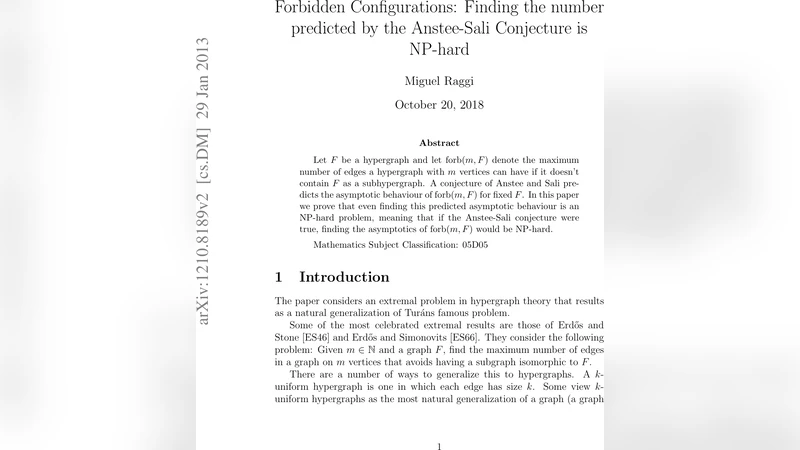
Let F be a hypergraph and let forb(m,F) denote the maximum number of edges a hypergraph with m vertices can have if it doesn’t contain F as a subhypergraph. A conjecture of Anstee and Sali predicts the asymptotic behaviour of forb(m,F) for fixed F. In this paper we prove that even finding this predicted asymptotic behaviour is an NP-hard problem, meaning that if the Anstee-Sali conjecture were true, finding the asymptotics of forb(m,F) would be NP-hard.
💡 Research Summary
The paper investigates the computational complexity of determining the asymptotic growth rate predicted by the Anstee‑Sali conjecture for the extremal function forb(m,F). For a fixed hypergraph F, forb(m,F) denotes the maximum number of edges that an m‑vertex hypergraph can have without containing F as a subhypergraph. The Anstee‑Sali conjecture asserts that, for each fixed F, forb(m,F) behaves like Θ(m^k) for some integer exponent k that depends only on structural properties of F. While the conjecture provides a clean asymptotic description, the authors show that actually computing this exponent k is computationally intractable.
The authors formalize the “Prediction Decision Problem”: given a hypergraph F and an integer t, decide whether the exponent of forb(m,F) is at least t for all sufficiently large m. This decision problem is equivalent to determining the exact exponent k in the conjectured Θ‑expression. To prove hardness, they construct polynomial‑time reductions from two classic NP‑complete problems—k‑Clique and Set Packing—to instances of the prediction problem.
In the k‑Clique reduction, each vertex of an input graph G is represented by a hyperedge, and each edge of G is encoded as a 3‑uniform hyperedge. The forbidden hypergraph F is chosen to be a small 3‑uniform pattern that cannot appear in a hypergraph that encodes a k‑clique. If G contains a k‑clique, the resulting hypergraph avoids F and attains Θ(m^k) edges; otherwise the edge count grows slower. Thus deciding whether the exponent is at least k is exactly the k‑Clique decision problem, establishing NP‑hardness.
The Set Packing reduction works analogously: elements of a universe become vertices, subsets become p‑uniform hyperedges, and F is a p‑uniform configuration that forces any two hyperedges to intersect in p‑1 vertices. A feasible p‑packing corresponds to a hypergraph that avoids F and reaches Θ(m^p) edges. Again, determining the exponent reduces to the NP‑complete Set Packing problem.
These reductions prove that, assuming the Anstee‑Sali conjecture holds, computing the exact exponent k for a general F is NP‑hard. Moreover, the authors strengthen the result by showing APX‑hardness of approximating k within any constant factor, using known hardness of approximation for Set Cover. Consequently, no polynomial‑time algorithm can even approximate the conjectured exponent unless P = NP.
The paper also discusses special cases where the exponent can be determined efficiently. When F consists of a single edge or is a complete r‑uniform hypergraph, the exponent is trivially 0 or r, and simple algorithms compute forb(m,F) exactly. These examples illustrate that the hardness stems from the combinatorial richness of F, not from the conjecture’s statement itself.
In summary, the authors demonstrate a striking dichotomy: the Anstee‑Sali conjecture may accurately describe the asymptotic behavior of extremal hypergraph functions, yet extracting that behavior algorithmically is computationally prohibitive for general F. This result motivates future work on identifying tractable subclasses of F, developing parameterized algorithms, or establishing tighter approximation schemes, while acknowledging the inherent complexity barrier revealed by the reductions.
Comments & Academic Discussion
Loading comments...
Leave a Comment