On Complexity of Flooding Games on Graphs with Interval Representations
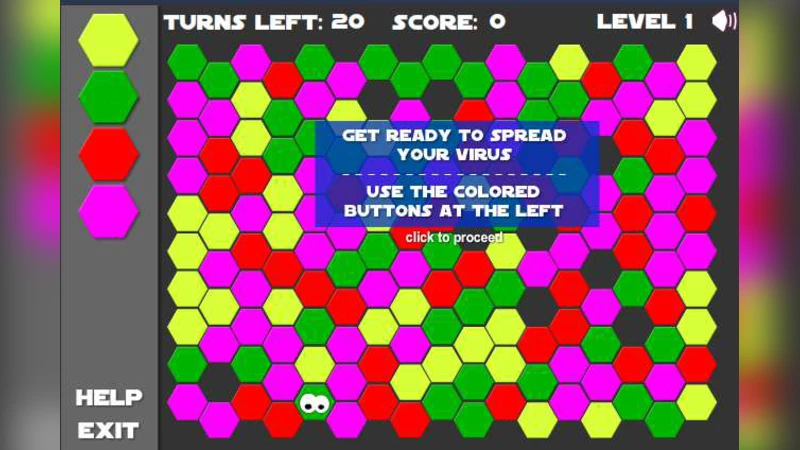
The flooding games, which are called Flood-It, Mad Virus, or HoneyBee, are a kind of coloring games and they have been becoming popular online. In these games, each player colors one specified cell in his/her turn, and all connected neighbor cells of the same color are also colored by the color. This flooding or coloring spreads on the same color cells. It is natural to consider these new coloring games on more general boards, or general graphs. Recently, computational complexities of the variants of the flooding games on several graph classes have been studied. In this paper, we investigate the flooding games on some graph classes characterized by interval representations. Our results state that the number of colors is a key parameter to determine the computational complexity of the flooding games. When the number of colors is a fixed constant, these games can be solved in polynomial time on an interval graph. On the other hand, if the number of colors is not bounded, the flooding game is NP-complete on a proper interval graph. We also state similar results for split graphs.
💡 Research Summary
The paper investigates the computational complexity of flooding games—commonly known as Flood‑It, Mad Virus, or HoneyBee—when the underlying board is modeled by graphs that admit interval representations. In a flooding game each move consists of selecting a vertex and a colour; the chosen colour is then propagated to the entire monochromatic connected component containing that vertex. The objective is to make the whole graph monochromatic using as few moves as possible.
The authors focus on two structural graph families: (i) interval graphs, where each vertex corresponds to a real‑interval and edges exist exactly when the intervals intersect, and (ii) split graphs, which can be partitioned into a clique and an independent set. Within interval graphs they also consider the more restricted class of proper (or unit) interval graphs, where all intervals have the same length. The central parameter studied is the number of colours k.
Fixed‑k (k is a constant).
For interval graphs the paper presents a polynomial‑time algorithm when k is bounded by a constant. The algorithm first orders the intervals by their left endpoints, which yields a linear “interval order”. A dynamic programming (DP) table is defined over states (i, S) where i denotes the i‑th interval in this order and S⊆{1,…,k} records the set of colours already used in the part of the graph processed so far. Transition rules consider either (a) flooding the i‑th interval with a colour c∈{1,…,k}, thereby merging it with any adjacent component already coloured c, or (b) skipping the interval. Each transition can be evaluated in O(k) time, leading to an overall running time O(n·k·2^k) and space O(n·2^k). Since k is constant, this is polynomial in the size of the input. The authors argue that the same DP framework extends to any graph class that preserves the interval order (e.g., certain chordal graphs), highlighting that the linear structure of interval graphs is the key to tractability when the colour palette is limited.
Unbounded‑k (k is part of the input).
When the number of colours is not bounded, the problem becomes computationally intractable even on very restricted graph classes. The authors prove NP‑completeness for proper (unit) interval graphs by a reduction from 3‑SAT. Each Boolean variable is represented by a pair of unit intervals corresponding to the true and false assignments; each clause is represented by a clause‑interval that overlaps precisely those variable intervals that satisfy the clause. Choosing a colour for a variable‑interval corresponds to fixing a truth assignment, and the requirement that the whole graph be flooded with a single colour forces every clause‑interval to be “covered” by at least one true literal. Hence a monochromatic flooding sequence exists if and only if the original formula is satisfiable.
A similar reduction shows NP‑completeness on split graphs. The clique part of the split graph acts as a “control hub” where colour choices are made, while the independent set encodes constraints that mimic a colour‑assignment problem known to be NP‑hard. By carefully designing adjacency between the two parts, the authors ensure that any successful flooding sequence corresponds to a feasible assignment in the underlying combinatorial problem.
These hardness results demonstrate that the difficulty of flooding games is not merely a function of graph density or tree‑width; rather, the unbounded colour palette alone suffices to make the problem NP‑hard on graph classes that are otherwise algorithmically easy for many problems.
Parameterized and Approximation Perspectives.
The paper notes that the DP algorithm for interval graphs places the problem in the class FPT (fixed‑parameter tractable) when parameterised by k, because the exponential factor depends only on k. Conversely, the NP‑completeness proofs for proper interval and split graphs imply that the problem is W
Comments & Academic Discussion
Loading comments...
Leave a Comment