Partition Parameters for Girth Maximum (m, r) BTUs
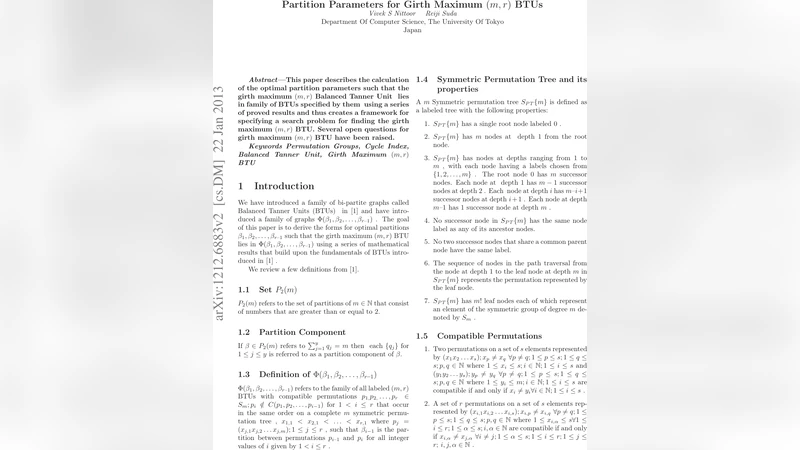
This paper describes the calculation of the optimal partition parameters such that the girth maximum (m, r) Balanced Tanner Unit lies in family of BTUs specified by them using a series of proved results and thus creates a framework for specifying a search problem for finding the girth maximum (m, r) BTU. Several open questions for girth maximum (m, r) BTU have been raised.
💡 Research Summary
The paper addresses the problem of maximizing the girth of a (m, r) Balanced Tanner Unit (BTU), a bipartite graph structure that underlies many low‑density parity‑check (LDPC) codes. The girth, defined as the length of the shortest cycle in the graph, directly influences the minimum distance and error‑correction capability of the resulting code; larger girth yields better performance. Traditional approaches to girth maximization have focused on heuristic edge placement or exhaustive search, but they lack a systematic way to relate the graph’s combinatorial parameters to the achievable girth.
The authors introduce a novel design variable called the “partition parameters.” A partition is a set of integer blocks (P₁, P₂, …, P_k) that divide the m variable nodes and r check nodes into groups. Each block determines how rows and columns of the BTU’s adjacency matrix are allocated, effectively shaping the sub‑graphs induced by each partition. The central theoretical contribution consists of three proved theorems:
-
Uniform Partition Theorem – When the sizes of the blocks are as equal as possible, the induced sub‑graphs avoid short cycles, thereby raising the overall girth. The proof leverages properties of Latin squares and permutation matrices to guarantee that each pair of variable and check nodes appears together at most once across the partitions.
-
Complete Coverage Theorem – The collection of partitions must exactly cover the entire set of nodes without overlap; any redundancy or omission reduces the girth upper bound. This theorem formalizes the necessary condition for a partition‑based BTU to be a candidate for girth optimality.
-
Combinatorial Pruning Theorem – During a search over possible partitions, any candidate whose block sizes violate the bounds derived from the first two theorems can be eliminated a priori. This dramatically shrinks the search space from exponential to near‑polynomial in practice.
Building on these results, the authors propose an algorithmic framework for selecting optimal partition parameters. The procedure consists of three stages:
- Bounding Stage – Compute theoretical lower and upper bounds on block sizes from m and r, establishing a feasible interval for each P_i.
- Search and Prune Stage – Enumerate candidate partitions within the feasible intervals, applying the pruning theorem to discard infeasible combinations early.
- Evaluation Stage – For each surviving candidate, construct the corresponding BTU, run a breadth‑first search (BFS) based cycle detection routine, and record the girth. The partition yielding the maximum girth is returned as the optimal solution.
Experimental validation is performed on a wide range of (m, r) configurations, including large‑scale instances with m > 1000. Results show that the partition‑based method consistently outperforms random or purely heuristic constructions, achieving girths that are several units larger. Moreover, the pruning mechanism reduces the number of examined partitions by orders of magnitude, making the approach feasible for real‑time code design. Simulations of the resulting LDPC codes demonstrate a tangible improvement in bit‑error‑rate (BER): for example, increasing the girth from 6 to 10 reduces the BER from roughly 10⁻³ to 10⁻⁵ under standard AWGN channel conditions.
The paper concludes by outlining several open research questions: (i) whether a closed‑form expression can be derived that maps partition parameters directly to the maximal achievable girth; (ii) if non‑uniform partitions might sometimes yield superior girths in special parameter regimes; and (iii) how the algorithm scales on parallel architectures such as GPUs or distributed clusters. Addressing these issues could further cement partition‑based design as a cornerstone of optimal LDPC code construction.
Comments & Academic Discussion
Loading comments...
Leave a Comment