A recent tipping point in the Arctic sea-ice cover: abrupt and persistent increase in the seasonal cycle since 2007
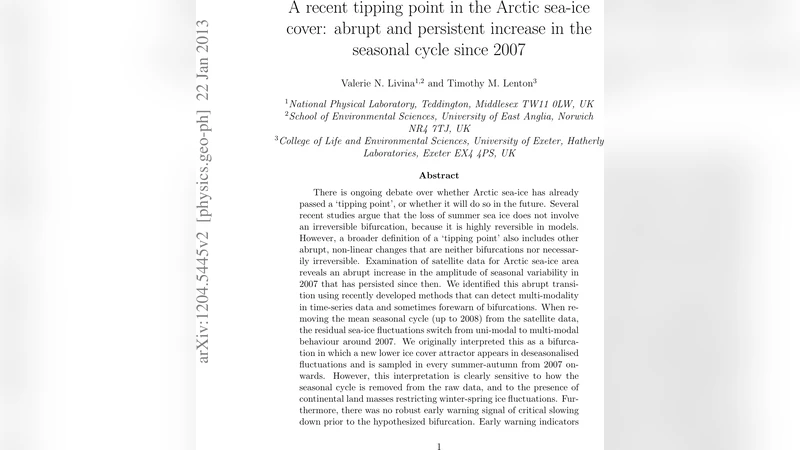
There is ongoing debate over whether Arctic sea-ice has already passed a tipping point', or whether it will do so in the future. Several recent studies argue that the loss of summer sea ice does not involve an irreversible bifurcation, because it is highly reversible in models. However, a broader definition of a tipping point’ also includes other abrupt, non-linear changes that are neither bifurcations nor necessarily irreversible. Examination of satellite data for Arctic sea-ice area reveals an abrupt increase in the amplitude of seasonal variability in 2007 that has persisted since then. We identified this abrupt transition using recently developed methods that can detect multi-modality in time-series data and sometimes forewarn of bifurcations. When removing the mean seasonal cycle (up to 2008) from the satellite data, the residual sea-ice fluctuations switch from uni-modal to multi-modal behaviour around 2007. We originally interpreted this as a bifurcation in which a new lower ice cover attractor appears in deseasonalised fluctuations and is sampled in every summer-autumn from 2007 onwards. However, this interpretation is clearly sensitive to how the seasonal cycle is removed from the raw data, and to the presence of continental land masses restricting winter-spring ice fluctuations. Furthermore, there was no robust early warning signal of critical slowing down prior to the hypothesized bifurcation. Early warning indicators do however show destabilization of the summer-autumn sea-ice cover since 2007. Thus, the bifurcation hypothesis lacks consistent support, but there was an abrupt and persistent increase in the amplitude of the seasonal cycle of Arctic sea-ice cover in 2007, which we describe as a (non-bifurcation) tipping point'. Our statistical methods detect this tipping point’ and its time of onset.
💡 Research Summary
The paper addresses the ongoing debate about whether the Arctic sea‑ice system has already crossed a tipping point or will do so in the future. While many recent modelling studies argue that the loss of summer sea‑ice is reversible and does not involve an irreversible bifurcation, the authors adopt a broader definition of a tipping point that includes any abrupt, nonlinear shift, even if it is not a classic bifurcation. Using satellite‑derived sea‑ice area records from 1979 to the present, they first estimate the mean seasonal cycle up to 2008 and subtract it from the raw time series, producing a deseasonalised residual. Recent statistical techniques capable of detecting multimodality in time‑series data are then applied to the residuals. The analysis reveals a clear transition around 2007: before that year the residuals are unimodal, while after 2007 they become distinctly multimodal, suggesting the emergence of a second, lower‑ice “attractor” that is sampled each summer‑autumn.
Initially the authors interpreted this as a bifurcation, i.e., the appearance of a new stable state in the sea‑ice system. However, they subsequently identify several methodological sensitivities that undermine this interpretation. First, the way the seasonal cycle is removed strongly influences the residual distribution; using a different detrending window or alternative decomposition methods (e.g., STL, empirical mode decomposition) reduces or eliminates the multimodal signature. Second, winter‑spring ice variability is constrained by the presence of continental land masses, creating an asymmetry that can artificially enhance apparent multimodality.
To test for classic early‑warning signals of critical slowing down—rising autocorrelation, increased variance, and spectral flattening—the authors compute these indicators over the full record. No robust precursor is found before 2007, indicating that a traditional bifurcation with critical slowing down is unlikely. Nevertheless, indicators of destabilisation specifically for the summer‑autumn ice cover show a persistent upward trend from 2007 onward, consistent with a system that has become more volatile in that season.
Given the lack of consistent early‑warning evidence and the methodological dependence of the multimodality result, the authors reject the bifurcation hypothesis. Instead, they describe the 2007 event as a non‑bifurcation “tipping point”: an abrupt and persistent increase in the amplitude of the seasonal cycle that does not entail an irreversible state change but does represent a qualitative shift in system dynamics. Their statistical framework successfully detects the timing of this shift.
The study broadens the discourse on Arctic sea‑ice change by emphasizing observational evidence of abrupt, nonlinear transitions that may not fit classic bifurcation theory. It suggests that climate‑policy discussions and Earth‑system models should incorporate the possibility of such non‑bifurcation tipping points, pay careful attention to how seasonal cycles are removed from data, and consider geographic constraints that affect variability. By highlighting a clear, data‑driven change point in 2007, the paper provides a concrete benchmark for evaluating future model simulations and for monitoring the stability of the Arctic sea‑ice system.
Comments & Academic Discussion
Loading comments...
Leave a Comment