Complex Networks from Simple Rewrite Systems
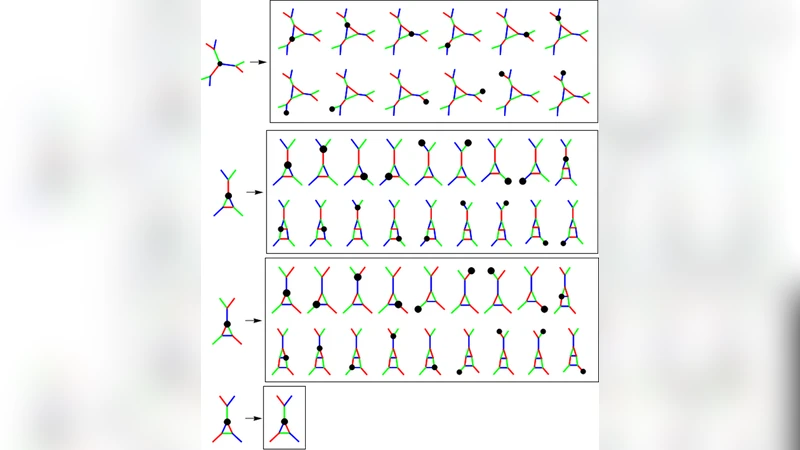
Complex networks are all around us, and they can be generated by simple mechanisms. Understanding what kinds of networks can be produced by following simple rules is therefore of great importance. We investigate this issue by studying the dynamics of extremely simple systems where are writer' moves around a network, and modifies it in a way that depends upon the writer's surroundings. Each vertex in the network has three edges incident upon it, which are colored red, blue and green. This edge coloring is done to provide a way for the writer to orient its movement. We explore the dynamics of a space of 3888 of these colored trinet automata’ systems. We find a large variety of behaviour, ranging from the very simple to the very complex. We also discover simple rules that generate forms which are remarkably similar to a wide range of natural objects. We study our systems using simulations (with appropriate visualization techniques) and analyze selected rules mathematically. We arrive at an empirical classification scheme which reveals a lot about the kinds of dynamics and networks that can be generated by these systems.
💡 Research Summary
The paper introduces a novel class of graph‑generating systems called “colored trinet automata.” Each vertex in the underlying graph is 3‑regular, possessing exactly three incident edges that are permanently colored red, blue, or green. A single mobile agent, termed the “writer,” traverses the graph by following edges whose colors dictate its direction. At each step the writer observes the local color configuration of the vertex it occupies and applies a pre‑specified rewrite rule that may insert new vertices, delete existing edges, recolor edges, or change the writer’s heading.
The authors enumerate all possible deterministic rule sets under the constraint that the writer can distinguish only the unordered pair of colors present on the two edges incident to its current vertex (there are 12 distinct local color patterns). For each pattern the writer may choose among nine elementary operations (insert, delete, rotate, recolor, etc.). Combining these choices yields a total of 3 888 distinct automata, which the authors refer to as the “space of colored trinet automata.”
To explore the expressive power of this space, the authors implement a high‑performance simulation framework in Python, visualising the evolving graphs in three dimensions and recording standard network metrics (vertex count, average path length, clustering coefficient, degree distribution). Each automaton is run for up to 10 000 discrete steps, starting from a single seed triangle. The resulting behaviours fall naturally into four broad dynamical classes:
-
Static or periodic – roughly 12 % of the rules quickly reach a fixed point or a small limit cycle. No further growth occurs because the rewrite rules either never insert new vertices or immediately delete any that are created.
-
Linear growth – about 35 % of the rules add a constant number of vertices per step (typically one to three). The overall shape remains essentially a long chain; degree distribution stays narrow and average path length grows linearly with time.
-
Branching (super‑linear) growth – 28 % of the rules contain a “branching trigger”: when a particular color pair appears, the writer inserts multiple vertices, causing a rapid increase in the number of branches. The resulting graphs resemble trees with a power‑law tail in the degree distribution.
-
Chaotic/complex – the remaining 25 % exhibit non‑linear, unpredictable expansion. Local rule conflicts propagate, leading to bursts of vertex creation and a rapid rise in informational entropy. The authors quantify this by measuring the Shannon entropy of the color‑pair distribution over time; the derivative (dH/dt) is markedly positive in this regime.
A striking observation is that several simple rules generate structures that are visually reminiscent of natural forms. For example, rule #1742 produces a plant‑like morphology: branches thicken as the writer repeatedly encounters a red‑blue pattern, while a blue‑green pattern adds leaf‑like clusters at the tips. Rule #3021 yields a spiral or shell‑like shape because the writer rotates its heading according to the encountered colors, causing newly inserted vertices to follow a logarithmic‑spiral trajectory. Other rules generate lattice‑like sheets that later develop wave‑like perturbations, evoking crystal growth or fluid surface ripples.
From a theoretical standpoint the authors model the writer’s movement as a Markov chain on the set of color‑pair states. For linear‑growth and periodic rules they prove the existence of a stationary distribution or a finite cycle, respectively. They also represent insertion/deletion operations as modifications of the graph Laplacian, showing that branching rules cause a sudden spectral spread, which corresponds to a rapid increase in graph connectivity. For the chaotic class they compute the time‑dependent entropy of the color‑pair distribution and demonstrate that it grows faster than in the other classes, providing a quantitative signature of complexity.
The work contributes to the broader field of self‑organising systems and algorithmic graph generation by demonstrating that extremely local, color‑guided rewrite rules can give rise to a rich taxonomy of global network topologies, ranging from trivial to highly intricate. The authors suggest several avenues for future research: extending the rule space to more colors or higher‑degree vertices, introducing multiple interacting writers (agents) to study cooperative or competitive dynamics, and performing systematic comparisons with empirical biological or material networks to assess the model’s descriptive power. Overall, the paper offers both a comprehensive empirical survey of a new generative paradigm and a set of analytical tools that can be applied to other discrete dynamical systems.
Comments & Academic Discussion
Loading comments...
Leave a Comment