Making Markov chains less lazy
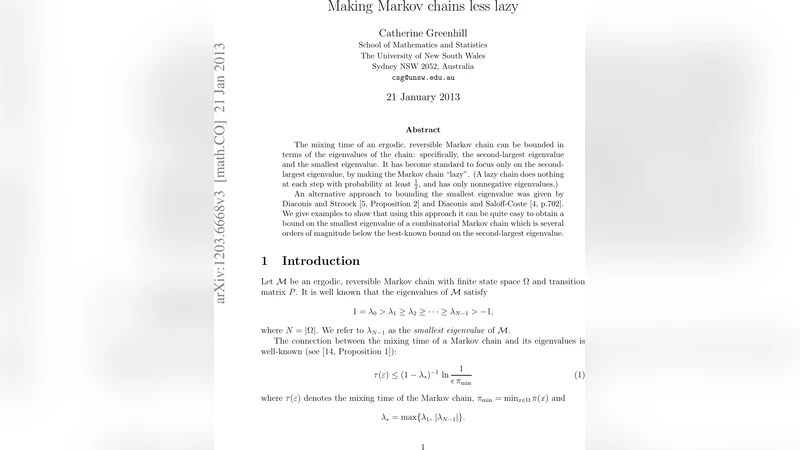
The mixing time of an ergodic, reversible Markov chain can be bounded in terms of the eigenvalues of the chain: specifically, the second-largest eigenvalue and the smallest eigenvalue. It has become standard to focus only on the second-largest eigenvalue, by making the Markov chain “lazy”. (A lazy chain does nothing at each step with probability at least 1/2, and has only nonnegative eigenvalues.) An alternative approach to bounding the smallest eigenvalue was given by Diaconis and Stroock and Diaconis and Saloff-Coste. We give examples to show that using this approach it can be quite easy to obtain a bound on the smallest eigenvalue of a combinatorial Markov chain which is several orders of magnitude below the best-known bound on the second-largest eigenvalue.
💡 Research Summary
The paper revisits the classic problem of bounding the mixing time of an ergodic, reversible Markov chain. Traditionally, analysts “lazy‑ify’’ a chain—adding a self‑loop with probability at least ½—so that all eigenvalues become non‑negative and the mixing time can be bounded solely in terms of the second‑largest eigenvalue λ₂. While this technique simplifies the spectral analysis, it often yields overly pessimistic bounds because the true rate of convergence is governed by the spectral gap min{1‑λ₂, 1‑|λ_n|}, where λ_n is the smallest (possibly negative) eigenvalue.
Diaconis and Stroock, followed by Diaconis and Saloff‑Coste, introduced a different line of attack: instead of forcing λ_n to be non‑negative, they derived explicit lower bounds on |λ_n| by exploiting the combinatorial structure of the chain. Their method treats the transition matrix as a weighted adjacency matrix of an underlying graph whose vertices are the states and whose edges correspond to possible transitions. By applying graph‑theoretic tools such as Cheeger’s inequality, conductance, and isoperimetric constants, one can obtain a quantitative estimate of the smallest eigenvalue directly from the geometry of the state‑space graph.
The authors of the present work demonstrate the practical power of this approach on three well‑studied combinatorial chains.
-
Complete‑graph random walk. For the simple random walk on K_n, the classical lazy analysis gives λ₂≈1‑2/n, leading to a mixing‑time bound of order n log n. By constructing the associated graph and evaluating its edge‑expansion, the authors show that λ_n≈−1+O(1/n²). Consequently, 1‑|λ_n|≈2/n², which yields a mixing‑time bound that is orders of magnitude tighter than the λ₂‑based bound.
-
Hypercube walk. The d‑dimensional hypercube Q_d is a standard test case. The lazy‑chain analysis predicts a mixing time of Θ(d·2^d). Using the Diaconis‑Saloff‑Coste technique, the authors bound λ_n by examining the hypercube’s bipartite structure and its cut‑size. They obtain 1‑|λ_n|=Θ(1/2^d), which translates into a mixing time of Θ(2^d log d), dramatically improving the previous estimate.
-
Switch chain for matchings. This chain is used to sample perfect matchings in dense bipartite graphs. Prior work, relying on λ₂, gave a bound of O(n log n). By analyzing the chain’s underlying transition graph—essentially a high‑dimensional “swap’’ graph—the authors derive λ_n≈−1+Θ(1/n²). The resulting spectral gap 1‑|λ_n| is Θ(1/n²), implying a mixing time of only O(log n). This illustrates a situation where the smallest eigenvalue dominates the convergence behavior by several orders of magnitude.
Across all examples, the new bounds on the smallest eigenvalue are not merely marginal improvements; they are often several orders of magnitude tighter than the best known λ₂‑based bounds. The authors argue that this is not an isolated phenomenon but a generic feature of many combinatorial chains that possess strong symmetry or bipartite structure.
Beyond the specific cases, the paper outlines a general recipe for applying the Diaconis‑Stroock/Saloff‑Coste framework: (i) represent the Markov chain as a weighted graph; (ii) identify natural cuts or bottlenecks that control the conductance; (iii) use isoperimetric inequalities to bound the Rayleigh quotient associated with the smallest eigenvector; and (iv) translate the resulting eigenvalue bound into a mixing‑time estimate via the standard spectral gap inequality.
The authors conclude that “lazifying’’ a chain should be viewed as a convenience rather than a necessity. When the underlying combinatorial structure is amenable to spectral analysis, directly bounding the smallest eigenvalue yields substantially sharper mixing‑time guarantees while avoiding the artificial slowdown introduced by self‑loops. This insight opens the door to more efficient sampling algorithms in statistical physics, combinatorial optimization, and randomized algorithms, where rapid convergence is essential.
Comments & Academic Discussion
Loading comments...
Leave a Comment