The bottleneck 2-connected $k$-Steiner network problem for $kleq 2$
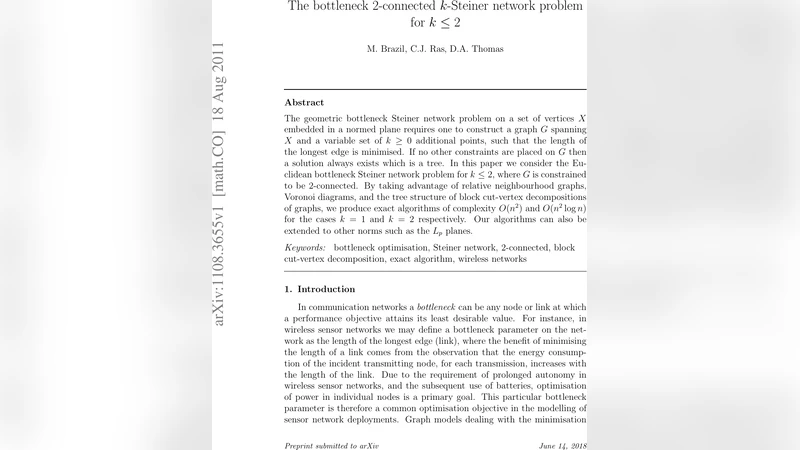
The geometric bottleneck Steiner network problem on a set of vertices $X$ embedded in a normed plane requires one to construct a graph $G$ spanning $X$ and a variable set of $k\geq 0$ additional points, such that the length of the longest edge is minimised. If no other constraints are placed on $G$ then a solution always exists which is a tree. In this paper we consider the Euclidean bottleneck Steiner network problem for $k\leq 2$, where $G$ is constrained to be 2-connected. By taking advantage of relative neighbourhood graphs, Voronoi diagrams, and the tree structure of block cut-vertex decompositions of graphs, we produce exact algorithms of complexity $O(n^2)$ and $O(n^2\log n)$ for the cases $k=1$ and $k=2$ respectively. Our algorithms can also be extended to other norms such as the $L_p$ planes.
💡 Research Summary
The paper tackles a geometric network design problem that extends the classic bottleneck Steiner tree to the setting where the resulting network must be 2‑connected and may contain up to two Steiner points (k ≤ 2). Formally, given a set X of n points in the Euclidean plane, the goal is to construct a 2‑connected graph N_k spanning X together with a set S_k of k additional points such that the length of the longest edge ℓ_max(N_k) is minimized. This problem is denoted (2,k)‑MBSN (minimum bottleneck 2‑connected k‑Steiner network).
The authors first review relevant graph‑theoretic concepts: block‑cut vertex decomposition (BCF), critical edges, and the 2‑relative neighbourhood graph (2‑RNG). The 2‑RNG contains an edge uv iff the lune defined by the two circles of radius |uv| centred at u and v contains fewer than two other points of X. Crucially, the 2‑RNG is always 2‑connected, has only O(n) edges, and can be built in O(n²) time. Moreover, any optimal (2,0)‑MBSN is a subgraph of the 2‑RNG, providing a natural search space for the constrained problem.
A key structural insight is that in any 2‑connected network that includes Steiner points, each leaf block of the block‑cut decomposition must be incident to at least one Steiner‑edge (Lemma 5). Consequently, the placement of Steiner points can be modeled as a coloured‑point covering problem: each leaf block defines a colour class, and a Steiner point must lie in a region that “covers’’ at least one point of each colour. The minimal covering region is a smallest colour‑spanning disk (SCSD), which can be computed in O(n log n) time when the number of colours is constant.
The algorithm proceeds in two alternating phases. Phase 1 reduces vertex degrees to at most five. If a vertex v has degree ≥ 6, the algorithm selects two neighbours x₁, x₂ that form the smallest angle at v, replaces edge vx₁ by edge x₁x₂, and discards vx₁. Lemma 6 guarantees that this operation preserves 2‑connectivity and never increases ℓ_max because |x₁x₂| < |vx₁|. Repeating this operation eliminates all vertices of degree six except the highly symmetric “regular 6‑star’’ configuration, which can also be broken without creating a new regular 6‑star.
Phase 2 eliminates edges that are not present in the 2‑RNG. For each such edge, the algorithm constructs a short replacement path that uses Steiner points placed at the centres of appropriate SCSDs. When k = 1, there is a single colour class, and the optimal Steiner point is simply the centre of the smallest disk covering all leaf blocks; this can be found in O(n log n). When k = 2, the algorithm enumerates O(n) possible assignments of leaf blocks to the two Steiner points, computes two SCSDs (one per colour set) and selects the assignment that yields the smallest maximal edge length. Because each SCSD computation is O(n log n) and there are O(n) assignments, the total time for this phase is O(n² log n).
The two phases are applied alternately until no further degree reductions or edge replacements are possible. At termination the graph satisfies both structural properties: every vertex has degree ≤ 5 and every edge belongs to the 2‑RNG. By construction it is 2‑connected, spans X, contains exactly k Steiner points, and its longest edge is minimal among all feasible networks. The resulting time complexities are O(n²) for k = 1 and O(n² log n) for k = 2.
The paper also notes that the same methodology extends to other L_p norms, because the definitions of the 2‑RNG, lune, and SCSD adapt straightforwardly to any convex normed plane. Thus the contribution is a pair of exact, polynomial‑time algorithms for a previously unaddressed variant of the bottleneck Steiner problem, with clear relevance to wireless sensor network deployment, VLSI routing, and any application where both low longest‑link length and fault‑tolerant (2‑connected) topology are required.
Comments & Academic Discussion
Loading comments...
Leave a Comment